Loading...
Done

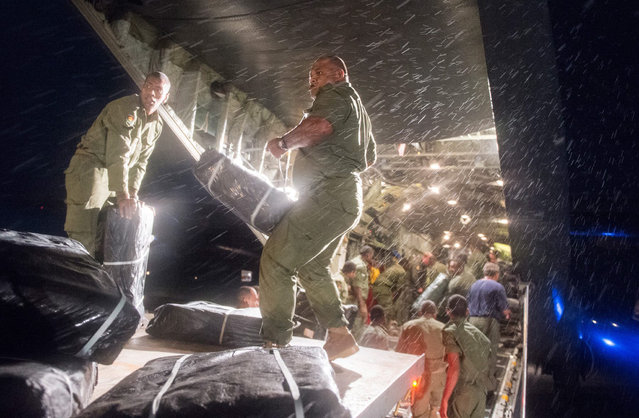
A handout image provided by the New Zealand Defence Force shows aid supplies being unloaded by Fijian soldiers from an Royal New Zealand Airforce C-130 Hercules plane in Suva, Fiji, 23 February 2016. Tool kits, generators, ration packs, water containers and chainsaws make up part of the New Zealand relief following Tropical Cyclone Winston. The death toll from the cyclone that hit Fiji over the weekend climbed to 29, local media reported ON 23 February. (Photo by Sam Shepherd/EPA/NZ Defence Force)

A handout image provided by the New Zealand Defence Force shows aid supplies being unloaded by Fijian soldiers from an Royal New Zealand Airforce C-130 Hercules plane in Suva, Fiji, 23 February 2016. Tool kits, generators, ration packs, water containers and chainsaws make up part of the New Zealand relief following Tropical Cyclone Winston. The death toll from the cyclone that hit Fiji over the weekend climbed to 29, local media reported ON 23 February. Cyclone Winston, the most powerful storm in Fiji's history, battered the country's main island of Viti Levu and other smaller surrounding islands on Saturday, the Fiji Broadcasting Corporation reported. (Photo by Sam Shepherd/EPA/NZ Defence Force)
Details
24 Feb 2016 12:56:00
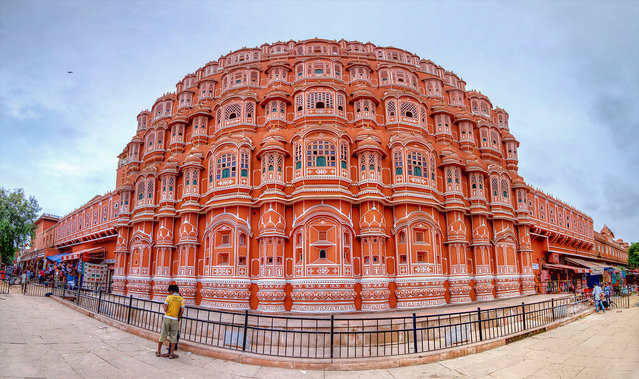
Hawa Mahal India

Hawa Mahal, which translates as the Palace of Winds, was built in 1799 by Maharaja Sawai Pratap Singh. The design of the palace was created by Shreyansh Jain to resemble the crown of Krishna. The design of this unique five-story building is akin to a honeycomb. The main purpose of this building was to allow royal ladies to watch the street below while remaining unseen, since during those times they had a strict code of dressing, which meant covering their faces. The palace was designed to produce the Venturi effect, which created natural air conditioning and kept the interior relatively cool during hot summers.
Details
22 Nov 2014 13:22:00
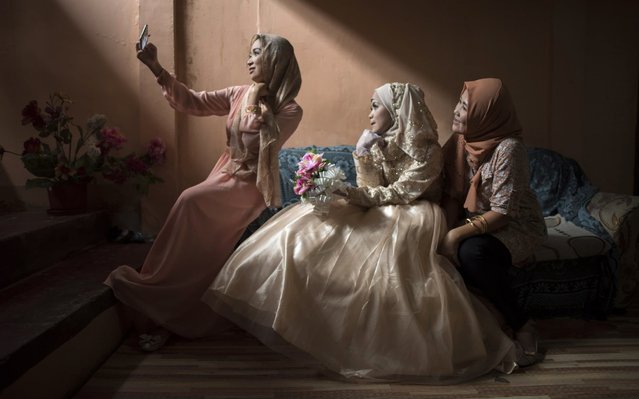
Bride Katty Malang Mikunug with friends, takes a photo before the wedding on October 21, 2017 in Saguiaran in Lanao del Sur, southern Philippines. Paulo Mamayo Ambor, 22, a resident of Marawi who got displaced by the fighting between government troops and IS-inspired militants, weds Katty Malang Mikunug, 22, a resident of an adjacent town in Saguiaran. Philippines President Rodrigo Duterte declared Marawi liberated, following the death of Abu Sayyaf leader Isnilon Hapilon and one of the Maute brothers, Omar Maute, after nearly five months of fierce urban battle inside the besieged city. The fighting started May 23, and left more than 1,000 people dead, whilst displacing at least 400,000 people. (Photo by Jes Aznar/Getty Images)

Bride Katty Malang Mikunug with friends, takes a photo before the wedding on October 21, 2017 in Saguiaran in Lanao del Sur, southern Philippines. Paulo Mamayo Ambor, 22, a resident of Marawi who got displaced by the fighting between government troops and IS-inspired militants, weds Katty Malang Mikunug, 22, a resident of an adjacent town in Saguiaran. Philippines President Rodrigo Duterte declared Marawi liberated, following the death of Abu Sayyaf leader Isnilon Hapilon and one of the Maute brothers, Omar Maute, after nearly five months of fierce urban battle inside the besieged city. The fighting started May 23, and left more than 1,000 people dead, whilst displacing at least 400,000 people. (Photo by Jes Aznar/Getty Images)
Details
23 Oct 2017 07:17:00
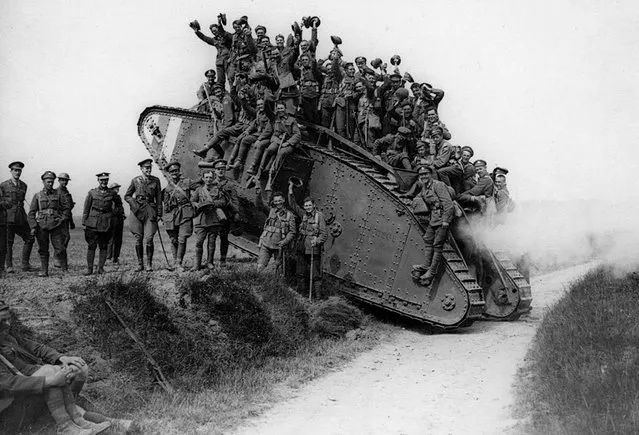
These black-and-white photos are taken from the new book “Armoured Warfare in the First World War 1916 – 1918” by Anthony Tucker-Jones and published by Pen & Sword Military. “Interestingly the British, French and Germans took completely different approaches with varying results”. The British military produced “Little Willie” in Autumn 1915 weighing 18 tonnes, which had a crew of two plus four gunners. “Inspired by a tracked artillery tractor “Little Willie” was referred to as a water tank – hence the name tank – to ensure secrecy”, said Anthony. “This led to the strange looking Mark I with its peculiar rhomboid shape, designed to cross trenches with guns in sponsons on either side. The Germans saw the tank as unchivalrous and were slow to grasp its utility. They favoured the Stormtrooper (specialist soldiers used to infiltrate enemy trenches) and artillery, not the tank”, said Anthony. “However, they didn’t hesitate to make use of captured British tanks. Although the tank helped secure victory and German soldiers dubbed it “Germany’s Downfall” the country was ultimately brought to its knees by the Allies blockade”. Here: British troops hitch a ride on a Mark IV after the massed tank fleet spearheading attack at Cambrai on November 20, 1917. (Photo by Anthony Tucker-Jones/Mediadrumworld.com)

These black-and-white photos are taken from the new book “Armoured Warfare in the First World War 1916 – 1918” by Anthony Tucker-Jones and published by Pen & Sword Military. Here: British troops hitch a ride on a Mark IV after the massed tank fleet spearheading attack at Cambrai on November 20, 1917. (Photo by Anthony Tucker-Jones/Mediadrumworld.com)
Details
23 Feb 2017 00:02:00
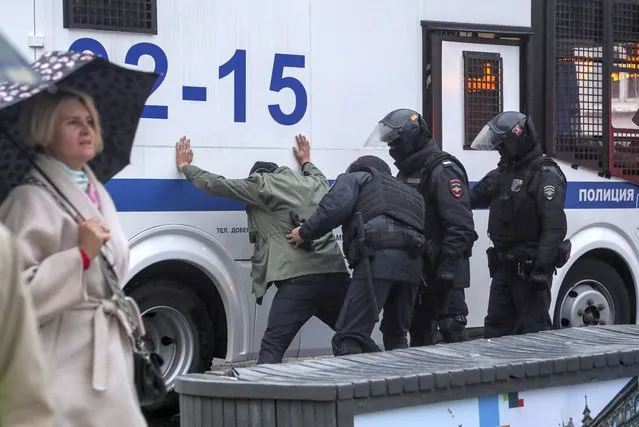
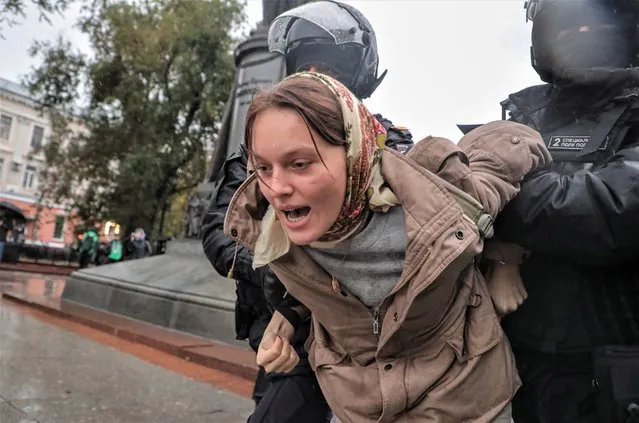
Russian policemen detain a participant taking part in an unauthorized protest against Russia's partial military mobilization due to the conflict in Ukraine, in downtown of Moscow, Russia, 24 September 2022. Russian President Putin announced in a televised address to the nation on 21 September, that he signed a decree on partial mobilization in the Russian Federation. Russian citizens who are in the reserve will be called up for military service. On 24 February 2022 Russian troops entered the Ukrainian territory in what the Russian president declared a “Special Military Operation”, starting an armed conflict that has provoked destruction and a humanitarian crisis. (Photo by Maxim Shipenkov/EPA/EFE)

Russian policemen detain a participant taking part in an unauthorized protest against Russia's partial military mobilization due to the conflict in Ukraine, in downtown of Moscow, Russia, 24 September 2022. Russian President Putin announced in a televised address to the nation on 21 September, that he signed a decree on partial mobilization in the Russian Federation. Russian citizens who are in the reserve will be called up for military service. On 24 February 2022 Russian troops entered the Ukrainian territory in what the Russian president declared a “Special Military Operation”, starting an armed conflict that has provoked destruction and a humanitarian crisis. (Photo by Maxim Shipenkov/EPA/EFE)
Details
28 Sep 2022 04:46:00
Russian policemen detain a person taking part in an unauthorized protest against Russia's partial military mobilization due to the conflict in Ukraine, in downtown Moscow, Russia on 24 September 2022. Russian President Putin announced in a televised address to the nation on 21 September, that he signed a decree on partial mobilization in the Russian Federation. Russian citizens who are in the reserve will be called up for military service. On 24 February 2022 Russian troops entered the Ukrainian territory in what the Russian president declared a “Special Military Operation”, starting an armed conflict that has provoked destruction and a humanitarian crisis. (Photo by Maxim Shipenkov/EPA/EFE)

Russian policemen detain a person taking part in an unauthorized protest against Russia's partial military mobilization due to the conflict in Ukraine, in downtown Moscow, Russia on 24 September 2022. Russian President Putin announced in a televised address to the nation on 21 September, that he signed a decree on partial mobilization in the Russian Federation. Russian citizens who are in the reserve will be called up for military service. On 24 February 2022 Russian troops entered the Ukrainian territory in what the Russian president declared a “Special Military Operation”, starting an armed conflict that has provoked destruction and a humanitarian crisis. (Photo by Maxim Shipenkov/EPA/EFE)
Details
29 Sep 2022 03:47:00
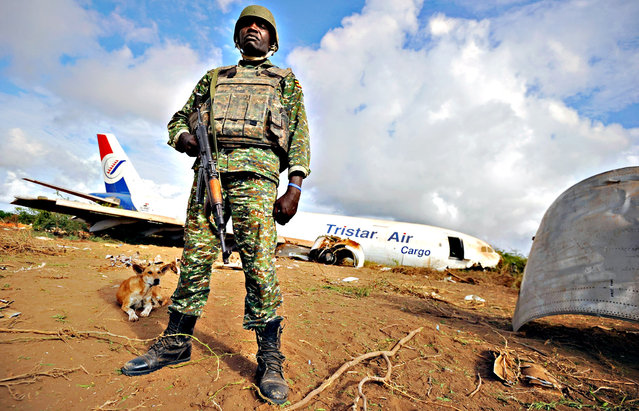
A soldier from the African Union (AU) peacekeeping force stands guard at the site where a cargo plane carrying supplies for AU troops crash-landed outside Somalia's capital, on October 13, 2015 at Abirska, some 18 kilometres outside Somalian capital, Mogadishu. The officials said the Egyptian-owned transport plane went down after making several unsuccessful passes over the seafront airport. (Photo by Mohamed Abdiwahab/AFP Photo)

A soldier from the African Union (AU) peacekeeping force stands guard at the site where a cargo plane carrying supplies for AU troops crash-landed outside Somalia's capital, on October 13, 2015 at Abirska, some 18 kilometres outside Somalian capital, Mogadishu. The officials said the Egyptian-owned transport plane went down after making several unsuccessful passes over the seafront airport. Two of the six crew members suffered light injuries in the crash, the officials said, but added that the plane and those on board were safe having landed in an area controlled by the Somali government and the African Union's AMISOM force. (Photo by Mohamed Abdiwahab/AFP Photo)
Details
16 Oct 2015 08:02:00
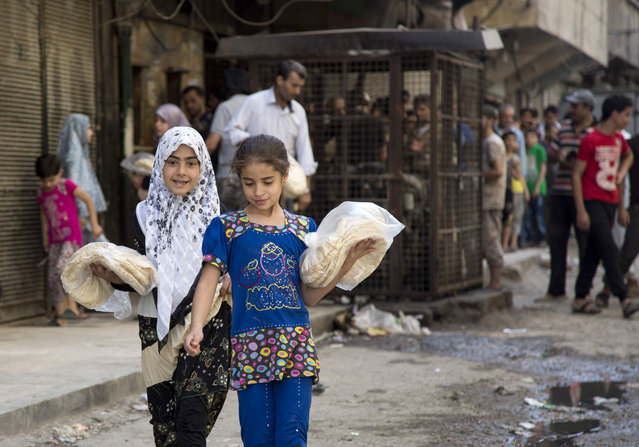
Syrian girls carry bags with bread as people queue up outisde a bakery in a rebel held neighbourhood in the northern city of Aleppo on July 12, 2016. Since mid-2012, Aleppo has been roughly divided between government control in the west and rebel control in the east, and has suffered enormous destruction in the war that has killed more than 280,000 people nationwide. Last week, a government advance brought regime troops within firing range of the Castello Road, the only remaining supply route into the opposition-held east, effectively severing rebel neighbourhoods from the outside world. With their route to the outside world cut, there is no new flour coming to the city's bakeries, and fuel to light their ovens is also now hard to find. (Photo by Karam Al-Masri/AFP Photo)

Syrian girls carry bags with bread as people queue up outisde a bakery in a rebel held neighbourhood in the northern city of Aleppo on July 12, 2016. Since mid-2012, Aleppo has been roughly divided between government control in the west and rebel control in the east, and has suffered enormous destruction in the war that has killed more than 280,000 people nationwide. Last week, a government advance brought regime troops within firing range of the Castello Road, the only remaining supply route into the opposition-held east, effectively severing rebel neighbourhoods from the outside world. With their route to the outside world cut, there is no new flour coming to the city's bakeries, and fuel to light their ovens is also now hard to find. (Photo by Karam Al-Masri/AFP Photo)
Details
08 Aug 2016 10:02:00