Loading...
Done
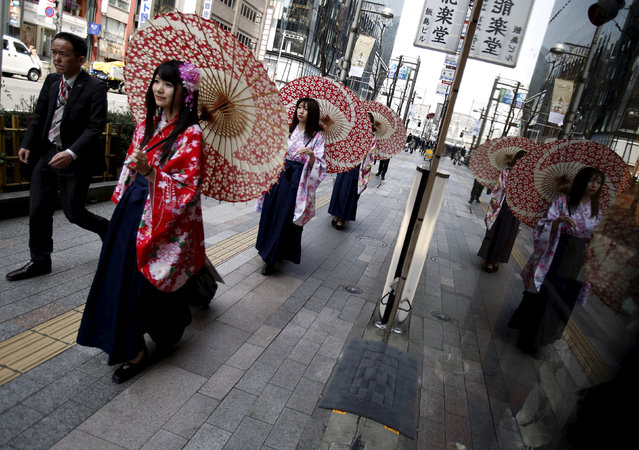
Women in Kimono holding an umbrella walk on a street at Ginza shopping district in Tokyo, Japan, March 31, 2016. (Photo by Yuya Shino/Reuters)

Women in Kimono holding an umbrella walk on a street at Ginza shopping district in Tokyo, Japan, March 31, 2016. (Photo by Yuya Shino/Reuters)
Details
05 Sep 2016 11:09:00
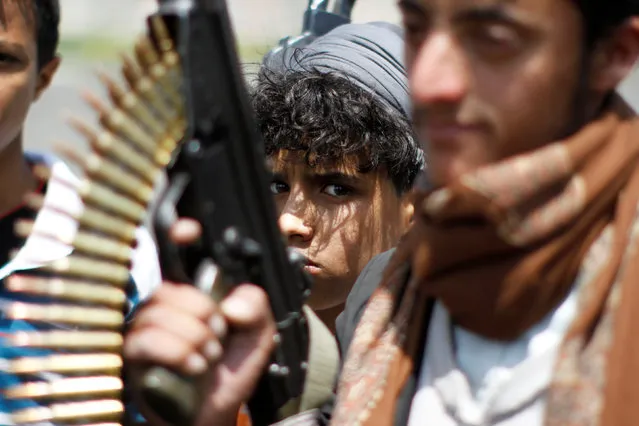
An armed youth loyal to the Houthi movement takes part in a protest against the Saudi-backed exiled government deciding to cut off the Yemeni central bank from the outside world, in the capital Sanaa, Yemen August 25, 2016. (Photo by Mohamed al-Sayaghi/Reuters)

An armed youth loyal to the Houthi movement takes part in a protest against the Saudi-backed exiled government deciding to cut off the Yemeni central bank from the outside world, in the capital Sanaa, Yemen August 25, 2016. (Photo by Mohamed al-Sayaghi/Reuters)
Details
06 Sep 2016 10:13:00
A passenger takes off his pants as others not wearing pants dance while waiting for a subway train during the “No Pants Subway Ride” in Mexico City, Mexico, February 21, 2016. (Photo by Carlos Jasso/Reuters)

A passenger takes off his pants as others not wearing pants dance while waiting for a subway train during the “No Pants Subway Ride” in Mexico City, Mexico, February 21, 2016. The event is an annual flash mob and occurs in different cities around the world, according to its organisers. (Photo by Carlos Jasso/Reuters)
Details
23 Feb 2016 11:57:00
A model gets ready backstage during a body art festival in Almaty, Kazakhstan, March 23, 2016. (Photo by Shamil Zhumatov/Reuters)

A model gets ready backstage during a body art festival in Almaty, Kazakhstan, March 23, 2016. (Photo by Shamil Zhumatov/Reuters)
Details
24 Mar 2016 12:21:00
Rooftops of solar powered houses are pictured in Ota, 80 km northwest of Tokyo in this October 28, 2008 file photo. One by one, Japan is turning off the lights at the giant oil-fired power plants that propelled it to the ranks of the world's top industrialised nations. With nuclear power in the doldrums after the Fukushima disaster, it's solar energy that is becoming the alternative. (Photo by Yuriko Nakao/Reuters)

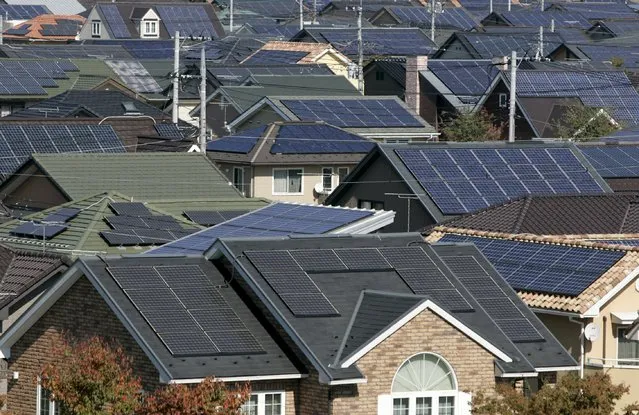
Rooftops of solar powered houses are pictured in Ota, 80 km northwest of Tokyo in this October 28, 2008 file photo. One by one, Japan is turning off the lights at the giant oil-fired power plants that propelled it to the ranks of the world's top industrialised nations. With nuclear power in the doldrums after the Fukushima disaster, it's solar energy that is becoming the alternative. Solar power is set to become profitable in Japan as early as this quarter, according to the Japan Renewable Energy Foundation (JREF), freeing it from the need for government subsidies and making it the last of the G7 economies where the technology has become economically viable. (Photo by Yuriko Nakao/Reuters)
Details
24 Nov 2015 08:04:00
A worker holds harvested chillies at a chilli plantation in Pasir Datar Indah village near Sukabumi, Indonesia's West Java province, August 6, 2015. (Photo by Reuters/Beawiharta)

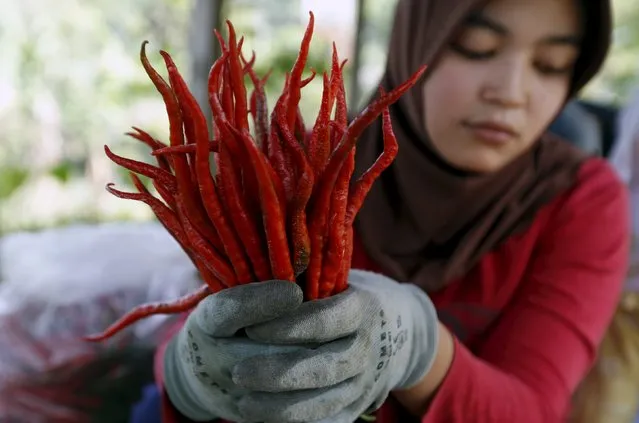
A worker holds harvested chillies at a chilli plantation in Pasir Datar Indah village near Sukabumi, Indonesia's West Java province, August 6, 2015. (Photo by Reuters/Beawiharta)
Details
20 Aug 2015 13:03:00
A Nepalese man sits outside a Hindu temple as a goat rests on a parked scooter in Khokana, Lalitpur District, Nepal, Monday, Sept. 26, 2016. Writing on the wall offers prayers to Hindu god Shiva. (Photo by Niranjan Shrestha/AP Photo)

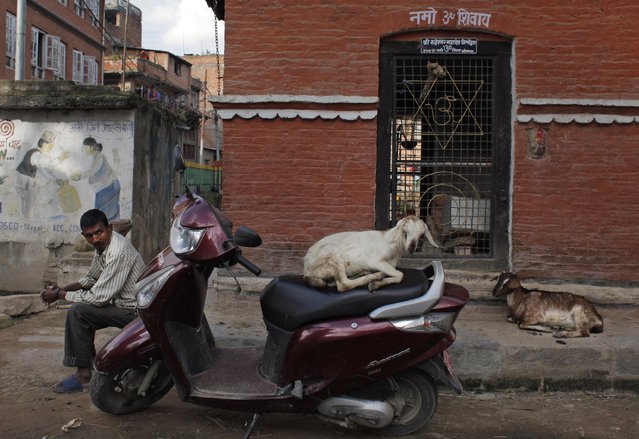
A Nepalese man sits outside a Hindu temple as a goat rests on a parked scooter in Khokana, Lalitpur District, Nepal, Monday, September 26, 2016. Writing on the wall offers prayers to Hindu god Shiva. (Photo by Niranjan Shrestha/AP Photo)
Details
27 Sep 2016 09:27:00
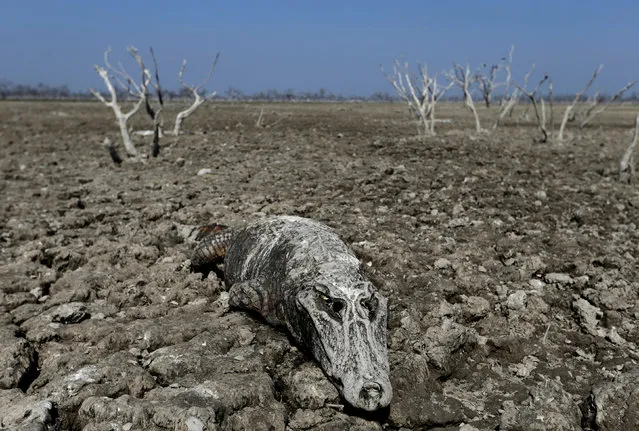
The carcass of a yacare caiman lies in the dried-up river bed of the Pilcomayo river in Boqueron, Paraguay, August 14, 2016. In Paraguay, alongside the Pilcomayo River, black vultures flew over a shrinking pond where a group of crocodilian reptiles known as yacare caimans sought refuge. Water from the river, which divides Paraguay and Argentina in the area of the Gran Chaco, was scarce. This is not an uncommon sight in the region of General Diaz, about 700 kilometres (435 miles) northwest of the country's capital Asuncion, where the Pilcomayo's waters form lakes and streams that give life to capybaras, birds and caimans. “The river's situation is critical. No water is forecast to enter the basin until December, as happens every year”, said Alcides Gonzalez, a resident of the area. (Photo by Jorge Adorno/Reuters)

The carcass of a yacare caiman lies in the dried-up river bed of the Pilcomayo river in Boqueron, Paraguay, August 14, 2016. In Paraguay, alongside the Pilcomayo River, black vultures flew over a shrinking pond where a group of crocodilian reptiles known as yacare caimans sought refuge. Water from the river, which divides Paraguay and Argentina in the area of the Gran Chaco, was scarce. This is not an uncommon sight in the region of General Diaz, about 700 kilometres (435 miles) northwest of the country's capital Asuncion, where the Pilcomayo's waters form lakes and streams that give life to capybaras, birds and caimans. (Photo by Jorge Adorno/Reuters)
Details
03 Nov 2016 12:40:00