Loading...
Done
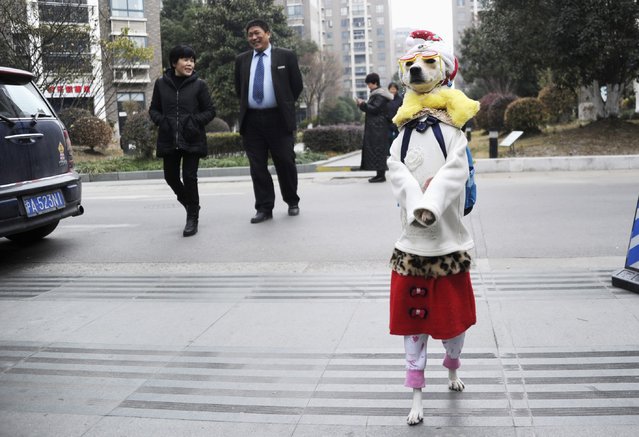
Dog Xiaoniu dressed in clothes walks across a street with its owner (not pictured) in Shanghai, December 19, 2014. According to local media, Xiaoniu accompanies its owner to the food market everyday and is able to walk with its hind legs for up to about an hour. (Photo by Reuters/Stringer)

Dog Xiaoniu dressed in clothes walks across a street with its owner (not pictured) in Shanghai, December 19, 2014. According to local media, Xiaoniu accompanies its owner to the food market everyday and is able to walk with its hind legs for up to about an hour. (Photo by Reuters/Stringer)
Details
27 Dec 2014 12:03:00
A man carries an injured civilian at a site hit by what activists said was an air strike by forces of Syria's President Bashar al-Assad in the Duma neighbourhood of Damascus December 27, 2014. (Photo by Bassam Khabieh/Reuters)

A man carries an injured civilian at a site hit by what activists said was an air strike by forces of Syria's President Bashar al-Assad in the Duma neighbourhood of Damascus December 27, 2014. (Photo by Bassam Khabieh/Reuters)
Details
28 Dec 2014 11:56:00
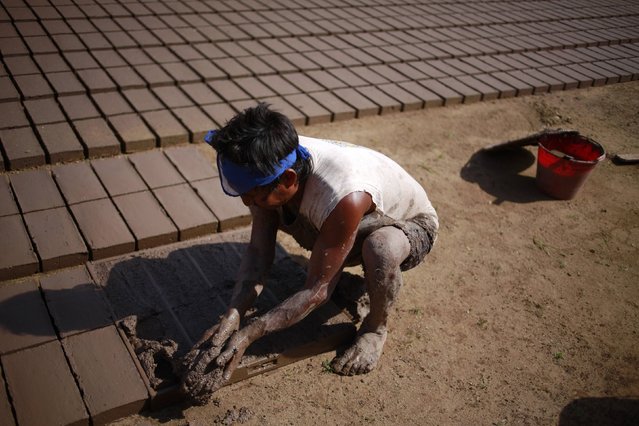
A worker settles mud in a mold to make bricks at a brick factory in Tixtla, on the outskirts of Chilpancingo, in the Guerrero state, January 26, 2015. The worker earns a salary of 15 Mexican pesos, or one dollar, for every 100 bricks made on a working day of at least 5 hours. (Photo by Jorge Dan Lopez/Reuters)

A worker settles mud in a mold to make bricks at a brick factory in Tixtla, on the outskirts of Chilpancingo, in the Guerrero state, January 26, 2015. The worker earns a salary of 15 Mexican pesos, or one dollar, for every 100 bricks made on a working day of at least 5 hours. (Photo by Jorge Dan Lopez/Reuters)
Details
28 Jan 2015 11:33:00
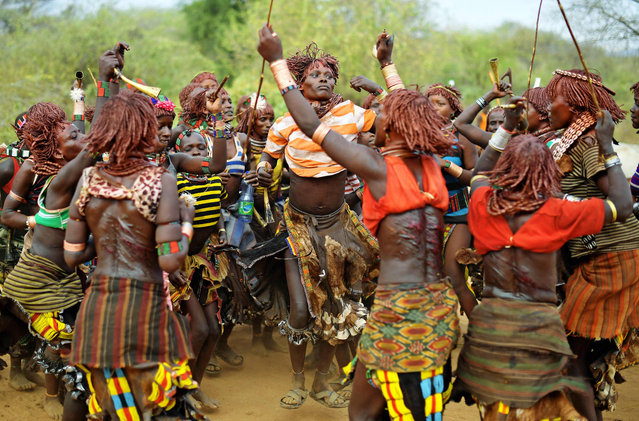
Hamar women dance before a bull jumping ceremony in Ethiopia's southern Omo Valley region near Turmi on September 19, 2016. The Hamar are a Nilotic ethnic group in Ethiopia. The construction of the Gibe III dam, the third largest hydroelectric plant in Africa, and large areas of very “thirsty” cotton and sugar plantations and factories along the Omo river are impacting heavily on the lives of tribes living in the Omo Valley who depend on the river for their survival and way of life. Human rights groups fear for the future of the tribes if they are forced to scatter, give up traditional ways through loss of land or ability to keep cattle as globalisation and development increases. (Photo by Carl De Souza/AFP Photo)

Hamar women dance before a bull jumping ceremony in Ethiopia's southern Omo Valley region near Turmi on September 19, 2016. The Hamar are a Nilotic ethnic group in Ethiopia. The construction of the Gibe III dam, the third largest hydroelectric plant in Africa, and large areas of very “thirsty” cotton and sugar plantations and factories along the Omo river are impacting heavily on the lives of tribes living in the Omo Valley who depend on the river for their survival and way of life. (Photo by Carl De Souza/AFP Photo)
Details
02 Oct 2016 08:45:00
Jorge (2nd R), 31, who is among members of lesbian, gay, bisexual and transgender (LGBT) community and his brother Paulo, 28, (R) laugh at Arouche Square in downtown Sao Paulo, Brazil, November 20, 2016. (Photo by Nacho Doce/Reuters)

Jorge (2nd R), 31, who is among members of lesbian, gay, bisexual and transgender (LGBT) community and his brother Paulo, 28, (R) laugh at Arouche Square in downtown Sao Paulo, Brazil, November 20, 2016. (Photo by Nacho Doce/Reuters)
Details
09 Dec 2016 11:29:00
Sumo wrestlers of Nishonoseki clan appeal to the winner of a training bout for the next opponent during a joint training session ahead of the May Grand Sumo Tournament in Tokyo May 2, 2015. (Photo by Toru Hanai/Reuters)

Sumo wrestlers of Nishonoseki clan appeal to the winner of a training bout for the next opponent during a joint training session ahead of the May Grand Sumo Tournament in Tokyo May 2, 2015. (Photo by Toru Hanai/Reuters)
Details
03 May 2015 10:42:00
Heads of love dolls are seen on the shelf on March 9, 2017 in Tokyo, Japan. Japan's oldest and largest “love doll” maker Orient Industry, has been producing silicone love dolls since 1977, and has seen there is a trend for intimate relationships with silicone dolls in Japan. The Orient Industry's factory produces approximately 500 life size hand-made per year, and one doll, costs up to 600,000JPY (approx. 6,000 USD), takes four to five weeks to be finished. Originally, the company was marketing love dolls for disabled people, and the company continues to support the community by providing discounts and consulting their sexual urges. (Photo by Taro Karibe/Getty Images)

Heads of love dolls are seen on the shelf on March 9, 2017 in Tokyo, Japan. Japan's oldest and largest “love doll” maker Orient Industry, has been producing silicone love dolls since 1977, and has seen there is a trend for intimate relationships with silicone dolls in Japan. (Photo by Taro Karibe/Getty Images)
Details
18 Mar 2017 10:32:00
A model presents a creation of Peruvian designer Ani Alvarez Calderon during Fashion Week in Lima, Peru, April 25, 2017. (Photo by Guadalupe Pardo/Reuters)

A model presents a creation of Peruvian designer Ani Alvarez Calderon during Fashion Week in Lima, Peru, April 25, 2017. (Photo by Guadalupe Pardo/Reuters)
Details
01 May 2017 09:47:00