Loading...
Done
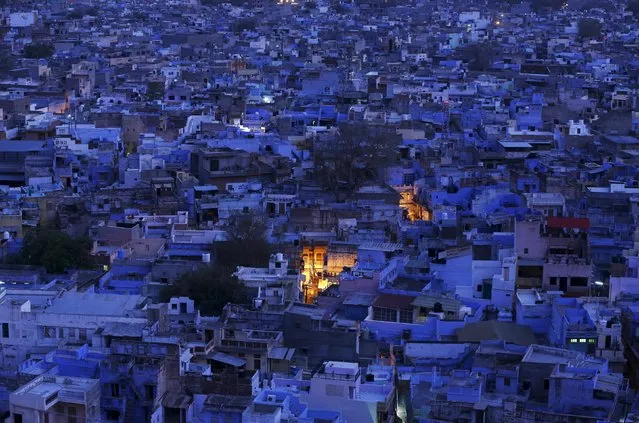
A general view of the residential area is pictured during dusk at Jodhpur in Rajasthan, April 5, 2015. Jodhpur, also known as the blue city in the desert Indian state of Rajasthan, which residents say originally, was used to show where the highest caste of priestly Hindus live, who wanted to set them apart from the rest of the population. Later the rest of the population followed suit. Another reason for the city to be blue is to keep the buildings cool during the summers, local residents said. (Photo by Adnan Abidi/Reuters)

A general view of the residential area is pictured during dusk at Jodhpur in Rajasthan, April 5, 2015. Jodhpur, also known as the blue city in the desert Indian state of Rajasthan, which residents say originally, was used to show where the highest caste of priestly Hindus live, who wanted to set them apart from the rest of the population. Later the rest of the population followed suit. Another reason for the city to be blue is to keep the buildings cool during the summers, local residents said. (Photo by Adnan Abidi/Reuters)
Details
12 Apr 2015 08:27:00
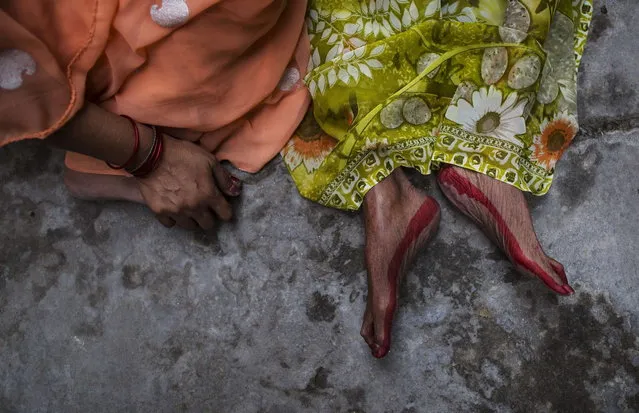
A relative (L) of Champa Devi, 88, sits next to her body, minutes after her death at Mukti Bhavan (Salvation House) at Varanasi, in the northern Indian state of Uttar Pradesh, June 21, 2014. (Photo by Danish Siddiqui/Reuters)

A relative (L) of Champa Devi, 88, sits next to her body, minutes after her death at Mukti Bhavan (Salvation House) at Varanasi, in the northern Indian state of Uttar Pradesh, June 21, 2014. The city of Varanasi, on the banks of the River Ganges, is widely considered Hinduism's holiest city and many Hindus believe that dying there and having their remains scattered in the Ganges allows their soul to escape a cycle of death and rebirth, attaining “moksha” or salvation. “Mukti Bhavan” or “Salvation House”, is a charity-run hostel that caters for people who wish to come to Varanasi to die. Guests can normally stay up to two weeks after which, if they haven't yet passed away, they are gently asked to leave. (Photo by Danish Siddiqui/Reuters)
Details
24 Jul 2014 12:32:00
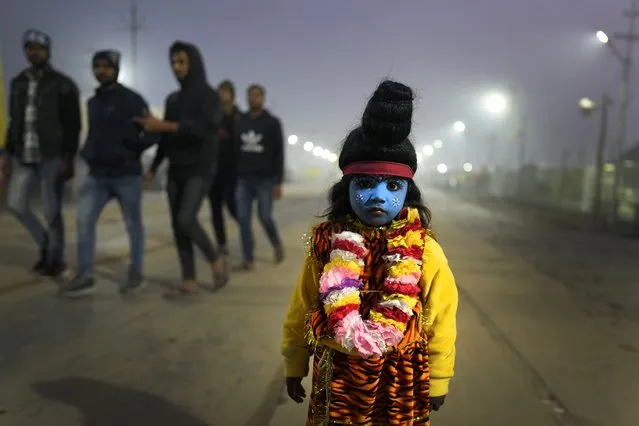
A child dressed as Hindu God Shiva begs for alms from devotees at the Sangam, the confluence of three rivers – the Ganges, the Yamuna and the mythical Saraswati, on the Makar Sankranti festival during the annual traditional fair of Magh Mela in Prayagraj, in the northern Indian state of Uttar Pradesh, Sunday, January 14, 2024. Hundreds of thousands of Hindu pilgrims are expected to take dips in the confluence, hoping to wash away sins during the month-long festival. (Photo by Rajesh Kumar Singh/AP Photo)

A child dressed as Hindu God Shiva begs for alms from devotees at the Sangam, the confluence of three rivers – the Ganges, the Yamuna and the mythical Saraswati, on the Makar Sankranti festival during the annual traditional fair of Magh Mela in Prayagraj, in the northern Indian state of Uttar Pradesh, Sunday, January 14, 2024. Hundreds of thousands of Hindu pilgrims are expected to take dips in the confluence, hoping to wash away sins during the month-long festival. (Photo by Rajesh Kumar Singh/AP Photo)
Details
05 Feb 2024 11:34:00
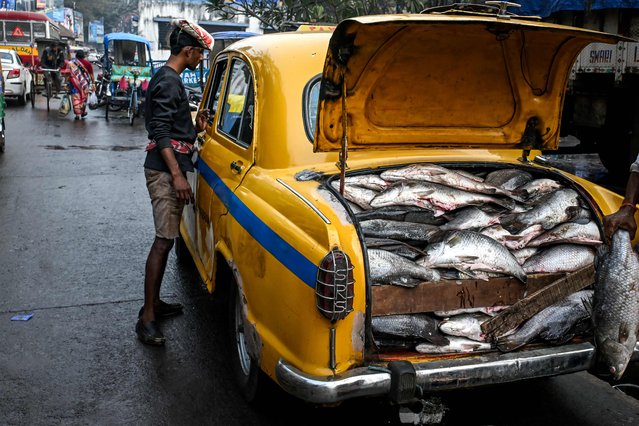
This photograph taken on January 30, 2025 shows a labourer looking into a Hindustan Ambassador yellow taxi, transporting fish at a wholesale market in Kolkata. Kolkata cherishes its past, which is why the one-time Indian capital is mourning a vanishing emblem of its faded grandeur: a hulking and noisy fleet of stately yellow taxis. (Photo by Dibyangshu Sarkar/AFP Photo)

This photograph taken on January 30, 2025 shows a labourer looking into a Hindustan Ambassador yellow taxi, transporting fish at a wholesale market in Kolkata. Kolkata cherishes its past, which is why the one-time Indian capital is mourning a vanishing emblem of its faded grandeur: a hulking and noisy fleet of stately yellow taxis. (Photo by Dibyangshu Sarkar/AFP Photo)
Details
06 Mar 2025 03:12:00
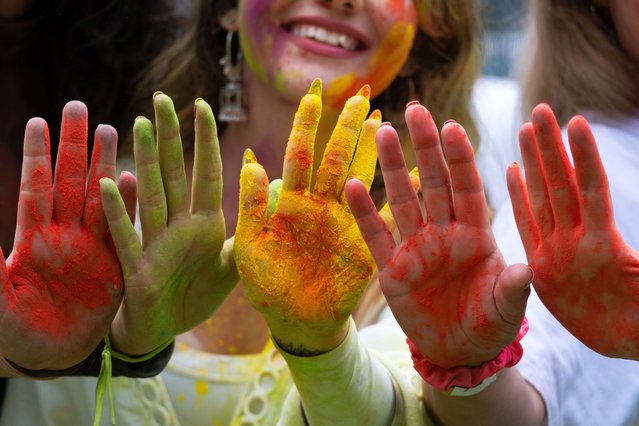
The Indian community and supporters living in Brazil celebrate the festival of colors in Sao Paulo, Brazil on March 24, 2024. A Burst of Colors and Tradition Holi, characterized by vivid hues, gulaal, and rituals, transcends mere festivity; it's a grand jubilation of joy and camaraderie. Legend has it that the festival commemorates the triumph of Lord Narasimha over the demon Hiranyakashyap, representing the victory of righteousness over malevolence. (Photo by Dario Oliveira/ZUMA Press Wire/Rex Features/Shutterstock)

The Indian community and supporters living in Brazil celebrate the festival of colors in Sao Paulo, Brazil on March 24, 2024. A Burst of Colors and Tradition Holi, characterized by vivid hues, gulaal, and rituals, transcends mere festivity; it's a grand jubilation of joy and camaraderie. Legend has it that the festival commemorates the triumph of Lord Narasimha over the demon Hiranyakashyap, representing the victory of righteousness over malevolence. (Photo by Dario Oliveira/ZUMA Press Wire/Rex Features/Shutterstock)
Details
21 Jul 2025 03:22:00
Freida Pinto attends the 2020 Vanity Fair Oscar Party hosted by Radhika Jones at Wallis Annenberg Center for the Performing Arts on February 09, 2020 in Beverly Hills, California. (Photo by Emma McIntyre/VF20/WireImage)

Indian actress Freida Pinto attends the 2020 Vanity Fair Oscar Party hosted by Radhika Jones at Wallis Annenberg Center for the Performing Arts on February 09, 2020 in Beverly Hills, California. (Photo by Emma McIntyre/VF20/WireImage)
Details
15 Feb 2020 00:01:00
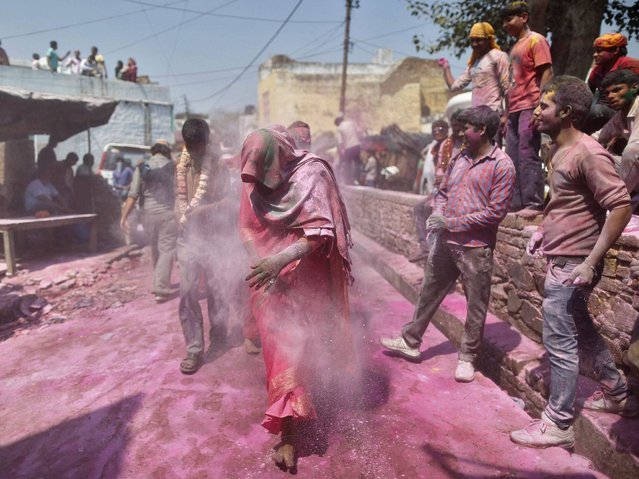
In a Holi tradition unique to Barsana and Nandgaon villages, men sing provocative songs to gain the attention of women, who then “beat” them with bamboo sticks called “lathis”. (Photo by Anindito Mukherjee/Reuters)

A woman covers her face as men throw colored powder at her during “Lathmar Holi” at the village of Barsana in the northern Indian state of Uttar Pradesh March 9, 2014. (Photo by Anindito Mukherjee/Reuters)
Details
13 Mar 2014 08:05:00


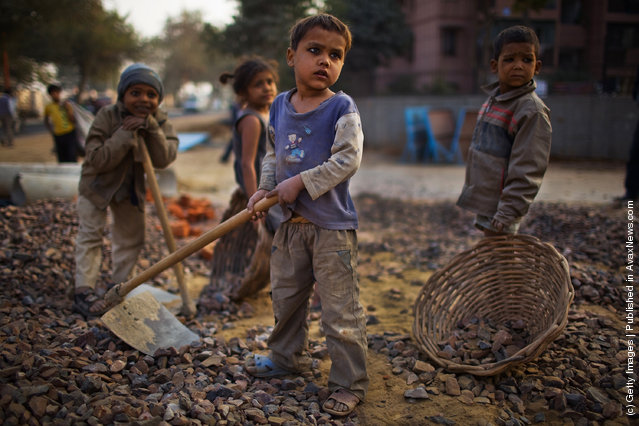
Indian children work nearby to their parents at a construction project in front of the Jawaharlal Nehru Stadium on January 30, 2010 in New Delhi, India. The children accompany their parents to the work site, where if they are prepared to work, they will receive money for bread an milk and be provided with dinner by the contractor. The sheer scale of the project has drawn an enormous population of migrant workers from all over India.
Details
20 May 2011 07:00:00