Loading...
Done
A vender arranges goods for sale at a market on the outskirts of Buenos Aires, Argentina, Wednesday, January 10, 2024. (Photo by Natacha Pisarenko/AP Photo)

A vender arranges goods for sale at a market on the outskirts of Buenos Aires, Argentina, Wednesday, January 10, 2024. (Photo by Natacha Pisarenko/AP Photo)
Details
25 Jan 2024 09:55:00
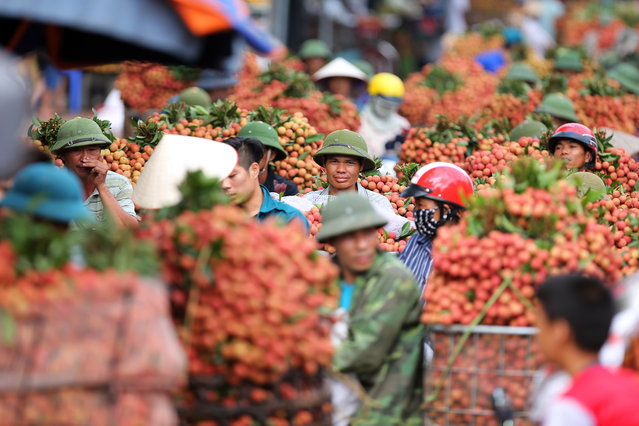
People carry lychee for sale on a motorbike on a street in Luc Ngan, Bac Giang province, Vietnam, 22 June 2016. Lychee output in Bac Giang province is expected to reach 130,000 tonnes this year. China is still Vietnam's main lychee export market so far, buying around 60 percent of the annual crop, according to official reports. (Photo by Luong Thai Linh/EPA)

People carry lychee for sale on a motorbike on a street in Luc Ngan, Bac Giang province, Vietnam, 22 June 2016. Lychee output in Bac Giang province is expected to reach 130,000 tonnes this year. China is still Vietnam's main lychee export market so far, buying around 60 percent of the annual crop, according to official reports. (Photo by Luong Thai Linh/EPA)
Details
30 Jun 2016 11:25:00
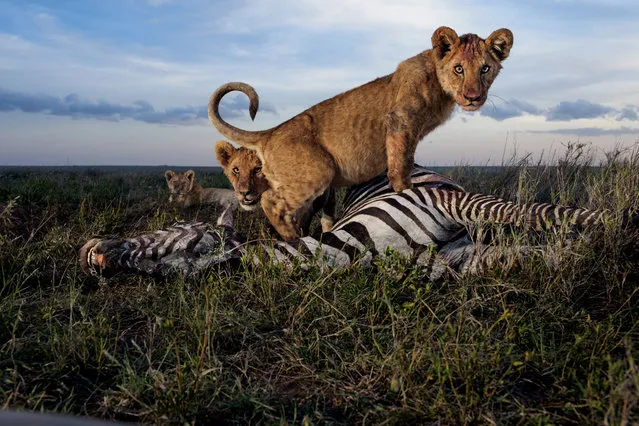
Cubs of the Simba East pride: too young to kill but old enough to crave meat. Adult females, and sometimes males, do the hunting. Zebras and wildebeests rank high as chosen prey in the rainy season. (Photo by Michael Nichols/National Geographic via The Atlantic)

“Serengeti National Park encompasses 5,700 square miles of grassy plains and woodlands near the northern border of Tanzania, and is home to more than 3,500 lions grouped into a couple dozen prides. Photographer Nick Nichols and videographer Nathan Williamson made several extended trips to the Serengeti between July 2011 and January 2013, determined to break new visual ground in their coverage of the Serengeti Lions”. Photo: Cubs of the Simba East pride: too young to kill but old enough to crave meat. Adult females, and sometimes males, do the hunting. Zebras and wildebeests rank high as chosen prey in the rainy season. (Photo by Michael Nichols/National Geographic via The Atlantic)
Details
09 Aug 2013 08:15:00
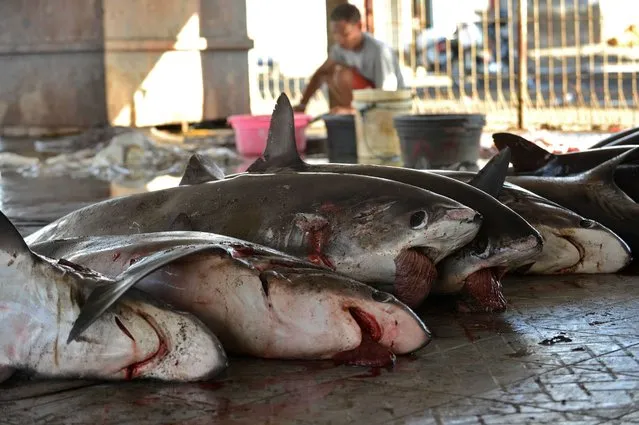
This picture taken on November 9, 2014 shows sharks for sale as a man removes the fins at a traditional market in Tanjung Luar in Lombok, West Nusa Teggara. Hundreds of sharks are hauled ashore every day at a busy market on the central Indonesian island of Lombok, the hub of a booming trade that provides a livelihood for local fishermen but is increasingly alarming environmentalists. (Photo by Sonny Tumbelaka/AFP Photo)

This picture taken on November 9, 2014 shows sharks for sale as a man removes the fins at a traditional market in Tanjung Luar in Lombok, West Nusa Teggara. Hundreds of sharks are hauled ashore every day at a busy market on the central Indonesian island of Lombok, the hub of a booming trade that provides a livelihood for local fishermen but is increasingly alarming environmentalists. The fins are sold to other Asian nations, including Singapore, Hong Kong and Taiwan, where shark-fin soup is considered a delicacy. (Photo by Sonny Tumbelaka/AFP Photo)
Details
23 Dec 2014 13:52:00
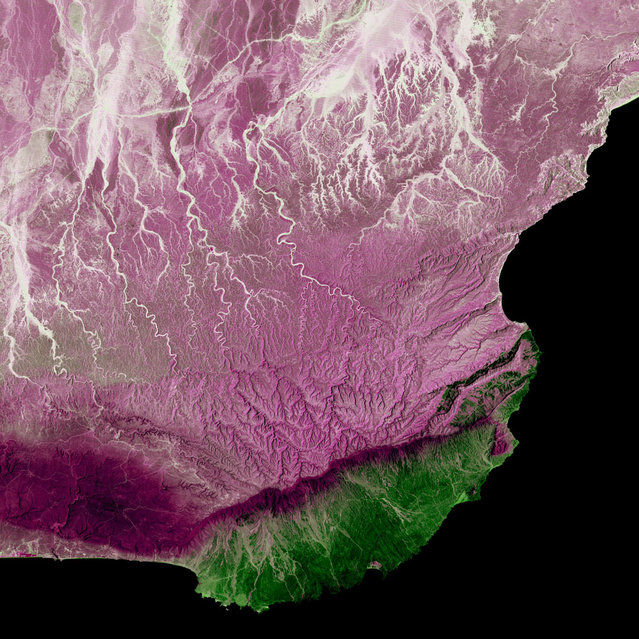
Dhofar Region, Oman. Much of Oman is desert, but the Arabian Sea coast in the Dhofar region represents a startling difference in climate. This coastal region catches the monsoon rains, or khareef, during the summer months. Drenching rains fall primarily on the mountainous ridge that separates the lush, fertile areas along the coast from the arid interior, recharging streams, waterfalls and springs that provide plentiful water supplies in the fertile lowlands for the remainder of the year. Image taken by Landsat 5 on April 2, 2005. (Photo by USGS/NASA)


Dhofar Region, Oman. Much of Oman is desert, but the Arabian Sea coast in the Dhofar region represents a startling difference in climate. This coastal region catches the monsoon rains, or khareef, during the summer months. Drenching rains fall primarily on the mountainous ridge that separates the lush, fertile areas along the coast from the arid interior, recharging streams, waterfalls and springs that provide plentiful water supplies in the fertile lowlands for the remainder of the year. Image taken by Landsat 5 on April 2, 2005. (Photo by USGS/NASA)
Details
25 Dec 2012 11:13:00
Pineapple

“One Third” – a project on food waste by an Austrian photography Klaus Pichler. According to a UN study one third of the world's food goes to waste – the largest part thereof in the industrialized nations of the global north. Equally, 925 million people around the world are threatened by starvation. The series “One Third” describes the connection between individual wastage of food and globalized food production.

Photo: Pineapple. Place of production: Guayaquil, Ecuador. Cultivation method: Outdoor plantation • Time of harvest: All- season. Transporting distance: 10.666 km (linear distance) • Means of transportation: Aircraft, truck. Carbon footprint (total) per kg: 11,94 kg • Water requirement (total) per kg: 360 l. Price: 2,10 € / kg. (Photo by Klaus Picher)
Details
02 May 2012 11:01:00
Toby balances halloween decorations on his head. (Photo by Pat Langer/Caters News Agency)

Toby, an 11-year-old German shepherd-husky mix, can hold almost anything on his head that his owner, Pat Langner, can think up, including balls, Christmas trees, and even the ingredients for a peanut butter and jelly sandwich. He also shows remarkable self-restraint by not immediately gobbling down the food that his owner gives him to balance. Here: Toby balances halloween decorations on his head. (Photo by Pat Langer/Caters News Agency)
Details
19 Dec 2017 08:05:00
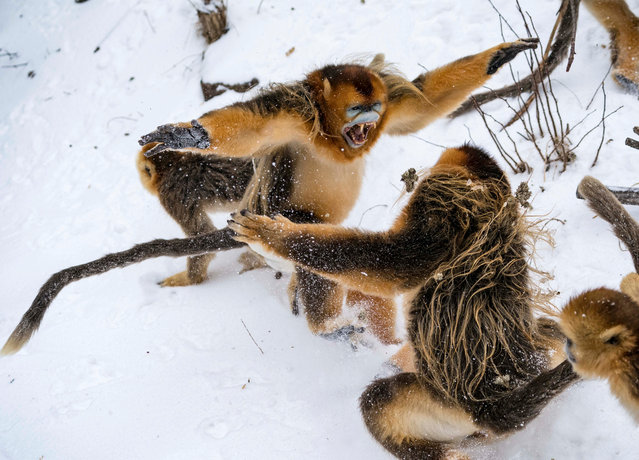
Golden monkeys play at a conservation base in Shennongjia, central China's Hubei Province, January 26, 2018. The golden monkey conservation base witnessed a snowfall recently. (Photo by Du Huaju/Xinhua/Barcroft Images)

Golden monkeys play at a conservation base in Shennongjia, central China's Hubei Province, January 26, 2018. The golden monkey conservation base witnessed a snowfall recently. (Photo by Du Huaju/Xinhua/Barcroft Images)
Details
04 Feb 2018 06:39:00