England players celebrate Sunday, July 27, 2025 after they defeated Spain to win the Euro 2025 tournament. The Lionesses won on penalties, retaining their European crown and avenging their loss to Spain in the 2023 World Cup final. (Photo by Harriet Lander/The FA/Getty Images)
Elsa, Dolly, Jeanie, Vince, Titch and Bailey savour seaside smells at Reculver Towers and Roman Fort, Kent, United Kingdom on February 23, 2021. The southeast of England will be warm again. (Photo by Liz Gregg/Triangle News)
A person dressed up as Spider-Man sits next to the cabs as taxi drivers hold a protest against taxi-hailing apps such as Uber, Cabify and Didi at Angel de la Independencia monument, in Mexico City, Mexico, October 12, 2020. (Photo by Edgard Garrido/Reuters)
Supporters of US President Donald Trump rally in front of a poll station at Coral Gable Branch Public Library in Miami, Florida on November 3, 2020. (Photo by Eva Marie Uzcategui/AFP Photo)
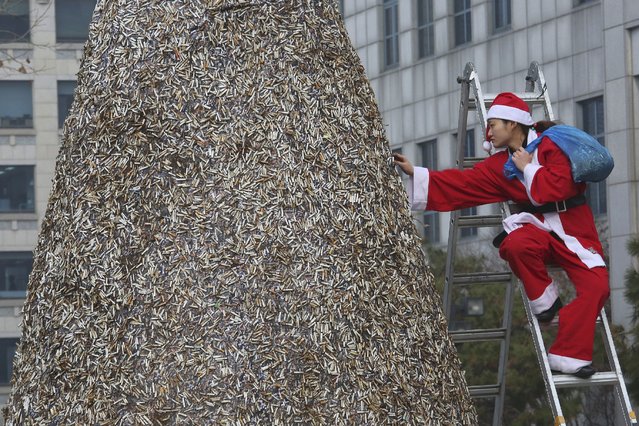
A member of Korean Federation for Environmental Movement in a Santa Claus outfit attaches dumped cigarette butts at a cigarette butt Christmas tree in front of Korea Tobacco & Ginseng Corporation office in Seoul, South Korea, Monday, December 23, 2019. The environmental activist group called for a ban on the use of plastic for cigarette filters as part of efforts to protect the environment from toxic plastic pollution. (Photo by Ahn Young-joon/AP Photo)
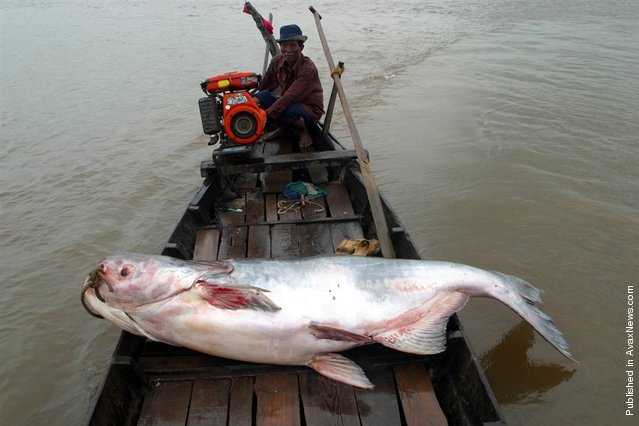
Among the fish populations that could be harmed by the Xayaburi dam in Laos is the critically endangered Mekong giant catfish, considered by the Guinness Book of World Records to be the world’s largest freshwater fish. The fish, which grows to 650 pounds and about 10 feet long, is only found in the Mekong River. It is migratory, moving between downstream habitats in Cambodia upstream to northern Thailand and Laos each year to spawn. Some experts fear the Xayaburi dam could block the migration and drive the giant catfish to extinction. (Photo by Courtesy of Zeb Hogan/University of Nevada, Reno)