Loading...
Done
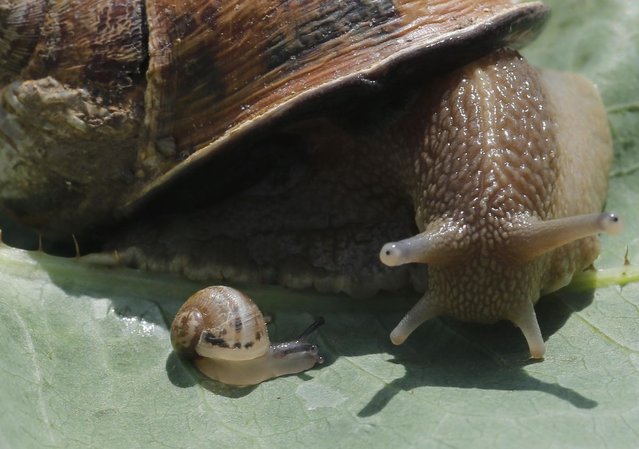
A snail (Helix Aspersa) and a baby snail sit on a leave in a farm in Vienna June 12, 2013. Andreas Gugumuck owns Vienna's largest snail farm, exporting snails, snail-caviar and snail-liver all over the world. The gourmet snails are processed using old traditional cooking techniques and some are sold locally to Austrian gourmet restaurants. (Photo by Leonhard Foeger/Reuters)

A snail (Helix Aspersa) and a baby snail sit on a leave in a farm in Vienna June 12, 2013. Andreas Gugumuck owns Vienna's largest snail farm, exporting snails, snail-caviar and snail-liver all over the world. The gourmet snails are processed using old traditional cooking techniques and some are sold locally to Austrian gourmet restaurants. (Photo by Leonhard Foeger/Reuters)
Details
31 Jul 2013 07:19:00
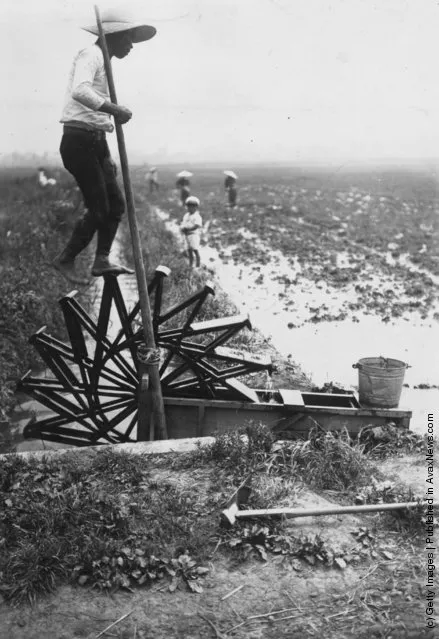
1938: A man irrigating a rice paddy field using a traditional method

A man irrigating a rice paddy field using a traditional method. (Photo by Fox Photos/Getty Images). Japan, circa 1938
Details
09 Oct 2011 14:58:00
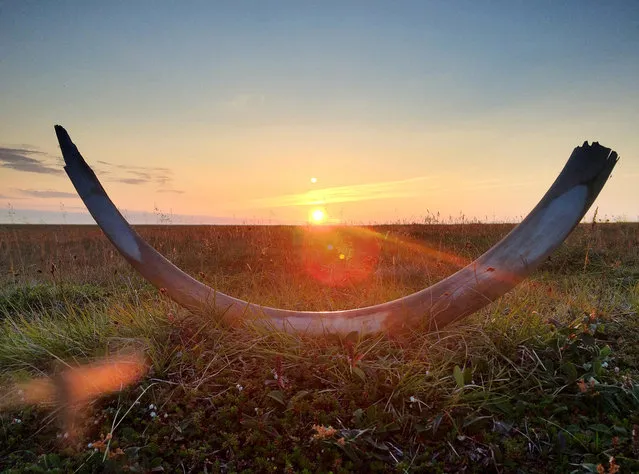
The tusk of a woolly mammoth that lived some 18,000 years ago, from which researchers sequenced the extinct mammal's entire genome, is seen in northeastern Siberia in this photo from 2015. (Photo by Love Dalen/Handout via Reuters)

The tusk of a woolly mammoth that lived some 18,000 years ago, from which researchers sequenced the extinct mammal's entire genome, is seen in northeastern Siberia in this photo from 2015. (Photo by Love Dalen/Handout via Reuters)
Details
09 Jun 2023 02:57:00
Revellers partied the night away in Leeds, UK on September 5, 2020. Leeds has been added to Public Health England's coronavirus "watchlist" and could be hit with lockdown measures after a rise in coronavirus cases in the city. (Photo by NB Press LTD/The Sun)

Revellers partied the night away in Leeds, UK on September 5, 2020. Leeds has been added to Public Health England's coronavirus "watchlist" and could be hit with lockdown measures after a rise in coronavirus cases in the city. (Photo by NB Press LTD/The Sun)
Details
06 Sep 2020 00:07:00
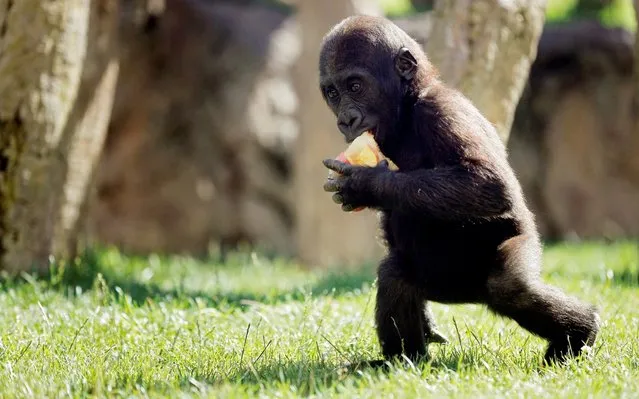
A gorilla cube named Pepe eats frozen fruit to fight high temperatures at the Bioparc zoo in Valencia, eastern Spain, 28 June 2019. Spanish peninsula is suffering a heat wave with temperatures reaching up to 45 degrees. (Photo by Kai Foersterling/EPA/EFE/Rex Features/Shutterstock)

A gorilla cube named Pepe eats frozen fruit to fight high temperatures at the Bioparc zoo in Valencia, eastern Spain, 28 June 2019. Spanish peninsula is suffering a heat wave with temperatures reaching up to 45 degrees. (Photo by Kai Foersterling/EPA/EFE/Rex Features/Shutterstock)
Details
30 Jun 2019 00:03:00
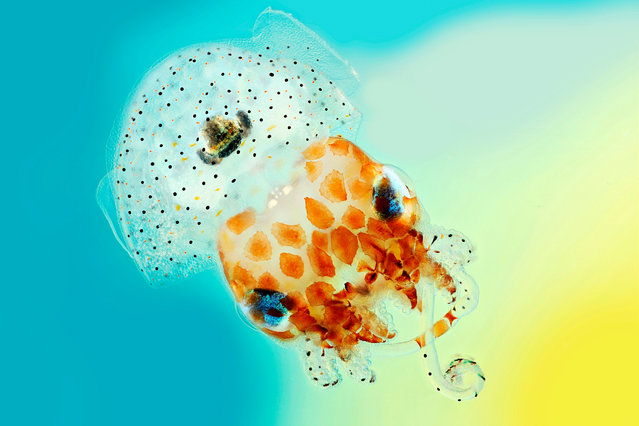
With its huge eyes, comical name and diminutive size, Mark R. Smith’s image of a baby Hawaiian bobtail squid can’t help but raise a smile. A curiously endearing creature, the cephalopod is just 1.5cm across, its mantle cavity bearing more than a passing resemblance to a rather natty shower cap. But it is also a beautiful example of symbiosis – nature’s version of “I’ll scratch your back if you scratch mine” – for on the underside of the squid is a light organ which houses bioluminescent bacteria. The squid offers the bacteria protection and food, while the bacteria emit a glow – a handy trait that the squid uses to offset its silhouette, helping it to evade predators in the depths below. Mark R. Smith’s entry combines several images of a Hawaiian bobtail squid with different focus lengths to create a final picture with greater depth of field than normal. (Photo by Mark R. Smith/Wellcome Images/Macroscopic Solutions)

With its huge eyes, comical name and diminutive size, Mark R. Smith’s image of a baby Hawaiian bobtail squid can’t help but raise a smile. A curiously endearing creature, the cephalopod is just 1.5cm across, its mantle cavity bearing more than a passing resemblance to a rather natty shower cap. But it is also a beautiful example of symbiosis – nature’s version of “I’ll scratch your back if you scratch mine” – for on the underside of the squid is a light organ which houses bioluminescent bacteria. The squid offers the bacteria protection and food, while the bacteria emit a glow – a handy trait that the squid uses to offset its silhouette, helping it to evade predators in the depths below. Mark R. Smith’s entry combines several images of a Hawaiian bobtail squid with different focus lengths to create a final picture with greater depth of field than normal. (Photo by Mark R. Smith/Wellcome Images/Macroscopic Solutions)
Details
08 Mar 2017 00:05:00
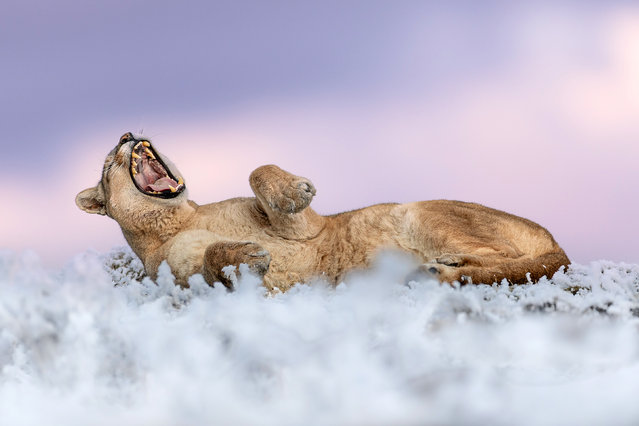
A puma rolls and yawns on frost-covered ground in Laguna Amarga, Torres del Paine, Chile in the first decade of December 2025, pausing briefly after several hours of rest before continuing on her way. (Photo by Sara Jenner/Solent News & Photo Agency)

A puma rolls and yawns on frost-covered ground in Laguna Amarga, Torres del Paine, Chile in the first decade of December 2025, pausing briefly after several hours of rest before continuing on her way. (Photo by Sara Jenner/Solent News & Photo Agency)
Details
21 Dec 2025 10:02:00
The Lun-class Ekranoplane was used by the Soviet Navy starting in 1987, and wasn't retired until the late 1990s, after the Soviet Union's fall. (Igor113)

“The Lun-class ekranoplan (NATO reporting name Duck) was a ground effect vehicle (GEV) designed by Rostislav Evgenievich Alexeev and used by the Soviet and Russian navies from 1987 until sometime in the late 1990s. It “flew” using the lift generated by the ground effect of its large wings when close to the surface of the water – about four metres or less. Although they might look similar and/or have related technical characteristics, ekranoplans like the Lun are not aircraft, seaplanes, hovercraft, or hydrofoils – ground effect is a separate technology altogether. The International Maritime Organization classifies these vehicles as maritime ships. The name Lun comes from the Russian for harrier”. – Wikipedia (Photo by Igor113)
Details
08 Aug 2014 10:51:00