Loading...
Done
In this November 20, 2017 photo, Indian kushti wrestlers fight in the ring, during their daily training at an akhada, a kind of wrestling hostel at Sabzi Mandi, in New Delhi, India. (Photo by Dar Yasin/AP Photo)

In this November 20, 2017 photo, Indian kushti wrestlers fight in the ring, during their daily training at an akhada, a kind of wrestling hostel at Sabzi Mandi, in New Delhi, India. Like many traditions in rapidly modernizing India, kushti wrestling faces the threat of being left behind. But for many poor families, the ancient sport provides a glimmer of hope. (Photo by Dar Yasin/AP Photo)
Details
13 Dec 2017 07:35:00
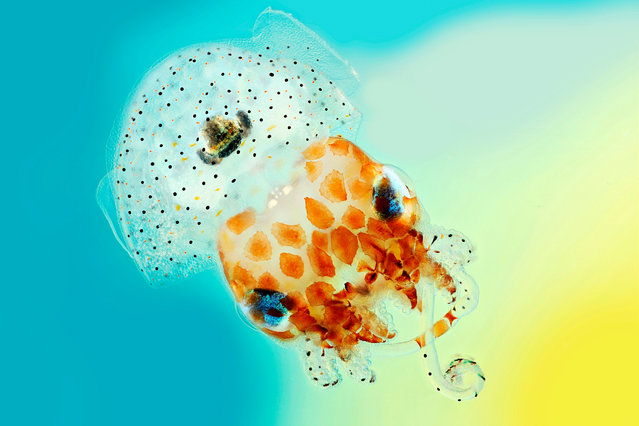
With its huge eyes, comical name and diminutive size, Mark R. Smith’s image of a baby Hawaiian bobtail squid can’t help but raise a smile. A curiously endearing creature, the cephalopod is just 1.5cm across, its mantle cavity bearing more than a passing resemblance to a rather natty shower cap. But it is also a beautiful example of symbiosis – nature’s version of “I’ll scratch your back if you scratch mine” – for on the underside of the squid is a light organ which houses bioluminescent bacteria. The squid offers the bacteria protection and food, while the bacteria emit a glow – a handy trait that the squid uses to offset its silhouette, helping it to evade predators in the depths below. Mark R. Smith’s entry combines several images of a Hawaiian bobtail squid with different focus lengths to create a final picture with greater depth of field than normal. (Photo by Mark R. Smith/Wellcome Images/Macroscopic Solutions)

With its huge eyes, comical name and diminutive size, Mark R. Smith’s image of a baby Hawaiian bobtail squid can’t help but raise a smile. A curiously endearing creature, the cephalopod is just 1.5cm across, its mantle cavity bearing more than a passing resemblance to a rather natty shower cap. But it is also a beautiful example of symbiosis – nature’s version of “I’ll scratch your back if you scratch mine” – for on the underside of the squid is a light organ which houses bioluminescent bacteria. The squid offers the bacteria protection and food, while the bacteria emit a glow – a handy trait that the squid uses to offset its silhouette, helping it to evade predators in the depths below. Mark R. Smith’s entry combines several images of a Hawaiian bobtail squid with different focus lengths to create a final picture with greater depth of field than normal. (Photo by Mark R. Smith/Wellcome Images/Macroscopic Solutions)
Details
08 Mar 2017 00:05:00
In this Thursday, April 13, 2017, picture entertainers wearing rabbit costumes speak at a fair in Bucharest, Romania. Ahead of Easter, celebrated by both Orthodox and Catholic believers on April 16 processions of priests clad in golden robes carrying foliage on Palm Sunday in a recreation of Jesus' ride into Jerusalem, mixed with more commercial flavored celebrations like an Easter fair outside the giant palace built by late Communist leader Nicolae Ceausescu where entertainers strutted around wearing giant rabbit heads. (Photo by Vadim Ghirda/AP Photo)

In this Thursday, April 13, 2017, picture entertainers wearing rabbit costumes speak at a fair in Bucharest, Romania. Ahead of Easter, celebrated by both Orthodox and Catholic believers on April 16 processions of priests clad in golden robes carrying foliage on Palm Sunday in a recreation of Jesus' ride into Jerusalem, mixed with more commercial flavored celebrations like an Easter fair outside the giant palace built by late Communist leader Nicolae Ceausescu where entertainers strutted around wearing giant rabbit heads. (Photo by Vadim Ghirda/AP Photo)
Details
17 Apr 2017 08:01:00
A bus goes through a flooded street in Wuhan, Hubei province, China July 6, 2016. (Photo by Reuters/China Daily)

A bus goes through a flooded street in Wuhan, Hubei province, China July 6, 2016. (Photo by Reuters/China Daily)
Details
11 Jul 2016 12:29:00
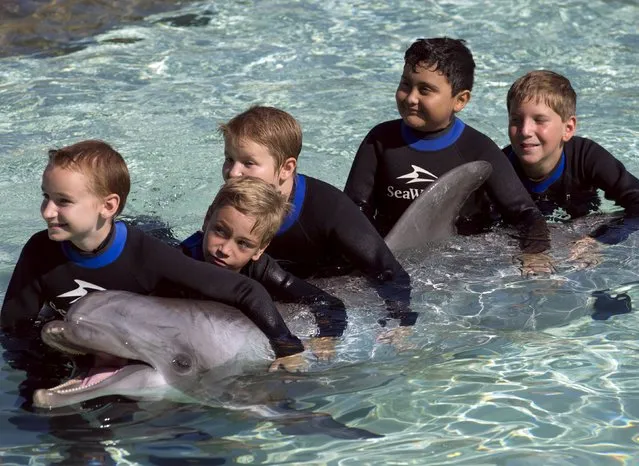
Patients from Rady Children's Hospital hug a bottlenose dolphin after being invited to swim and interact with dolphins at Sea World in San Diego, California  August 27, 2015. (Photo by Mike Blake/Reuters)

Patients from Rady Children's Hospital hug a bottlenose dolphin after being invited to swim and interact with dolphins at Sea World in San Diego, California August 27, 2015. Sea World has hosted Dolphin Interaction Program for seven years. It was started by dolphin trainer Joy Soto who battled and overcame non-Hodgkin’s lymphoma. (Photo by Mike Blake/Reuters)
Details
28 Aug 2015 12:19:00
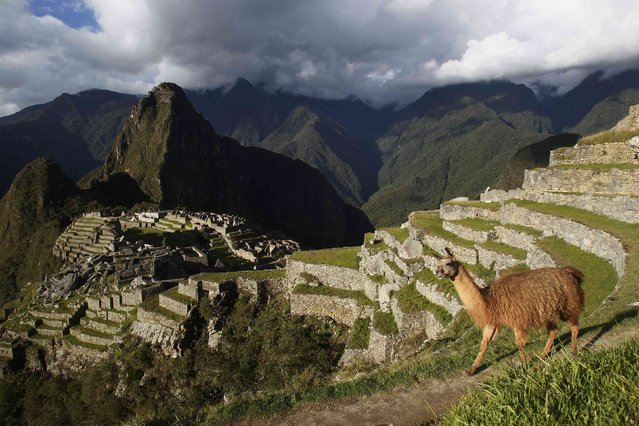
An alpaca is seen near the Inca citadel of Machu Picchu in Cusco December 2, 2014. Machu Picchu, a UNESCO World Heritage Site, is Peru's top tourist attraction, with the government limiting tourists to 2,500 per day due to safety reasons and concerns over the preservation of the ruins. (Photo by Enrique Castro-Mendivil/Reuters)

An alpaca is seen near the Inca citadel of Machu Picchu in Cusco December 2, 2014. Machu Picchu, a UNESCO World Heritage Site, is Peru's top tourist attraction, with the government limiting tourists to 2,500 per day due to safety reasons and concerns over the preservation of the ruins. (Photo by Enrique Castro-Mendivil/Reuters)
Details
04 Dec 2014 11:24:00
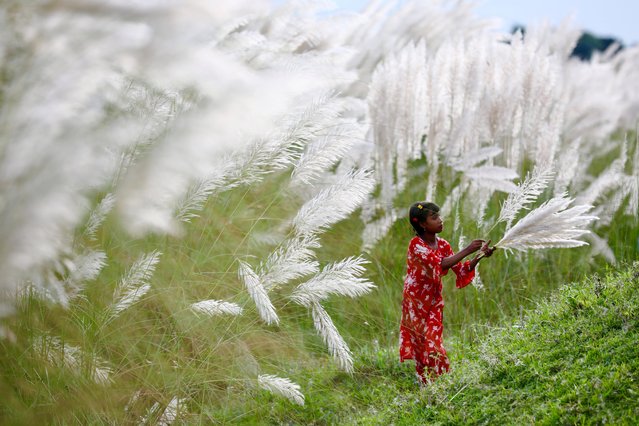
A girl picks catkins at a field amid the COVID-19 pandemic in Sarighat, on the outskirts of Dhaka, Bangladesh, October 2, 2020. (Photo by Mohammad Ponir Hossain/Reuters)

A girl picks catkins at a field amid the COVID-19 pandemic in Sarighat, on the outskirts of Dhaka, Bangladesh, October 2, 2020. (Photo by Mohammad Ponir Hossain/Reuters)
Details
16 Oct 2020 00:05:00
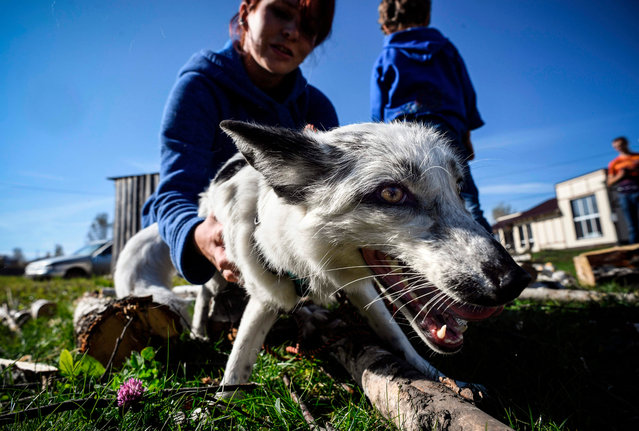
Tatyana Abramova, 33, plays with her home fox Plombir at her countryside house outside Siberian city of Novosibirsk on September 12, 2020. The official start of the Soviet experiment to better understand the domestication of animals by humans began in 1959, and was initiated by geneticists Dmitri Beliaiev and Lioudmila Trout on a farm in Akademgorodok, the scientific center of excellence in Siberia. Their primary objective was to domesticate foxes, to understand how the ancestor of wolves, another canine, evolved into a loyal and loving dog. And understand what this domestication tells us about the genetic evolution of species. (Photo by Alexander Nemenov/AFP Photo)

Tatyana Abramova, 33, plays with her home fox Plombir at her countryside house outside Siberian city of Novosibirsk on September 12, 2020. The official start of the Soviet experiment to better understand the domestication of animals by humans began in 1959, and was initiated by geneticists Dmitri Beliaiev and Lioudmila Trout on a farm in Akademgorodok, the scientific center of excellence in Siberia. Their primary objective was to domesticate foxes, to understand how the ancestor of wolves, another canine, evolved into a loyal and loving dog. And understand what this domestication tells us about the genetic evolution of species. (Photo by Alexander Nemenov/AFP Photo)
Details
25 Oct 2020 00:05:00