Loading...
Done
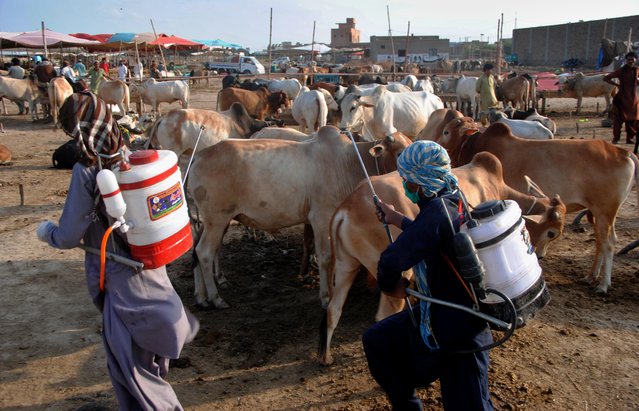
Health workers wearing face masks spray disinfectant liquid on sacrificial animals amid concerns over the spread of the SARS-CoV-2 coronavirus that causes the pandemic COVID-19 disease ahead of the Muslim festival of Eid al-Adha at an animal market in Hyderabad, southern Pakistan, 21 July 2020. Eid al-Adha, also known as the Festival of the Sacrifice, is the second and holiest of the two main Islamic holidays celebrated each year (the other one being Eid al-Fitr). Every year, on the 10th day of the Islamic lunar month of Dhu al-Hijjah, Muslims around the world ritually slaughter a sacrificial animal and split the meat into three parts: one is reserved for the family, another for friends and relatives, and the third is given to the poor and needy. The Saudi Supreme Court has declared that the first day of Eid al-Adha this year falls on 31 July. (Photo by Nadeem Khawar/EPA/EFE)

Health workers wearing face masks spray disinfectant liquid on sacrificial animals amid concerns over the spread of the SARS-CoV-2 coronavirus that causes the pandemic COVID-19 disease ahead of the Muslim festival of Eid al-Adha at an animal market in Hyderabad, southern Pakistan, 21 July 2020. (Photo by Nadeem Khawar/EPA/EFE)
Details
23 Jul 2020 00:07:00
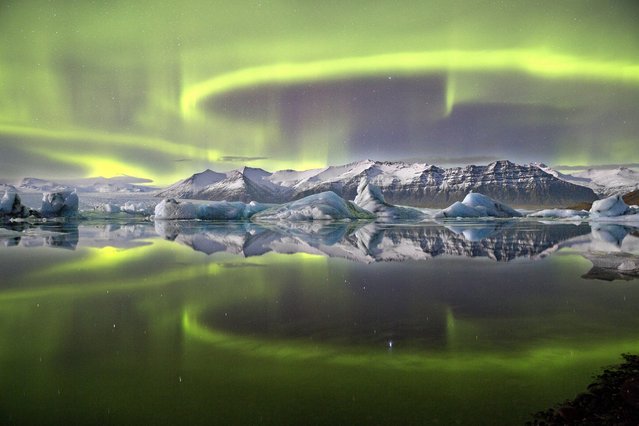
“Aurora over a glacier lagoon”. A vivid green overheaded aurrora pictured in Iceland's Vatnajokull National Park reflected almost symetrically in Jokulsrlon Glacier lagoon. A complete lack of wind and currrent combin in this sheltred lagoon scene to crete an arresting mirror effect giving the image a sensation of utter stillness. Despite theis there is motion on a suprising scale, as the loops and arcs of the aurora are shaped by the shifting forces of the Earth's magnetic field. (Photo by  James Woodend/The Astronomy Photographer of the Year 2014 Contest)

“Aurora over a glacier lagoon”. A vivid green overheaded aurrora pictured in Iceland's Vatnajokull National Park reflected almost symetrically in Jokulsrlon Glacier lagoon. A complete lack of wind and currrent combin in this sheltred lagoon scene to crete an arresting mirror effect giving the image a sensation of utter stillness. Despite theis there is motion on a suprising scale, as the loops and arcs of the aurora are shaped by the shifting forces of the Earth's magnetic field. James Woodend of Great Britain won the grand prize with the image, beating out more than 2,500 other entries. The Astronomy Photographer of the Year 2014 contest is judged by the Royal Observatory Greenwich and BBC Sky at Night magazine. (Photo by James Woodend/The Astronomy Photographer of the Year 2014 Contest)
Details
26 Sep 2014 13:39:00
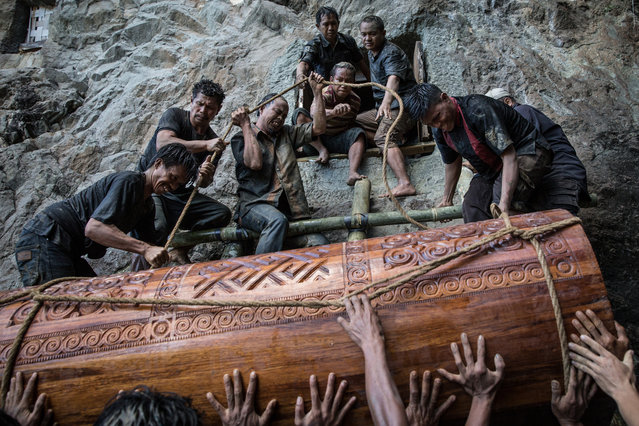
It is said that Torajans are people who “live to die”. For this Indonesian ethnic group, funerals are such extravagant events that they sometimes attract tourists. Families can postpone burials years (and the deceased are considered sick and hosted at home until the funeral) until the family can raise enough money and gather as many relatives as possible. And then it’s a jubilant multiday social event with a parade, dances and animal sacrifices. Agung Parameswara photographed these funerary practices when he traveled to South Sulawesi province, where the Torajans live. But often, their funeral isn’t the last time the dead are seen. In August, crypts are opened, coffins are slid back out and bodies delicately unsheathed. This tender ritual is known as Ma’Nene, which is customarily performed every few years. (Photo by Agung Parameswara/The Washington Post)

It is said that Torajans are people who “live to die”. For this Indonesian ethnic group, funerals are such extravagant events that they sometimes attract tourists. Families can postpone burials years (and the deceased are considered sick and hosted at home until the funeral) until the family can raise enough money and gather as many relatives as possible. And then it’s a jubilant multiday social event with a parade, dances and animal sacrifices. Agung Parameswara photographed these funerary practices when he traveled to South Sulawesi province, where the Torajans live. (Photo by Agung Parameswara/The Washington Post)
Details
06 Oct 2016 09:15:00
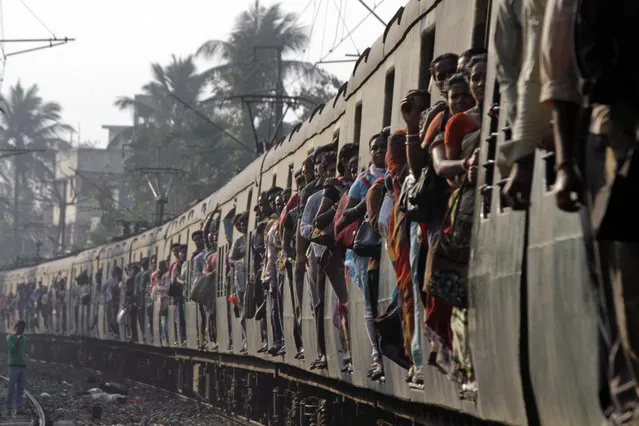
Indian commuters travel in a local train in Kolkata, India, Tuesday, Feb. 26, 2013. Indian Railway Minister Pawan Kumar Bansal is presenting the country's rail budget for next fiscal year in the parliament Tuesday, Feb. 26, 2013. Indian railway network is one of the world's largest, with some 14 million passengers daily and some 64,000 kilometers (40,000 miles) of railway track cut through some of the most densely populated cities. (Photo by Bikas Das/AP Photo)

Indian commuters travel in a local train in Kolkata, India, Tuesday, February 26, 2013. Indian Railway Minister Pawan Kumar Bansal is presenting the country's rail budget for next fiscal year in the parliament Tuesday, Feb. 26, 2013. Indian railway network is one of the world's largest, with some 14 million passengers daily and some 64,000 kilometers (40,000 miles) of railway track cut through some of the most densely populated cities. (Photo by Bikas Das/AP Photo)
Details
05 Mar 2013 12:57:00
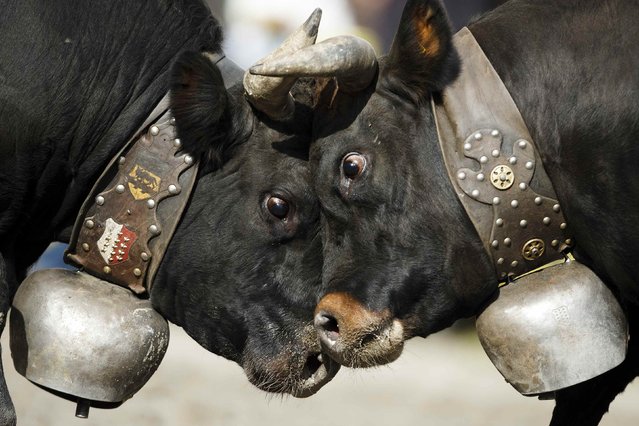
Two Herens cows lock horns during the qualification round of the annual “Battle of the Queens” cow fight finals in Aproz, in the western Alpine canton of Valais May 5, 2013. Each year when taken to the alpine pastures, the cows test their strength and fight for the herd's leadership. The competition continues until a new queen has forced all the other cows to retreat. (Photo by Valentin Flauraud/Reuters)

Two Herens cows lock horns during the qualification round of the annual “Battle of the Queens” cow fight finals in Aproz, in the western Alpine canton of Valais May 5, 2013. Each year when taken to the alpine pastures, the cows test their strength and fight for the herd's leadership. The competition continues until a new queen has forced all the other cows to retreat. (Photo by Valentin Flauraud/Reuters)
Details
06 May 2013 12:33:00
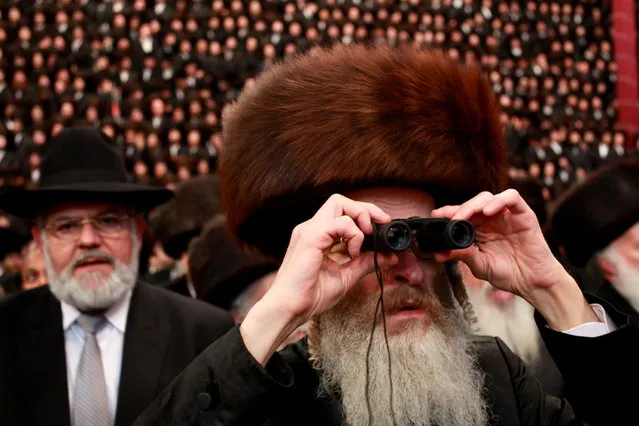
Ultra-orthodox Jewish wedding in Israel. Tens of thousands of Ultra-Orthodox Jews of the Belz Hasidic dynasty gather at the wedding ceremony of Rabbi Shalom Rokach in Kiryat Belz, in Jerusalem, on May 22, 2013. Around 25,000 ultra-orthodox Jews took part, making it one of the biggest weddings of the past few years. (Photo by Gil Cohen)

“Coming back home at 5am sunrise, I was just beginning to digest the grand event I was lucky to witness and cover: the wedding of the grandson of one of the most influential spiritual leaders in Israel’s ultra-Orthodox community...”. – Ronen Zvulun via Reuters. Photo: Ultra-orthodox Jewish wedding in Israel. Tens of thousands of Ultra-Orthodox Jews of the Belz Hasidic dynasty gather at the wedding ceremony of Rabbi Shalom Rokach in Kiryat Belz, in Jerusalem, on May 21, 2013. Around 25,000 ultra-orthodox Jews took part, making it one of the biggest weddings of the past few years. (Photo by Gil Cohen)
Details
24 May 2013 08:02:00
A Loggerhead sea turtle named Gal Handless is moved into a large case at the rescue center for sea turtles as it is transferred to the Istanbul Aquarium on May 29, 2013 in Michmoret, Israel. The turtle was rescued after losing her front fins when caught in a fishing net in 2004. She was rehabilitated at the rescue center but could not be returned back to the sea and now after 9 years she is being transferred to her new home at the Istanbul Aquarium in Turkey.   (Photo by Uriel Sinai)

A Loggerhead sea turtle named Gal Handless is moved into a large case at the rescue center for sea turtles as it is transferred to the Istanbul Aquarium on May 29, 2013 in Michmoret, Israel. The turtle was rescued after losing her front fins when caught in a fishing net in 2004. She was rehabilitated at the rescue center but could not be returned back to the sea and now after 9 years she is being transferred to her new home at the Istanbul Aquarium in Turkey. (Photo by Uriel Sinai)
Details
30 May 2013 11:01:00
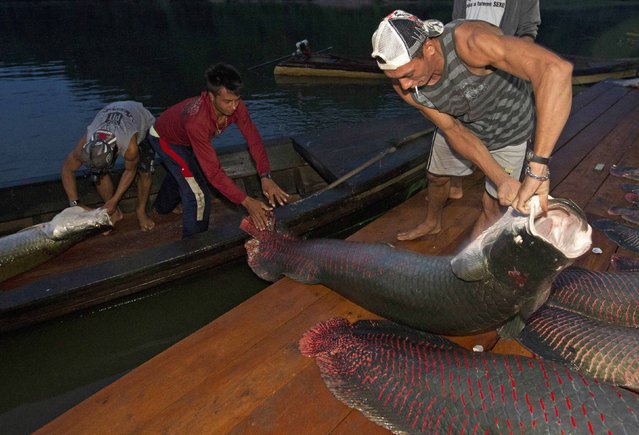
Villagers from the Medio Jurua nature reserve of Brazil's Amazon rainforest arrive with their catch of pirarucus, the largest freshwater fish in South America, after a night of fishing in Manaria Lake, Carauari municipality, September 3, 2012. Catching the pirarucu, a fish that is sought after for its meat and is considered by biologists to be a living fossil, is only allowed once a year by Brazil's environmental protection agency. (Photo by Bruno Kelly/Reuters)

Villagers from the Medio Jurua nature reserve of Brazil's Amazon rainforest arrive with their catch of pirarucus, the largest freshwater fish in South America, after a night of fishing in Manaria Lake, Carauari municipality, September 3, 2012. Catching the pirarucu, a fish that is sought after for its meat and is considered by biologists to be a living fossil, is only allowed once a year by Brazil's environmental protection agency. (Photo by Bruno Kelly/Reuters)
Details
19 Jul 2013 08:53:00