Loading...
Done


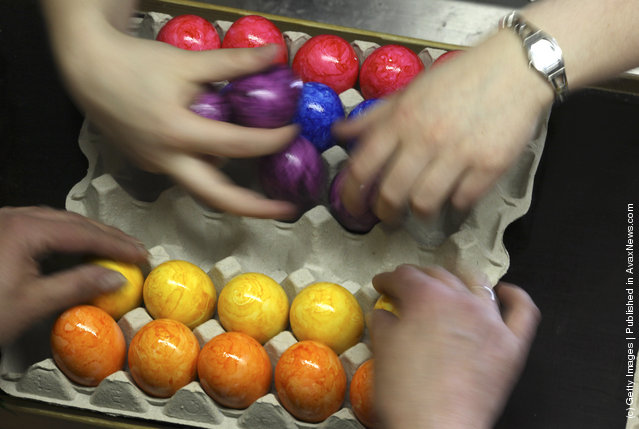
Workers sort freshly-painted Easter eggs at the Lueck poultry farm on April 7, 2011 in Sommerkahl near Aschaffenburg, Germany. The farm is currently working 24-hour shifts to meet demand for its brightly-coloured eggs two weeks before Easter. (Photo by Ralph Orlowski/Getty Images)
Details
10 Apr 2011 11:46:00
Employees conduct a final check to fix any cavities in the seams of balls inside the soccer ball factory that produces official match balls for the 2014 World Cup in Brazil, in Sialkot, Punjab province May 16, 2014. (Photo by Sara Farid/Reuters)

Employees conduct a final check to fix any cavities in the seams of balls inside the soccer ball factory that produces official match balls for the 2014 World Cup in Brazil, in Sialkot, Punjab province May 16, 2014. It was when he felt the roar of the crowd at the 2006 World Cup in Germany that Pakistani factory owner Khawaja Akhtar first dreamt up a goal of his own: to manufacture the ball for the biggest soccer tournament on the planet. Last year he finally got his chance – but only 33 days to make it happen. (Photo by Sara Farid/Reuters)
Details
26 May 2014 13:59:00
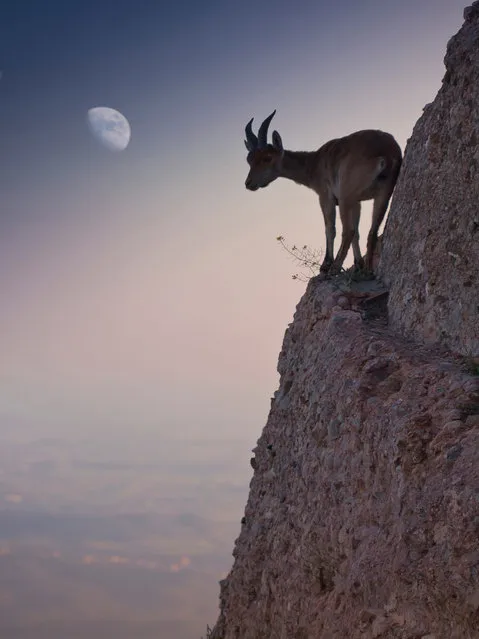
“For a bouquet of flowers”. Photographs made ​​in the last hours of the day. A goat is directed by a dangerous way to eat a small bouquet of flowers. Location: España, Barcelona, Montserrat. (Photo and caption by Renato Lopez Baldo/National Geographic Traveler Photo Contest)

“For a bouquet of flowers”. Photographs made ​​in the last hours of the day. A goat is directed by a dangerous way to eat a small bouquet of flowers. Location: España, Barcelona, Montserrat. (Photo and caption by Renato Lopez Baldo/National Geographic Traveler Photo Contest)

ATTENTION! All pictures are presented in high resolution. To see Hi-Res images – just TWICE click on any picture. In other words, click small picture – opens the BIG picture. Click BIG picture – opens VERY BIG picture.

Details
25 Jun 2013 12:51:00
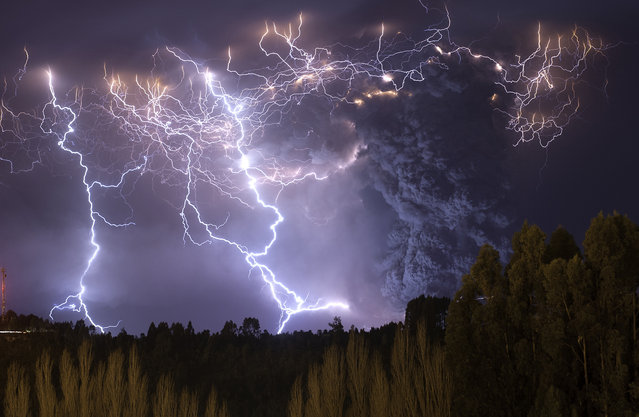
The eruption of Cordon Caulle began on June 4, 2011, located in the Region of Los Rios in Chile. For about 12 months, people and animals became accustomed to living with the daily fall of ash, which also caused problems in the air traffic in South America. The explosions and lightning during first days of the eruption could be seen from hundreds of miles around. This photograph was taken on the second night of eruption from the town of Lago Ranco. (Photo and caption by Francisco Negroni/National Geographic Traveler Photo Contest)

The eruption of Cordon Caulle began on June 4, 2011, located in the Region of Los Rios in Chile. For about 12 months, people and animals became accustomed to living with the daily fall of ash, which also caused problems in the air traffic in South America. The explosions and lightning during first days of the eruption could be seen from hundreds of miles around. This photograph was taken on the second night of eruption from the town of Lago Ranco. (Photo and caption by Francisco Negroni/National Geographic Traveler Photo Contest)

ATTENTION! All pictures are presented in high resolution. To see Hi-Res images – just TWICE click on any picture. In other words, click small picture – opens the BIG picture. Click BIG picture – opens VERY BIG picture.
Details
23 Jun 2013 11:24:00
“Stacked Supercell with Lightning”. This huge mesocyclone supercell was near the Nebraska / Kansas border on the night of June 22nd, 2012. What a stunning structure! (Photo and caption by Jennifer Brindley/National Geographic Traveler Photo Contest)

“Stacked Supercell with Lightning”. This huge mesocyclone supercell was near the Nebraska / Kansas border on the night of June 22nd, 2012. What a stunning structure! (Photo and caption by Jennifer Brindley/National Geographic Traveler Photo Contest)

ATTENTION! All pictures are presented in high resolution. To see Hi-Res images – just TWICE click on any picture. In other words, click small picture – opens the BIG picture. Click BIG picture – opens VERY BIG picture.

Details
25 Jun 2013 13:12:00
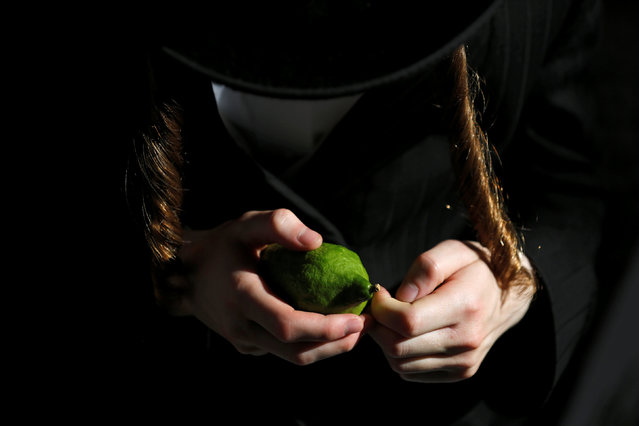
An ultra-Orthodox Jewish man inspects an etrog, citrus fruit used in rituals during the upcoming Jewish holiday of Sukkot in Jerusalem's Mea Shearim neighbourhood, October 13, 2016. (Photo by Amir Cohen/Reuters)

An ultra-Orthodox Jewish man inspects an etrog, citrus fruit used in rituals during the upcoming Jewish holiday of Sukkot in Jerusalem's Mea Shearim neighbourhood, October 13, 2016. (Photo by Amir Cohen/Reuters)
Details
14 Oct 2016 12:02:00
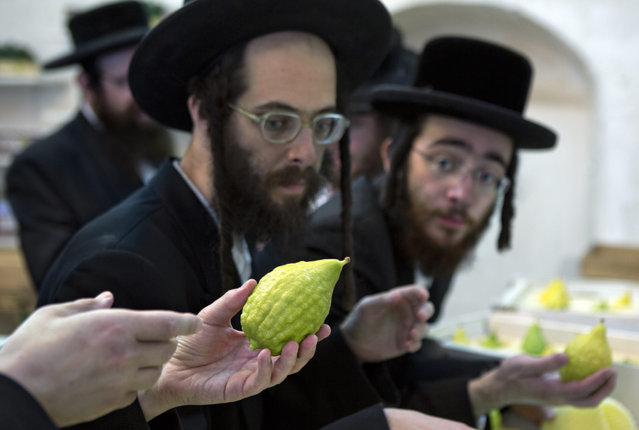
Ultra-Orthodox Jews inspect etrogs, or citrons, inside a shop in the Mea Shearim neighbourhood in Jerusalem, 07 October 2014, as they look to purchase an unblemished fruit ahead of the holiday of Sukkot. (Photo by Jim Hollander/EPA)

Ultra-Orthodox Jews inspect etrogs, or citrons, inside a shop in the Mea Shearim neighbourhood in Jerusalem, 07 October 2014, as they look to purchase an unblemished fruit ahead of the holiday of Sukkot. (Photo by Jim Hollander/EPA)
Details
08 Oct 2014 12:16:00
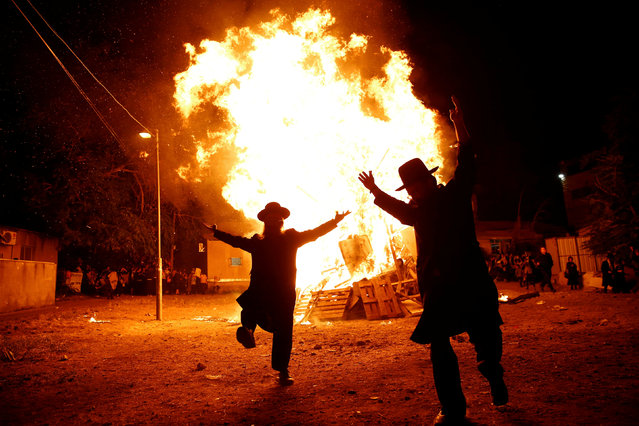
Ultra-Orthodox Jews dance next to a bonfire during celebrations for the Jewish holiday of Lag Ba-Omer in Jerusalem's Mea Shearim neighbourhood May 25, 2016. (Photo by Ronen Zvulun/Reuters)

Ultra-Orthodox Jews dance next to a bonfire during celebrations for the Jewish holiday of Lag Ba-Omer in Jerusalem's Mea Shearim neighbourhood May 25, 2016. This day marks the hillula (celebration, interpreted by some as anniversary of death) of Rabbi Shimon bar Yochai, a Mishnaic sage and leading disciple of Rabbi Akiva in the 2nd century, and the day on which he revealed the deepest secrets of kabbalah in the form of the Zohar (Book of Splendor), a landmark text of Jewish mysticism. (Photo by Ronen Zvulun/Reuters)
Details
26 May 2016 12:54:00