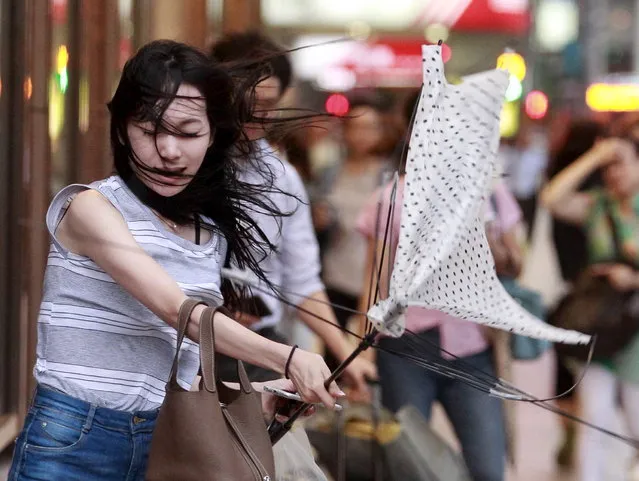
A woman holds her umbrella while walking against strong winds as Typhoon Soudelor approaches Taiwan in Taipei, August 7, 2015. (Photo by Pichi Chuang/Reuters)
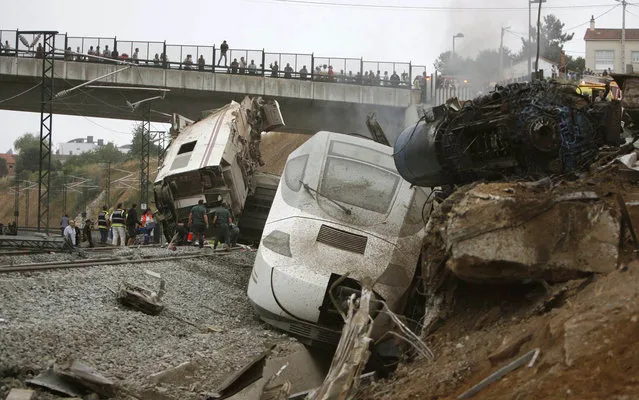
Emergency personnel respond to the scene of a train derailment in Santiago de Compostela, Spain, on Wednesday, July 24, 2013. A train derailed in northwestern Spain on Wednesday night, toppling passenger cars on their sides and leaving at least one torn open as smoke rose into the air. Dozens were feared dead, with possibly even more injured. (Photo by Antonio Hernandez/AP Photo/El correo Gallego)
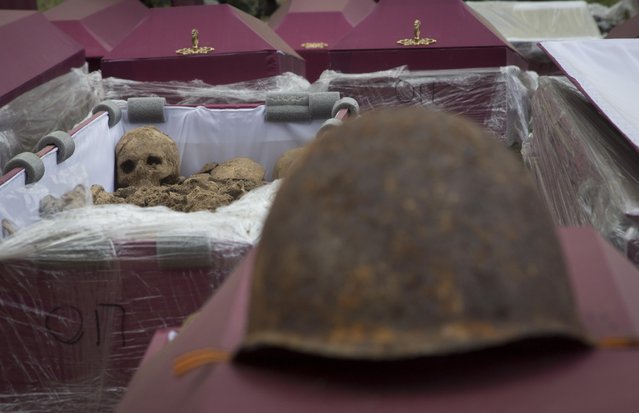
In this photo taken Thursday, May 7, 2015 photo, remains of Soviet soldiers killed during World War II lay in a coffin prior to a reburial ceremony at the Sinyavino Heights memorial near the village of Sinyavino, 50 km (31 miles) east of St. Petersburg, Russia. Hundreds of people came to a World War II battleground outside St. Petersburg this week to bury the remains of 964 Soviet soldiers recovered by volunteer search teams. Fifty crimson coffins containing skulls and bones were solemnly buried at the Sinyavino Heights memorial as Russian war songs played and an honor guard fired a salute. (Photo by Dmitry Lovetsky/AP Photo)
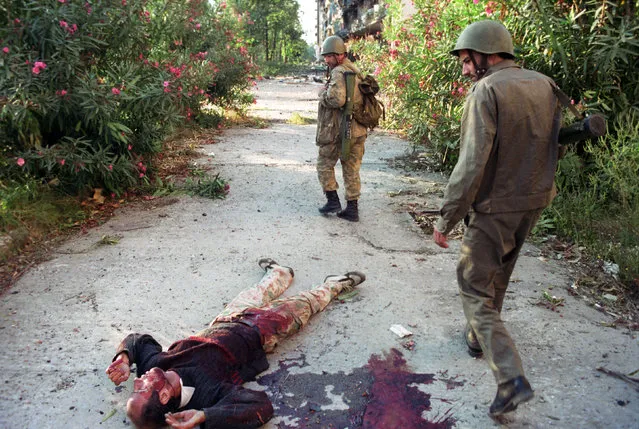
The War in Abkhazia from 1992 to 1993 was fought between Georgian government forces for the most part, and Abkhaz separatist forces, Russian armed forces and North Caucasian militants. Ethnic Georgians who lived in Abkhazia fought largely on the side of Georgian government forces. Ethnic Armenians and Russians within Abkhazia's population largely supported the Abkhazians, and many fought on their side. The separatists received support from thousands of North Caucasus and Cossack militants and from the Russian Federation forces stationed in and near Abkhazia. Here: Abkhazia. Sukhumi, 1993. A house-to-house combat. (Photo by Andrei Solovyov/ITAR-TASS)
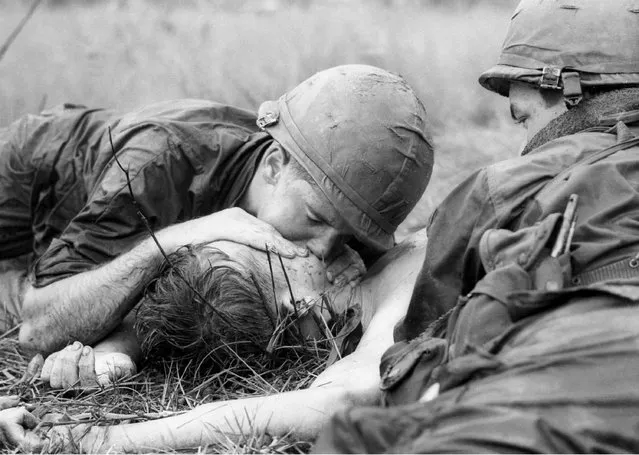
Medic James E. Callahan of Pittsfield, Mass., gives mouth-to-mouth resuscitation to a dying soldier in war zone D, about 50 miles northeast of Saigon, June 17, 1967. Thirty-one men of the 1st Infantry Division were reported killed in the guerrilla ambush, with more than 100 wounded. (Photo by Henri Huet/AP Photo)
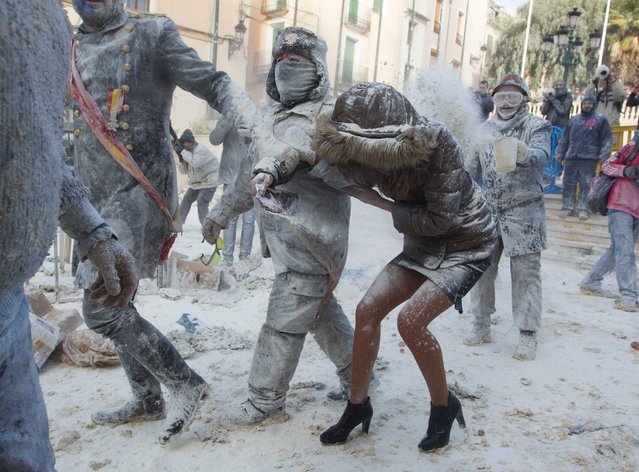
Revellers dressed in mock military garb take part in the “Els Enfarinats” battle in the southeastern Spanish town of Ibi on December 28, 2017. During this 200-year-old traditional festival participants known as Els Enfarinats (those covered in flour) dress in military clothes and stage a mock coup d'etat as they battle using flour, eggs and firecrackers outside the town hall as part of the celebrations of the Day of the Innocents. (Photo by Jaime Reina/AFP Photo)
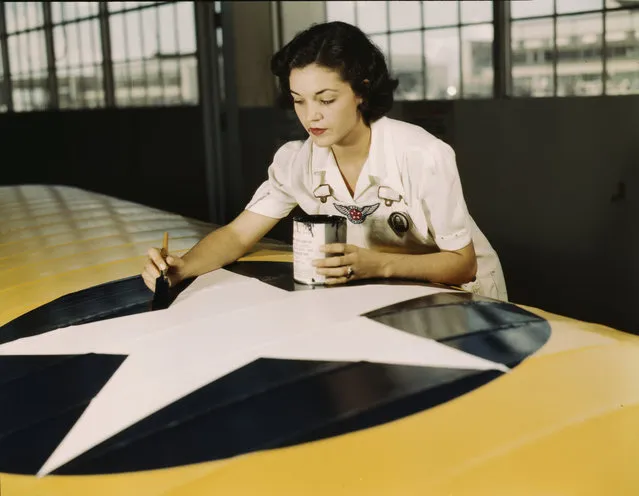
These stunning color portraits, produced by the U.S. Office of War Information during World War II depict the role of women in the US war effort. All of the images were shot on 4x5 color transparency film by Howard R. Hollem and Alfred T. Palmer during 1942 and 1943 and were turned over to the Library of Congress Prints and Photographs Division in 1944. They are seen here with their original captions.