Loading...
Done


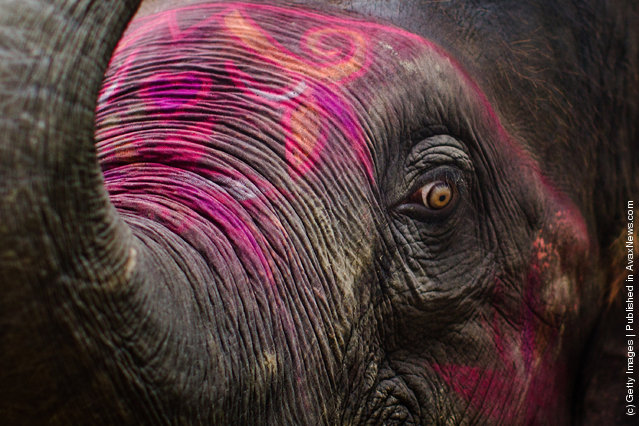
SONEPUR, INDIA - NOVEMBER 15: An elephant is painted in decorative colours during the Sonepur Mela on November 15, 2011 in Sonepur near Patna, India. The cattle fair, held in the Indian state of Bihar, has its origins during ancient times, when people traded elephants and horses across the auspicious river Ganges. The mela used to attract traders from places as distant as Central Asia. It is one of Asia's largest cattle fairs and lasts for a fortnight. (Photo by Daniel Berehulak/Getty Images)
Details
16 Nov 2011 02:42:00
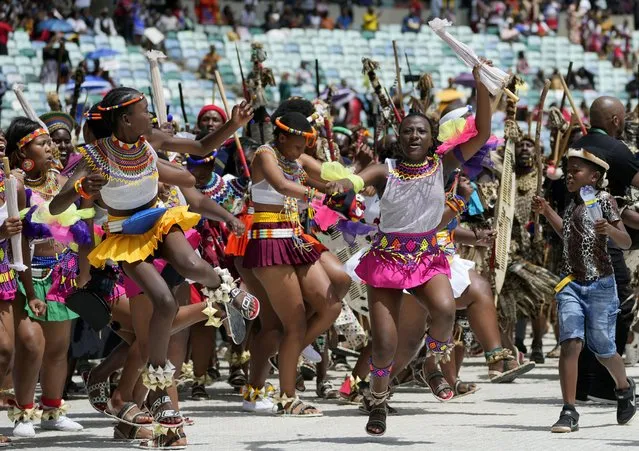
Zulu maidens sings and dance as they arrive for the coronation event, at the Moses Mabhida Stadium in Durban, South Africa, Saturday, October 29, 2022. South Africa President Cyril Ramaphosa on behalf of the government formally presented a certificate of recognition to His Majesty King MisuZulu ka Zwelithini of the AmaZulu. (Photo by Themba Hadebe/AP Photo)

Zulu maidens sings and dance as they arrive for the coronation event, at the Moses Mabhida Stadium in Durban, South Africa, Saturday, October 29, 2022. South Africa President Cyril Ramaphosa on behalf of the government formally presented a certificate of recognition to His Majesty King MisuZulu ka Zwelithini of the AmaZulu. (Photo by Themba Hadebe/AP Photo)
Details
10 Nov 2022 05:30:00
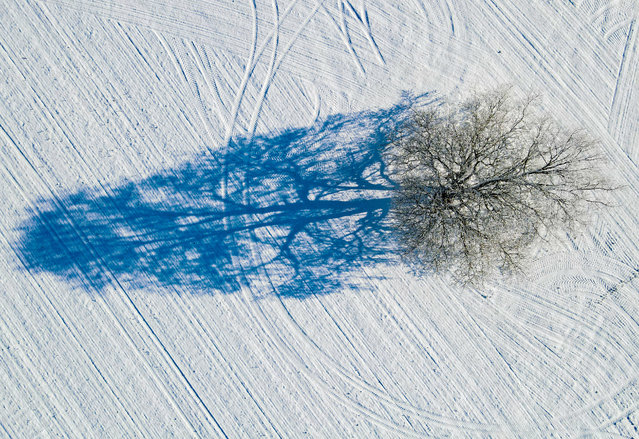
A tree covered with hoarfrost casts a shadow on a snowy field, shot with a drone in Sieversdorf-Hohenofen, Germany on January 31, 2021. (Photo by Patrick Pleul/dpa)

A tree covered with hoarfrost casts a shadow on a snowy field, shot with a drone in Sieversdorf-Hohenofen, Germany on January 31, 2021. (Photo by Patrick Pleul/dpa)
Details
04 Mar 2021 08:35:00
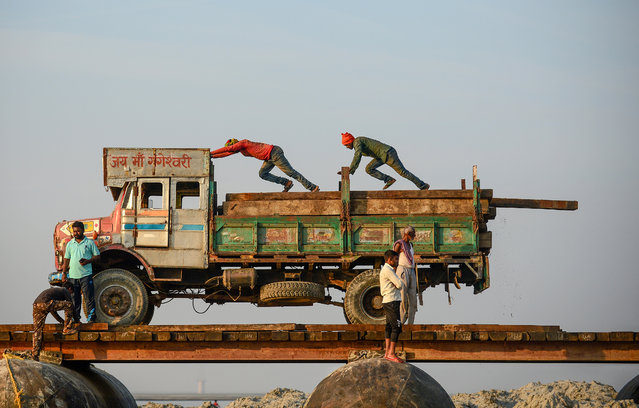
Labourers push wooden boards before carrying them to construct a temporary pontoon bridge over the Ganges river for the upcoming Hindu festival of Magh Mela in Allahabad on November 24, 2019. The Magh Mela is held every year on the banks of Triveni Sangam – the confluence of the three great rivers Ganga, Yamuna and the mystical Saraswati – in Allahabad during the Hindu month of Magh which corresponds to mid January – mid February. (Photo by Sanjay Kanojia/AFP Photo)

Labourers push wooden boards before carrying them to construct a temporary pontoon bridge over the Ganges river for the upcoming Hindu festival of Magh Mela in Allahabad on November 24, 2019. The Magh Mela is held every year on the banks of Triveni Sangam – the confluence of the three great rivers Ganga, Yamuna and the mystical Saraswati – in Allahabad during the Hindu month of Magh which corresponds to mid January – mid February. (Photo by Sanjay Kanojia/AFP Photo)
Details
02 Dec 2019 00:03:00
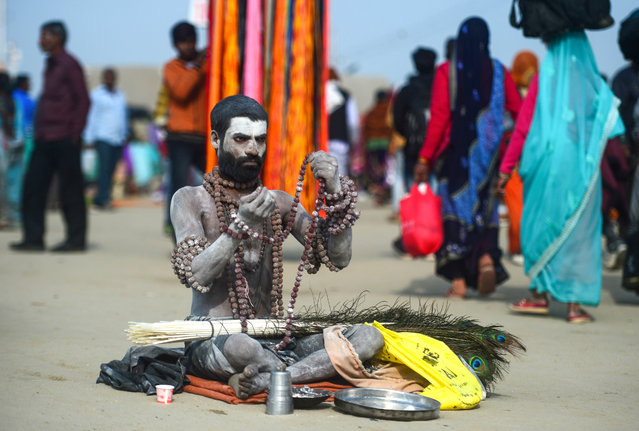
An Indian sadhu (Hindu holy man) sits on the banks of Sangam – the confluence of the Ganges, Yamuna and mythical Saraswati rivers – on the auspicious bathing day of 'Maghi Purnima' during the Kumbh Mela festival in Allahabad on February 19, 2019. Millions of Hindu pilgrims took the plunge in holy rivers on the most auspicious bathing days of the Kumbh Mela festival, led by naked, ash-smeared holy men and accompanied by chants from Hindu holy texts. (Photo by Sanjay Kanojia/AFP Photo)

An Indian sadhu (Hindu holy man) sits on the banks of Sangam – the confluence of the Ganges, Yamuna and mythical Saraswati rivers – on the auspicious bathing day of 'Maghi Purnima' during the Kumbh Mela festival in Allahabad on February 19, 2019. Millions of Hindu pilgrims took the plunge in holy rivers on the most auspicious bathing days of the Kumbh Mela festival, led by naked, ash-smeared holy men and accompanied by chants from Hindu holy texts. (Photo by Sanjay Kanojia/AFP Photo)
Details
16 Mar 2019 00:05:00
Sadhus take part in a religious roadshow ( Peshwai )  on December 14, 2024 in Allahabad, India. Kumbh Mela in 2025 is a Maha Kumbh, which is a significant Hindu festival celebrated once every 144 years at Prayagraj (Allahabad). Scheduled from January 13 to February 26, 2025, it attracts millions of devotees for ritual bathing at the confluence of the Ganges, Yamuna, and the mythical Saraswati rivers, marking a unique spiritual occasion with enhanced significance compared to regular Kumbh Mela. (Photo by Ritesh Shukla/Getty Images)

Sadhus take part in a religious roadshow (Peshwai) on December 14, 2024 in Allahabad, India. Kumbh Mela in 2025 is a Maha Kumbh, which is a significant Hindu festival celebrated once every 144 years at Prayagraj (Allahabad). Scheduled from January 13 to February 26, 2025, it attracts millions of devotees for ritual bathing at the confluence of the Ganges, Yamuna, and the mythical Saraswati rivers, marking a unique spiritual occasion with enhanced significance compared to regular Kumbh Mela. (Photo by Ritesh Shukla/Getty Images)
Details
26 Dec 2024 01:40:00
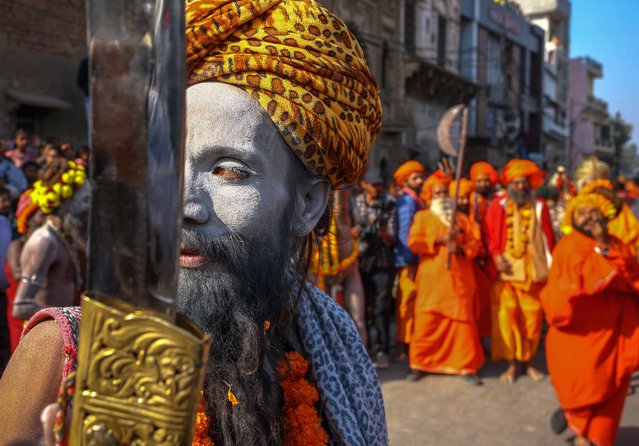
Members of Panchayati Akhara Bada Udasin take part in a religious procession as they head towards the Kumbh Mela festival ahead of the royal bath near the Sangam, the confluence of three of the holiest rivers in Hindu mythology – Ganga, Yamuna, and the mythical Saraswati – in Prayagraj, Uttar Pradesh, India, 12 January 2025. Every 12 years, Hindu pilgrims gather for ritual baths at the river's banks during the Maha Kumbh Mela festival. (Photo by Rajat Gupta/EPA)

Members of Panchayati Akhara Bada Udasin take part in a religious procession as they head towards the Kumbh Mela festival ahead of the royal bath near the Sangam, the confluence of three of the holiest rivers in Hindu mythology – Ganga, Yamuna, and the mythical Saraswati – in Prayagraj, Uttar Pradesh, India, 12 January 2025. Every 12 years, Hindu pilgrims gather for ritual baths at the river's banks during the Maha Kumbh Mela festival. (Photo by Rajat Gupta/EPA)
Details
18 Jan 2025 04:05:00
Plaster cast moulds of victims of the Mount Vesuvius eruption lie on a display table in a laboratory at Pompeii October 13, 2015. An expert team made up of archaeologists, radiologists, orthodontists and anthropologists began on September 2015 to use CAT scan technology (computerised axial tomography) to peer inside the plaster cast moulds of Pompeii's victims, in a study that has added more detail to previous findings. (Photo by Alessandro Bianchi/Reuters)

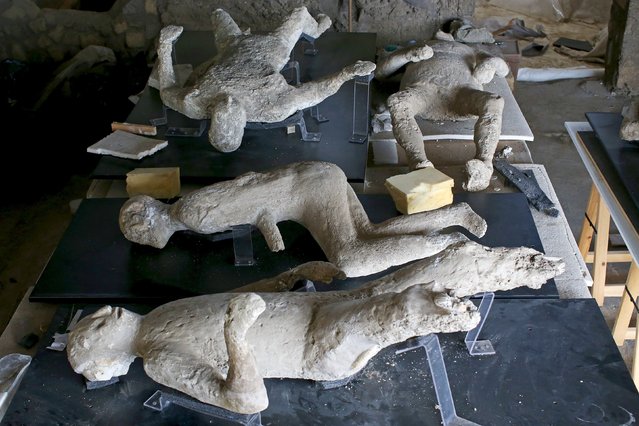
Plaster cast moulds of victims of the Mount Vesuvius eruption lie on a display table in a laboratory at Pompeii October 13, 2015. An expert team made up of archaeologists, radiologists, orthodontists and anthropologists began on September 2015 to use CAT scan technology (computerised axial tomography) to peer inside the plaster cast moulds of Pompeii's victims, in a study that has added more detail to previous findings. A 16-layer scan had to be used in order to penetrate the hardened plaster but the results showed up impressive skeletal remains and near perfect teeth. (Photo by Alessandro Bianchi/Reuters)
Details
22 Oct 2015 08:02:00