Loading...
Done
Birds behaviour winner: Land of the Eagle by Audun Rikardsen, Norway. High on a ledge, on the coast near his home in northern Norway, Rikardsen carefully positioned an old tree branch that he hoped would make a perfect golden eagle lookout. To this, he bolted a tripod head with a camera, flashes and motion sensor attached, and built himself a hide a short distance away. From time to time, he left road‑kill carrion nearby. Very gradually – over the next three years – a golden eagle got used to the camera and started to use the branch regularly to survey the coast below. (Photo by Audun Rikardsen/2019 Wildlife Photographer of the Year)

Birds behaviour winner: Land of the Eagle by Audun Rikardsen, Norway. High on a ledge, on the coast near his home in northern Norway, Rikardsen carefully positioned an old tree branch that he hoped would make a perfect golden eagle lookout. To this, he bolted a tripod head with a camera, flashes and motion sensor attached, and built himself a hide a short distance away. From time to time, he left road‑kill carrion nearby. Very gradually – over the next three years – a golden eagle got used to the camera and started to use the branch regularly to survey the coast below. (Photo by Audun Rikardsen/2019 Wildlife Photographer of the Year)
Details
17 Oct 2019 00:03:00
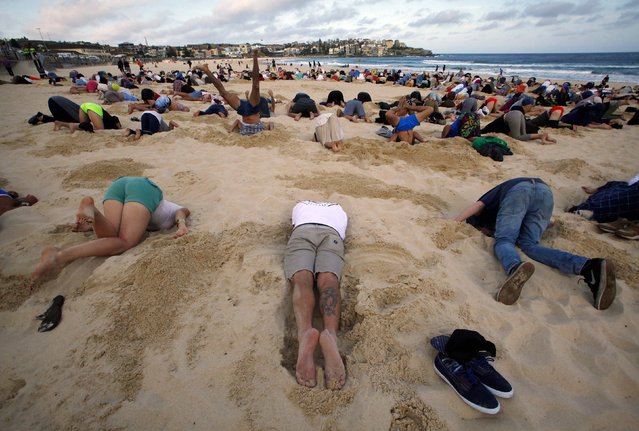
A group of around 400 demonstrators participate in a protest by burying their heads in the sand at Sydney's Bondi Beach November 13, 2014. (Photo by David Gray/Reuters)

A group of around 400 demonstrators participate in a protest by burying their heads in the sand at Sydney's Bondi Beach November 13, 2014. Hundreds of protesters participated in the event, held ahead of Saturday's G20 summit in Brisbane, which was being promoted as a message to Australian Prime Minister Tony Abbott's government that, “You have your head in the sand on climate change”. (Photo by David Gray/Reuters)
Details
14 Nov 2014 13:47:00
A frog appears to have a big smile for the camera, Russia. (Photo by Artyom Krivosheev/Barcroft Images/Comedy Wildlife Photography Awards 2016)

A frog appears to have a big smile for the camera, Russia. Things are heating up at the Comedy Wildlife Photography Awards as the shortlisted final 40 entries are revealed. This year's competition has featured over 2200 hilarious entries from around the world with photos including a fox face planting in the snow, a dancing brown bear and a pair of seemingly headless penguins – all beautifully photographed with perfect comedy timing and a strong conservation message. (Photo by Artyom Krivosheev/Barcroft Images/Comedy Wildlife Photography Awards 2016)
Details
08 Oct 2016 11:57:00
Coast and marine winner: Storm Gull (Lesser black-backed gull), New Haven, East Sussex. (Photo by Craig Denford/British Wildlife Photography Awards)

Coast and marine winner: Storm Gull (Lesser black-backed gull), New Haven, East Sussex. (Photo by Craig Denford/British Wildlife Photography Awards)
Details
07 Nov 2018 00:05:00
Mountains Gorilla is making grimaces, as he came out of the bush after the rain, in Virunga National Park, Rwanda. (Photo by Josef Friedhuber/Comedy Wildlife Photography Awards/Barcroft Media)

Prepare yourself for some rib-tickling laughter because the Comedy Wildlife Awards has announced its finalists. Founded by Tanzania-based photographers Paul Joynson-Hicks MBE and Tom Sullam, the aim of the awards is to put a spotlight on wildlife conservation efforts while simultaneously injecting some humour into the world of wildlife photography. Here: Mountains Gorilla is making grimaces, as he came out of the bush after the rain, in Virunga National Park, Rwanda. (Photo by Josef Friedhuber/Comedy Wildlife Photography Awards/Barcroft Media)
Details
07 Nov 2017 07:57:00
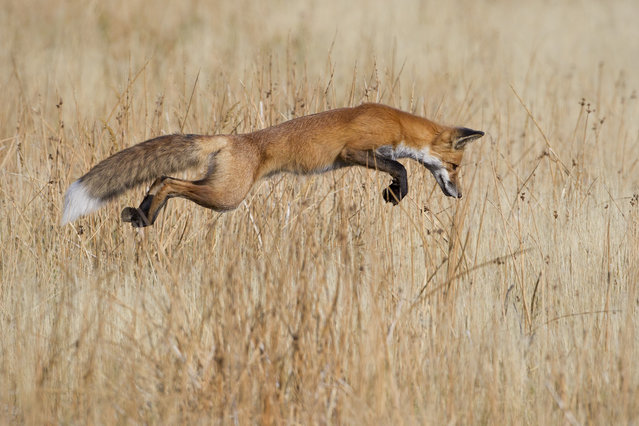
Canada: “Lucky pounce”. (Photo by Connor Stefanison/Wildlife Photographer of the Year 2013)

The winners of The London’s Natural History Museum's prestigious Wildlife Photographer of the Year for 2013 have finally been unveiled. Selected from almost 43,000 entries from 96 countries, the winners offer a glimpse of the stunning array of natural beauty on our planet. Photo: Canada: “Lucky pounce”. “Anticipating the pounce – that was the hardest part”, says Connor, who had come to Yellowstone National Park, Wyoming, USA, in search of wildlife as much as the spectacular landscape. He had found this fox, his first ever, on his last day in the park. It was so absorbed in hunting that Connor had plenty of time to get out of the car and settle behind a rock. It quartered the grassland, back and forth, and then started staring intently at a patch of ground, giving Connor just enough warning of the action to come. When it sprung up, Connor got his shot. And when it landed, the fox got his mouse. (Photo by Connor Stefanison/Wildlife Photographer of the Year 2013)
Details
17 Oct 2013 08:12:00
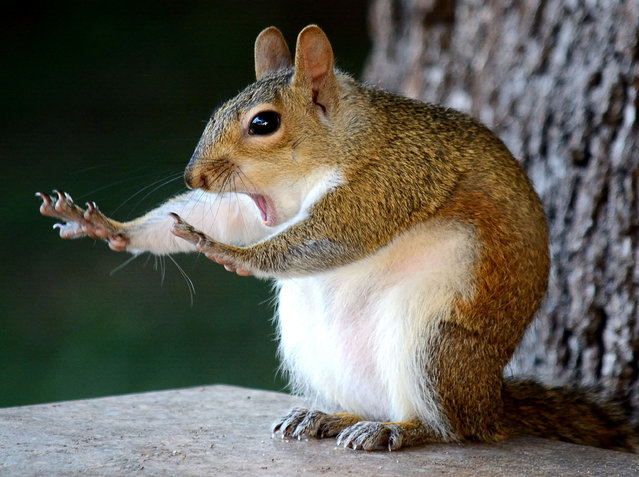
An alarmed squirrel. (Photo by Mary McGowan/Barcroft Images/Comedy Wildlife Photography Awards)

An alarmed squirrel. (Photo by Mary McGowan/Barcroft Images/Comedy Wildlife Photography Awards)
Details
17 Sep 2018 00:03:00
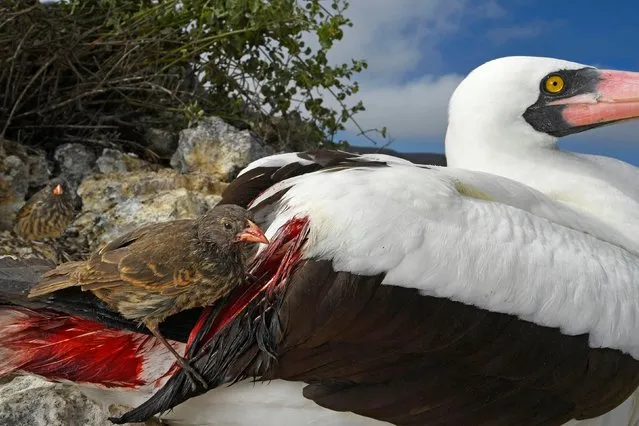
Bloodthirsty by Thomas P Peschak, Germany/South Africa — winner, Behaviour: birds. When rations run short on Wolf Island, in the remote northern Galápagos, the sharp-beaked ground finches become vampires. Their sitting targets are Nazca boobies and other large birds. The finches rely on a scant diet of seeds and insects, which regularly dries up, so they drink blood to survive. ‘I’ve seen more than half a dozen finches drinking from a single Nazca booby,’ says Tom. Rather than leave their nests the boobies tolerate the vampires, and the blood loss doesn’t seem to cause permanent harm. (Photo by Thomas P Peschak/2018 Wildlife Photographer of the Year)

Bloodthirsty by Thomas P. Peschak, Germany/South Africa — winner, Behaviour: birds. When rations run short on Wolf Island, in the remote northern Galápagos, the sharp-beaked ground finches become vampires. Their sitting targets are Nazca boobies and other large birds. The finches rely on a scant diet of seeds and insects, which regularly dries up, so they drink blood to survive. ‘I’ve seen more than half a dozen finches drinking from a single Nazca booby,’ says Tom. Rather than leave their nests the boobies tolerate the vampires, and the blood loss doesn’t seem to cause permanent harm. (Photo by Thomas P. Peschak/2018 Wildlife Photographer of the Year)
Details
19 Oct 2018 00:05:00