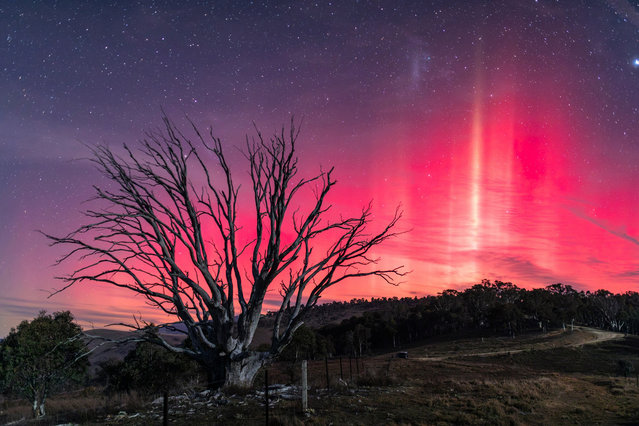
Paul Kerr was able to capture this stunning vista of the aurora australis from Canberra, New Zealand on June 1, 2025. (Photo by Paul Kerr/Hold Still Photography)
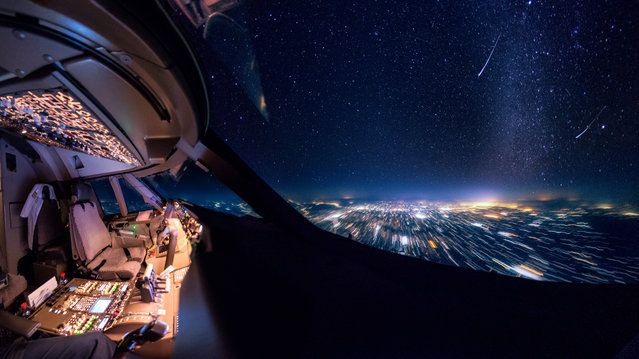
The Boeing 747-8 cargo plane pilot has seen thunderstorms, shooting stars and sunsets from up above the clouds and has looked down on mountaintops, carpets of cloud and cities lit up at night. The incredible pictures give a glimpse of the view from the pilots are treated to every day. Here: Shooting stars over India. (Photo by Christiaan van Heijst/Caters News Agency)
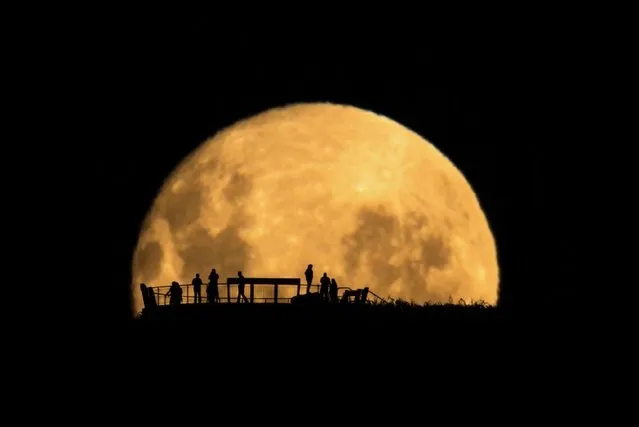
The Royal Observatory just announced its Astronomy Photographer Of The Year 2013 winners. Australian photographer Mark Gee was chosen among a thousand amateur and professional photographers around the globe to win the top title. His work is part of an exhibition of the winning photographers, which opened on Sept. 19 at the Royal Observatory Greenwich. The Royal Observatory shared with us the winners and notable mentions of the competition. Their descriptions of the prizewinners can be found below the images.
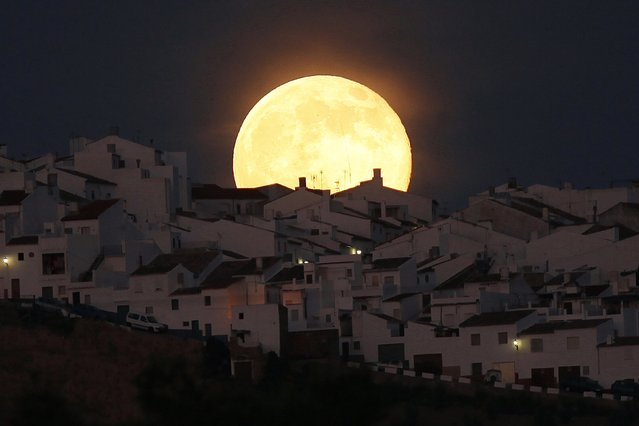
The Supermoon rises over houses in Olvera, in the southern Spanish province of Cadiz, July 12, 2014. Occurring when a full moon or new moon coincides with the closest approach the moon makes to the Earth, the Supermoon results in a larger-than-usual appearance of the lunar disk. (Photo by Jon Nazca/Reuters)
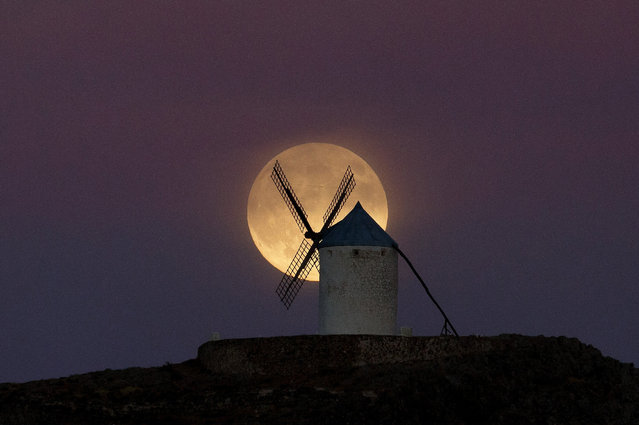
A moon appears behind a windmill a day before the supermoon is full on September 8, 2014 in Consuegra, in Toledo province, Spain. Consuegra belongs to a region made famous by the novel “Don Quijote de la Mancha” (Don Quixote) writed by Miguel De Cervantes. Some of the windmills belong to the 16th century. (Photo by Pablo Blazquez Dominguez/Getty Images)
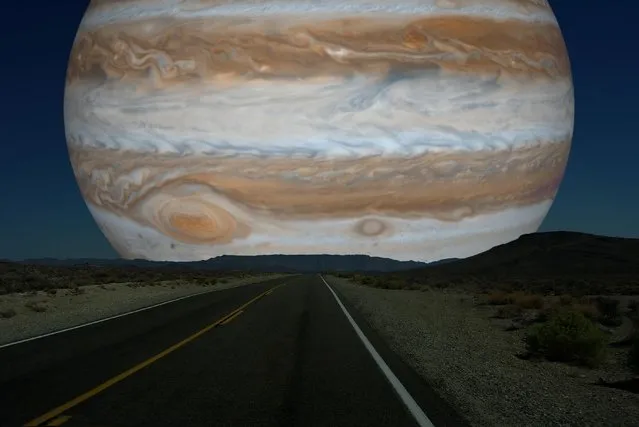
Our moon is a pretty big object. It's big enough to be a respectable planet in its own right, if it were orbiting the sun instead of the Earth. (Actually, it is orbiting the sun in a nearly perfectly circular orbit, that the Earth only slightly perturbs... but that's a topic for another day.) The Moon is a quarter the diameter of the Earth. Only Pluto has a satellite that is larger, in proportion to the size of the planet it orbits.
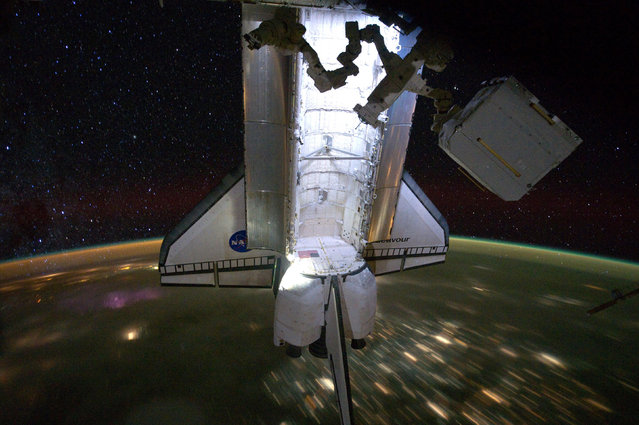
Backdropped by a night time view of the Earth and the starry sky, the Space Shuttle Endeavour is seen docked to the International Space Station on May 28, 2011. (Photo by Reuters/NASA)