Loading...
Done
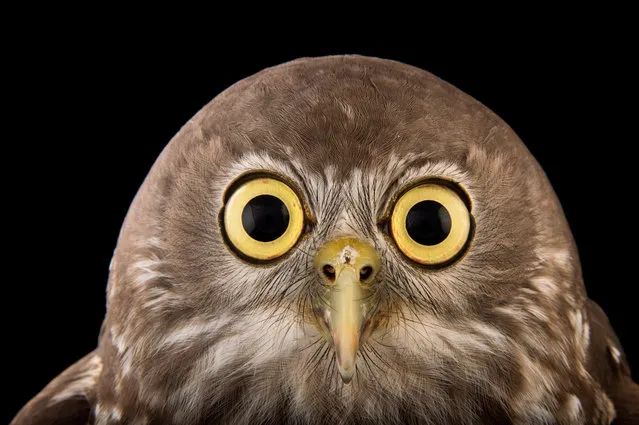
The National Geographic Photo Ark is a travelling exhibition of photographer Joel Sartore’s quest to create a photo archive of biodiversity around the world. So far, Sartore has captured studio portraits of more than 6,000 species – a number that he hopes to double. On 1 July, the ark will open at Melbourne zoo – the first time it has been exhibited in the southern hemisphere. More than 50 portraits will be on display, including many of Australian endangered animals being protected by programs at the zoo itself. These captions have been edited from text supplied by Melbourne zoo. Here: Barking owl. So-named because its call sounds like a barking dog, these birds are native to Australia, Indonesia and Papua New Guinea. In Victoria they are listed as an endangered species, and in 2003 there were estimated to be fewer than 50 breeding pairs. The main threat to the species in Victoria is loss of habitat, especially large trees with hollows in which they can nest and on which many of their prey depend. Apart from a bark, they may utter a chilling scream when they feel threatened. (Photo by Joel Sartore/National Geographic Photo Ark/The Guardian)

The National Geographic Photo Ark is a travelling exhibition of photographer Joel Sartore’s quest to create a photo archive of biodiversity around the world. So far, Sartore has captured studio portraits of more than 6,000 species – a number that he hopes to double. On 1 July, the ark will open at Melbourne zoo – the first time it has been exhibited in the southern hemisphere. More than 50 portraits will be on display, including many of Australian endangered animals being protected by programs at the zoo itself. These captions have been edited from text supplied by Melbourne zoo. Here: Barking owl. (Photo by Joel Sartore/National Geographic Photo Ark/The Guardian)
Details
01 Jul 2017 07:45:00
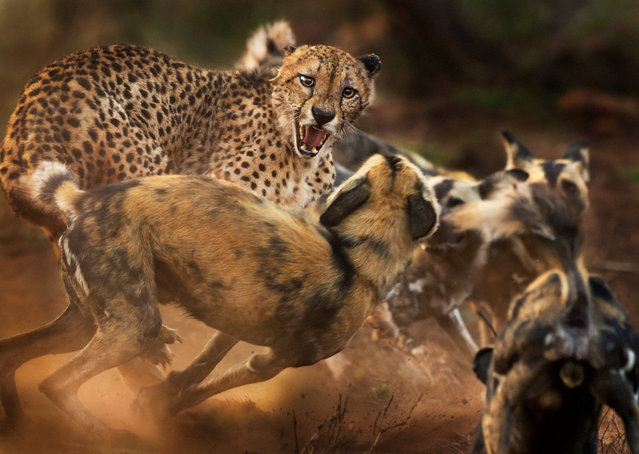
A lone male cheetah is set upon by a pack of African wild dogs. Peter Haygarth had been following the dogs as they hunted in Zimanga Private Game Reserve in KwaZulu-Natal, South Africa. On first encountering the cheetah, the dogs were wary, but as the rest of the pack arrived, their confidence grew and they began to encircle the cat. Peter kept his focus on the cat’s face. In a few minutes the spat was over as the cheetah fled. (Behaviour: mammals category). (Photo by Peter Haygarth)

A lone male cheetah is set upon by a pack of African wild dogs. Peter Haygarth had been following the dogs as they hunted in Zimanga Private Game Reserve in KwaZulu-Natal, South Africa. On first encountering the cheetah, the dogs were wary, but as the rest of the pack arrived, their confidence grew and they began to encircle the cat. Peter kept his focus on the cat’s face. In a few minutes the spat was over as the cheetah fled. (Behaviour: mammals category). (Photo by Peter Haygarth)
Details
10 Sep 2019 00:03:00
Volunteers transport an inflated sphere into a canoe to be lowered in MacArthur Park Lake during the installation of Portraits of Hope's exhibition “Spheres at MacArthur Park” in Los Angeles, California August 21, 2015. (Photo by Mario Anzuoni/Reuters)

Volunteers transport an inflated sphere into a canoe to be lowered in MacArthur Park Lake during the installation of Portraits of Hope's exhibition “Spheres at MacArthur Park” in Los Angeles, California August 21, 2015. The installation will feature about 3,000 inflatable hand-painted spheres. (Photo by Mario Anzuoni/Reuters)
Details
23 Aug 2015 09:15:00
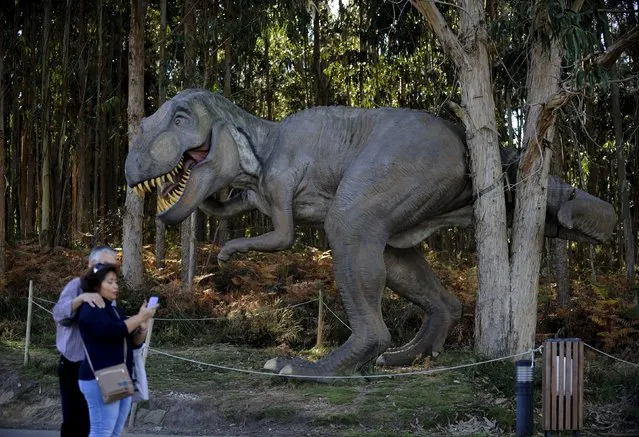
A couple takes a photo outside the MUJA (Jurassic Museum of Asturias) in Colunga, northern Spain, November 6, 2015. (Photo by Eloy Alonso/Reuters)

A couple takes a photo outside the MUJA (Jurassic Museum of Asturias) in Colunga, northern Spain, November 6, 2015. The scientific team of the Jurassic Museum of Asturias (MUJA) presents their latest studies on the fossil of a Ichthyosaur, which acccording to them is the most complete found in the Iberian Peninsula and one of the few in the world. (Photo by Eloy Alonso/Reuters)
Details
09 Nov 2015 08:00:00
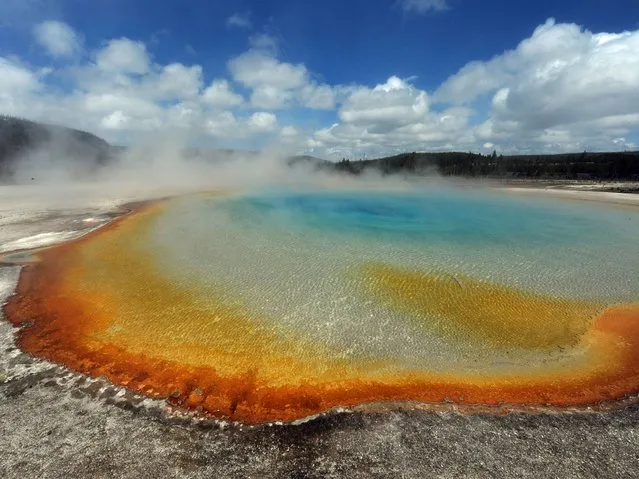
View of the “Sunset Lake” hot spring with it's unique colors caused by brown, orange and yellow algae-like bacteria called Thermophiles, that thrive in the cooling water turning the vivid aqua-blues to a murkier greenish brown, in the Yellowstone National Park, Wyoming on June 1, 2011. (Photo by Mark Ralston/AFP Photo)

View of the “Sunset Lake” hot spring with it's unique colors caused by brown, orange and yellow algae-like bacteria called Thermophiles, that thrive in the cooling water turning the vivid aqua-blues to a murkier greenish brown, in the Yellowstone National Park, Wyoming on June 1, 2011. Yellowstone National Park, was established by the U.S. Congress and signed into law by President Grant on March 1, 1872. The park is located primarily in the U.S. state of Wyoming, though it also extends into Montana and Idaho and was the first national park in the world. It is known for its wildlife and its many geothermal features, especially the Old Faithful Geyser. (Photo by Mark Ralston/AFP Photo)
Details
06 Apr 2014 08:02:00
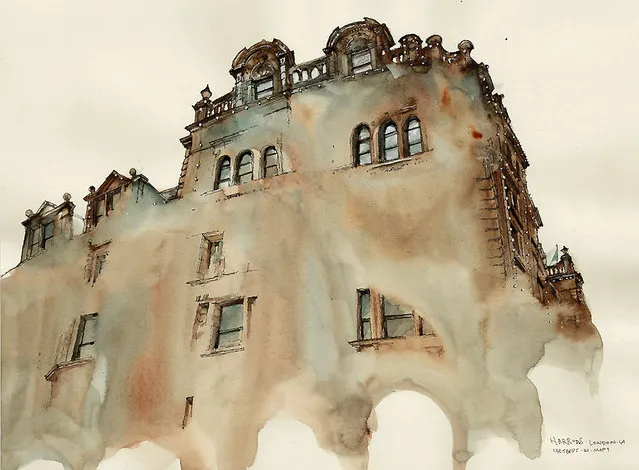
Architectural Watercolors By Sunga Park

South Korea-based graphic designer and illustrator Sunga Park has created these incredible watercolor studies of architectural landscapes.
Details
22 Feb 2014 15:03:00
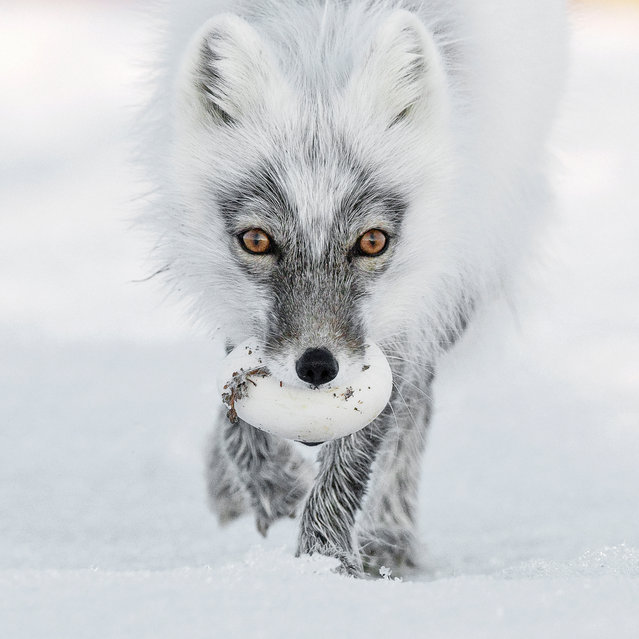
Arctic treasure by Sergey Gorshkov (Russia). An arctic fox carries its egg trophy from a raid on a snow goose nest and heads for a suitable burial spot. Finalist 2017, Animal Portraits. (Photo by  Sergey Gorshkov/2017 Wildlife Photographer of the Year)

Arctic treasure by Sergey Gorshkov (Russia). An arctic fox carries its egg trophy from a raid on a snow goose nest and heads for a suitable burial spot. Finalist 2017, Animal Portraits. (Photo by Sergey Gorshkov/2017 Wildlife Photographer of the Year)
Details
12 Sep 2017 09:33:00
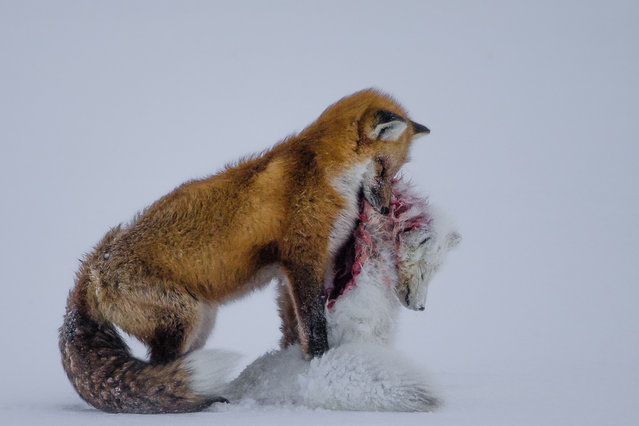
A tale of two foxes. Surprising behaviour, witnessed in Wapusk national park, on Hudson Bay, Canada, in early winter. Red foxes don’t actively hunt Arctic foxes, but where the ranges of two predators overlap, there can be conflict. Though the light was poor, the snow-covered tundra provided the backdrop for the moment that the red fox paused with the smaller fox in its mouth in a grim pose. (Photo by Don Gutoski/2015 Wildlife Photographer of the Year)

A tale of two foxes. Surprising behaviour, witnessed in Wapusk national park, on Hudson Bay, Canada, in early winter. Red foxes don’t actively hunt Arctic foxes, but where the ranges of two predators overlap, there can be conflict. Though the light was poor, the snow-covered tundra provided the backdrop for the moment that the red fox paused with the smaller fox in its mouth in a grim pose. (Photo by Don Gutoski/2015 Wildlife Photographer of the Year)
Details
20 Oct 2015 08:02:00