Loading...
Done
What 200 Calories Looks Like In Different Foods Part 3

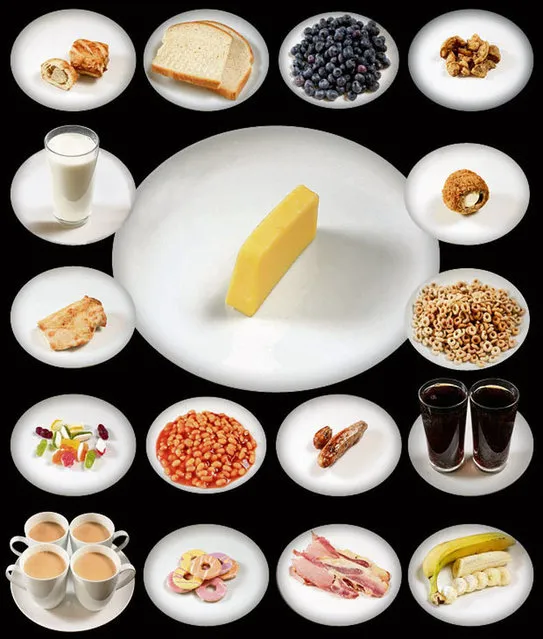
Some foods have significantly more Calories than others but what does the difference actually look like. Each of the photographs below represents 200 Calories of the particular type of food; the images are sorted from low to high calorie density. When you consider that an entire plate of broccoli contains the same number of Calories as a small spoonful of peanut butter, you might think twice the next time you decide what to eat. According to the U.S. Department of Agriculture, the average adult needs to consume about 2000 – 2500 Calories to maintain their weight. In other words, you have a fixed amount of Calories to "spend" each day; based on the following pictures, which would you eat?


See Also: Ppart 1 _ Part 2
Details
02 Aug 2014 09:53:00
What 200 Calories Looks Like In Different Foods Part 1

Some foods have significantly more Calories than others but what does the difference actually look like. Each of the photographs below represents 200 Calories of the particular type of food; the images are sorted from low to high calorie density. When you consider that an entire plate of broccoli contains the same number of Calories as a small spoonful of peanut butter, you might think twice the next time you decide what to eat. According to the U.S. Department of Agriculture, the average adult needs to consume about 2000 - 2500 Calories to maintain their weight. In other words, you have a fixed amount of Calories to "spend" each day; based on the following pictures, which would you eat?


See Also: Ppart 2 _ Part 3
Details
30 Jul 2014 10:18:00
What 200 Calories Looks Like In Different Foods Part 2

Some foods have significantly more Calories than others but what does the difference actually look like. Each of the photographs below represents 200 Calories of the particular type of food; the images are sorted from low to high calorie density. When you consider that an entire plate of broccoli contains the same number of Calories as a small spoonful of peanut butter, you might think twice the next time you decide what to eat. According to the U.S. Department of Agriculture, the average adult needs to consume about 2000 – 2500 Calories to maintain their weight. In other words, you have a fixed amount of Calories to “spend” each day; based on the following pictures, which would you eat?


See Also: Ppart 1 _ Part 3
Details
01 Aug 2014 11:30:00
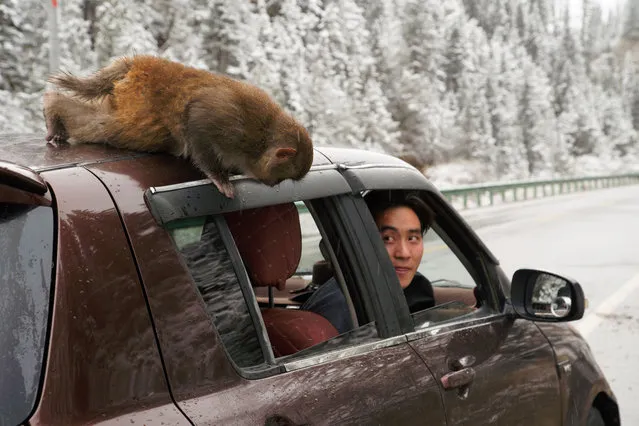
A herd of wild monkeys ask for food from passing vehicles along a mountain road after a snowfall on October 20, 2020 in Luhuo County, Sichuan Province of China. (Photo by Jin Shujie/VCG via Getty Images)

A herd of wild monkeys ask for food from passing vehicles along a mountain road after a snowfall on October 20, 2020 in Luhuo County, Sichuan Province of China. (Photo by Jin Shujie/VCG via Getty Images)
Details
29 Oct 2020 00:05:00
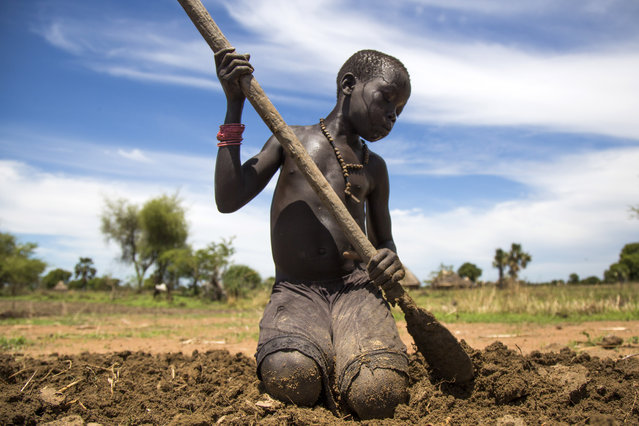
Nyibol Lual, 13 years old, helps her family to prepare the land for cultivation on May 31, 2017, in Panthau, Northern Bahr al Ghazal, South Sudan. The family has a small land where they cultivate sorghum. An estimated 63 per cent of the population in Northern Bahr al Ghazal is experiencing severe food insecurity, according to the latest Integrated Food Security Phase Classification (IPC) report. The situation is particularly bad in Aweil West and Aweil South counties, where the exhaustion of household food stocks and growing dependence on financially inaccessible markets have left the population facing Emergency levels of food insecurity. (Photo by Albert Gonzalez Farran/AFP Photo)

Nyibol Lual, 13 years old, helps her family to prepare the land for cultivation on May 31, 2017, in Panthau, Northern Bahr al Ghazal, South Sudan. The family has a small land where they cultivate sorghum. An estimated 63 per cent of the population in Northern Bahr al Ghazal is experiencing severe food insecurity, according to the latest Integrated Food Security Phase Classification (IPC) report. The situation is particularly bad in Aweil West and Aweil South counties, where the exhaustion of household food stocks and growing dependence on financially inaccessible markets have left the population facing Emergency levels of food insecurity. (Photo by Albert Gonzalez Farran/AFP Photo)
Details
01 Jun 2017 10:10:00
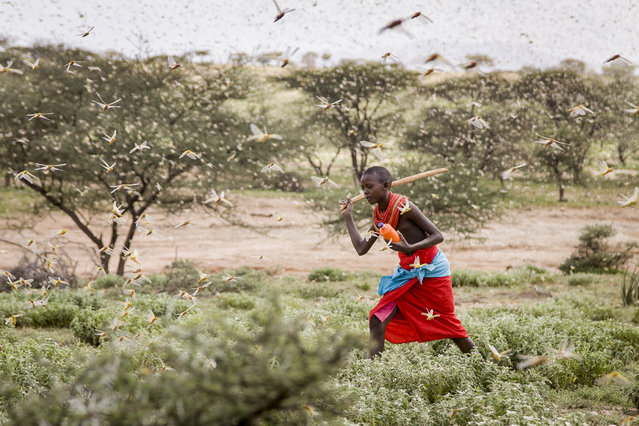
In this photo taken Thursday, January 16, 2020, a Samburu boy uses a wooden stick to try to swat a swarm of desert locusts filling the air, as he herds his camel near the village of Sissia, in Samburu county, Kenya. The most serious outbreak of desert locusts in 25 years is spreading across East Africa and posing an unprecedented threat to food security in some of the world's most vulnerable countries, authorities say, with unusual climate conditions partly to blame. (Photo by Patrick Ngugi/AP Photo)

In this photo taken Thursday, January 16, 2020, a Samburu boy uses a wooden stick to try to swat a swarm of desert locusts filling the air, as he herds his camel near the village of Sissia, in Samburu county, Kenya. The most serious outbreak of desert locusts in 25 years is spreading across East Africa and posing an unprecedented threat to food security in some of the world's most vulnerable countries, authorities say, with unusual climate conditions partly to blame. (Photo by Patrick Ngugi/AP Photo)
Details
19 Jan 2020 00:07:00
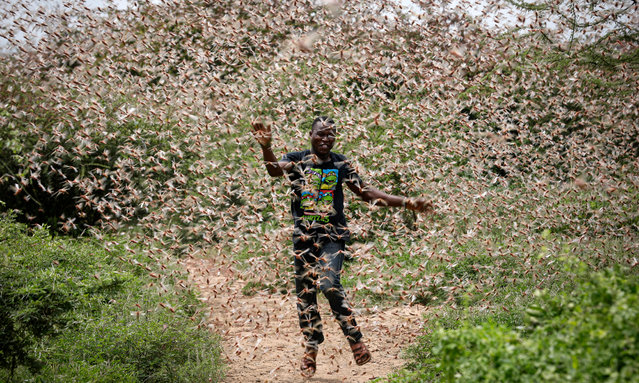
A local farmer Theophilus Mwendwa runs through a swarm of desert locusts to chase them away in the bush near Enziu, Kitui County, some 200km east of the capital Nairobi, Kenya, 24 January 2020. Large swarms of desert locusts have been invading Kenya for weeks, after having infested some 70 thousand hectares of land in Somalia which the United Nations Food and Agriculture Organisation (FAO) has termed the “worst situation in 25 years” in the Horn of Africa. FAO cautioned that it poses an “unprecedented threat” to food security and livelihoods in the region. (Photo by Dai Kurokawa/EPA/EFE)

A local farmer Theophilus Mwendwa runs through a swarm of desert locusts to chase them away in the bush near Enziu, Kitui County, some 200km east of the capital Nairobi, Kenya, 24 January 2020. Large swarms of desert locusts have been invading Kenya for weeks, after having infested some 70 thousand hectares of land in Somalia which the United Nations Food and Agriculture Organisation (FAO) has termed the “worst situation in 25 years” in the Horn of Africa. FAO cautioned that it poses an “unprecedented threat” to food security and livelihoods in the region. (Photo by Dai Kurokawa/EPA/EFE)
Details
22 Feb 2020 00:01:00
A young boy scoops water from a hand-dug well in the dry riverbed near Matinyani, in the semi-arid Kitui County in southeastern Kenya, 22 March 2015, the World Water Day. Residents of Kitui County and other arid and semi-arid areas of the country have been hard-hit by extremely poor rainfall this year while the government said in previous month that some 1.6 million people countrywide are facing acute starvation due to the drought and will need relief food over the next six months. (Photo by Dai Kurokawa/EPA)

A young boy scoops water from a hand-dug well in the dry riverbed near Matinyani, in the semi-arid Kitui County in southeastern Kenya, 22 March 2015, the World Water Day. Residents of Kitui County and other arid and semi-arid areas of the country have been hard-hit by extremely poor rainfall this year while the government said in previous month that some 1.6 million people countrywide are facing acute starvation due to the drought and will need relief food over the next six months. Residents of Matinyani say they haven't seen a drop of rain in nearly four months. Thousands of Kenyans in rural areas walk tens of kilometers just to fetch water to drink and to be used in their homes. According to an estimate by UNESCO (United Nations Educational, Scientific and Cultural Organization), 17 million people lack access to safe water in Kenya, where the drought is a perennial problem. (Photo by Dai Kurokawa/EPA)
Details
23 Mar 2015 11:01:00