Loading...
Done
Rickshaw puller Shiori Yoshida, 28, attracts tourists to the guided tour at the Asakusa district in Tokyo, Japan on August 22, 2023. Pullers walk or run an average of 20 km (12 miles) a day and, in addition to being physically strong, they must have extensive knowledge of Tokyo and know how to engage with the tourists who mostly hire them for sightseeing. “I have fun and enjoy myself”, Yoshida said. “In order for the customers to enjoy themselves, I also enjoy myself”. (Photo by Issei Kato/Reuters)

Rickshaw puller Shiori Yoshida, 28, attracts tourists to the guided tour at the Asakusa district in Tokyo, Japan on August 22, 2023. Pullers walk or run an average of 20 km (12 miles) a day and, in addition to being physically strong, they must have extensive knowledge of Tokyo and know how to engage with the tourists who mostly hire them for sightseeing. “I have fun and enjoy myself”, Yoshida said. “In order for the customers to enjoy themselves, I also enjoy myself”. (Photo by Issei Kato/Reuters)
Details
16 Oct 2023 04:43:00
“The Last Pollen Spore Preparing to Leave a Ladybug Trying to Hold On, Because It Didn't Want to Be Alone”. Photo by Hiep Nguyen Hoang (Hanoi, Vietnam). Photographed in Hanoi, Vietnam, April 2012.

“The Last Pollen Spore Preparing to Leave a Ladybug Trying to Hold On, Because It Didn't Want to Be Alone”. Photo by Hiep Nguyen Hoang (Hanoi, Vietnam). Photographed in Hanoi, Vietnam, April 2012.
Details
08 Mar 2013 12:09:00
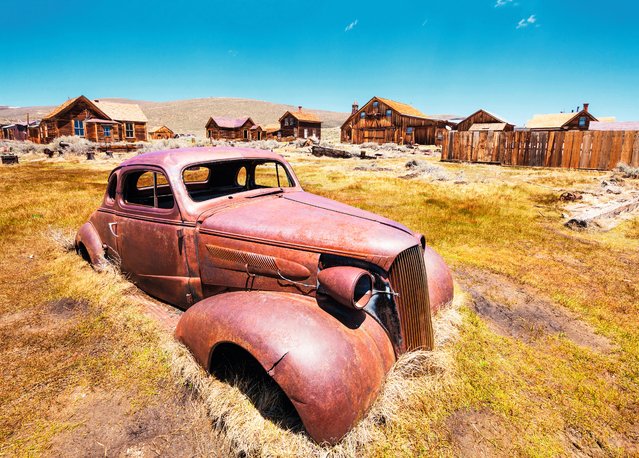
Bodie, Mono County, California. Gold was discovered at Bodie in 1859 (just after the initial California gold rush) and it went from mining camp to boomtown. Its decline began in 1880, when word spread of new boomtowns elsewhere. The Standard Consolidated Mine closed in 1913, and four years later the Bodie Railway was abandoned. By 1940 the population was down to 40. Today, Bodie is maintained in a state of arrested decay as a visitor attraction. (Photo by Alamy Stock Photo)

Kieron Connolly’s new book of photographs of more than 100 once-busy and often elegant buildings gives an idea of how the world might look if humankind disappeared. Here: Bodie, Mono County, California. Gold was discovered at Bodie in 1859 (just after the initial California gold rush) and it went from mining camp to boomtown. Its decline began in 1880, when word spread of new boomtowns elsewhere. The Standard Consolidated Mine closed in 1913, and four years later the Bodie Railway was abandoned. By 1940 the population was down to 40. Today, Bodie is maintained in a state of arrested decay as a visitor attraction. (Photo by Alamy Stock Photo)
Details
07 Sep 2016 09:50:00
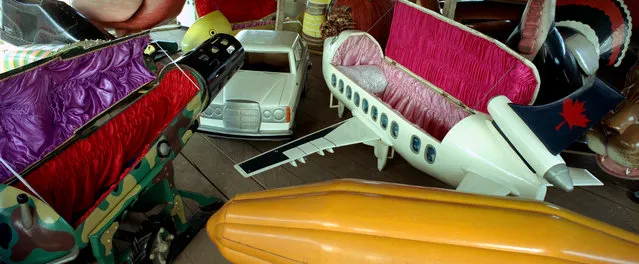
The Fantasy Coffins From Ghana

Some people joke about having clowns at their funeral, but how about having a coffin that looks like a gigantic cellphone? It is impossible to tell at the first glance that these colorful sculptures are actually coffins. The coffins were made by Kane Kwei and his assistant Paa Joe more than twenty years ago and have been a somewhat grim tourist attraction ever since. These coffins were probably made as an advertisement for the actual business, since it would hard to imagine someone actually ordering a coffin such as this.
Details
07 Apr 2015 10:40:00
Photo by Vadim Trunov

Young photographer Vadim Trunov has serious portfolio, but most impressive is his macrophotography of snails and insects.Among the favorite characters Trunova – mantises, ladybugs, ants, dragonflies, bugs-soldiers.
Details
14 Dec 2012 12:50:00
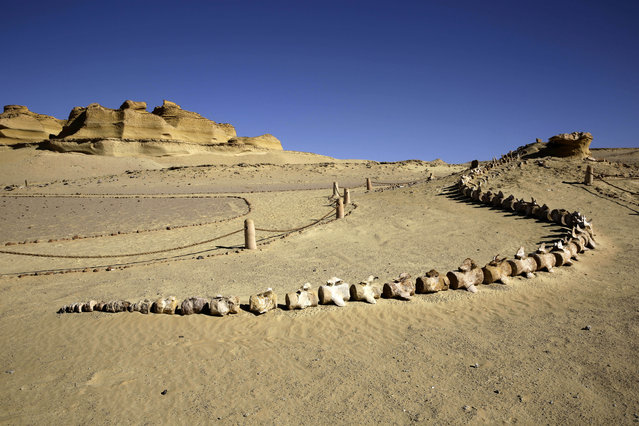
Fossilized whale bones are on display  outside the Wati El Hitan Fossils and Climate Change Museum, a UNESCO natural World Heritage site, on the opening day, in the Fayoum oasis, Egypt, Thursday, January 14, 2016. Egypt has cut the ribbon on the Middle East's first fossil museum housing the world's largest intact skeleton of a "walking whale" in an attempt to attract much-needed tourists driven off by recent militant attacks. The construction of the much-hyped Fossils and Climate Change Museum was covered a 2 billion euros (2. 17 billion dollars) grant from Italy, according to Italian Ambassador Maurizio Massari. (Photo by Thomas Hartwell/AP Photo)

Fossilized whale bones are on display outside the Wati El Hitan Fossils and Climate Change Museum, a UNESCO natural World Heritage site, on the opening day, in the Fayoum oasis, Egypt, Thursday, January 14, 2016. Egypt has cut the ribbon on the Middle East's first fossil museum housing the world's largest intact skeleton of a "walking whale" in an attempt to attract much-needed tourists driven off by recent militant attacks. The construction of the much-hyped Fossils and Climate Change Museum was covered a 2 billion euros (2. 17 billion dollars) grant from Italy, according to Italian Ambassador Maurizio Massari. Its centerpiece is an intact, 37-million-year-old and 20-meter-long skeleton of a legged form of whale that testifies to how modern-day whales evolved from land mammals. The sand-colored, dome-shaped museum is barely discernible in the breathtaking desert landscape that stretches all around. (Photo by Thomas Hartwell/AP Photo)
Details
16 Jan 2016 08:06:00
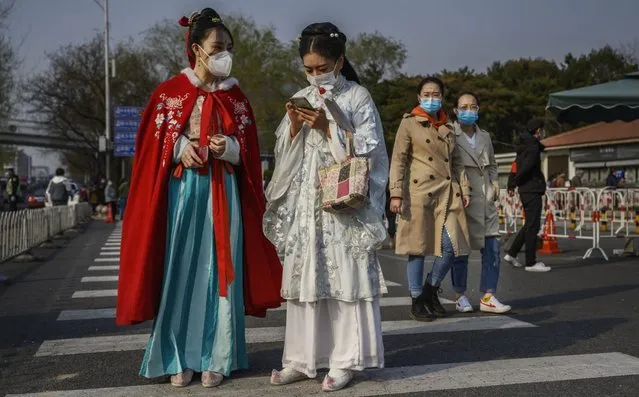
Chinese women wear protective masks as they are dressed in traditional clothing from the Qing Dynasty era outside a park on March 29, 2020 in Beijing, China. A limited section of the iconic tourist site was re-opened to the public this week allowing a smaller number of visitors to reserve tickets online in advance and to enter after passing health screening. With the pandemic hitting hard across the world, China recorded its first day with no new domestic cases of the coronavirus last week, since the government imposed sweeping measures to keep the disease from spreading. For two months, millions of people across China have been restricted in how they move from their homes, while other cities have been locked down in ways that appeared severe at the time but are now being replicated in other countries trying to contain the virus. Officials believe the worst appears to be over in China, though there are concerns of another wave of infections as the government attempts to reboot the worlds second largest economy. In Beijing, it is mandatory to wear masks outdoors, retail stores operate on reduced hours, restaurants employ social distancing among patrons, and tourist attractions at risk of drawing large crowds remain closed. Monitoring and enforcement of virus-related measures and the quarantine of anyone arriving to Beijing is carried out by neighborhood committees and a network of Communist Party volunteers who wear red arm bands. A primary concern for Chinese authorities remains the arrival of flights from Europe and elsewhere, given the exposure of passengers in regions now regarded as hotbeds for transmission. Since January, China has recorded more than 81,000 cases of COVID-19 and at least 3200 deaths, mostly in and around the city of Wuhan, in central Hubei province, where the outbreak first started. (Photo by Kevin Frayer/Getty Images)

Chinese women wear protective masks as they are dressed in traditional clothing from the Qing Dynasty era outside a park on March 29, 2020 in Beijing, China. A limited section of the iconic tourist site was re-opened to the public this week allowing a smaller number of visitors to reserve tickets online in advance and to enter after passing health screening. (Photo by Kevin Frayer/Getty Images)
Details
01 Apr 2020 00:05:00
“Unexpected x2 (a.k.a. “how much is that doggie in the window”)”. Taiwan, 2011. (Asian (Street) Impressions)

“Unexpected x2 (a.k.a. “how much is that doggie in the window”)”. Taiwan, 2011. (Photo and caption by Asian (Street) Impressions)
Details
13 Oct 2013 10:34:00