Loading...
Done
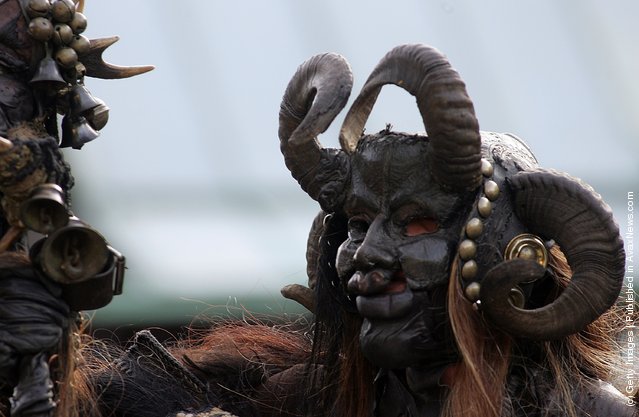
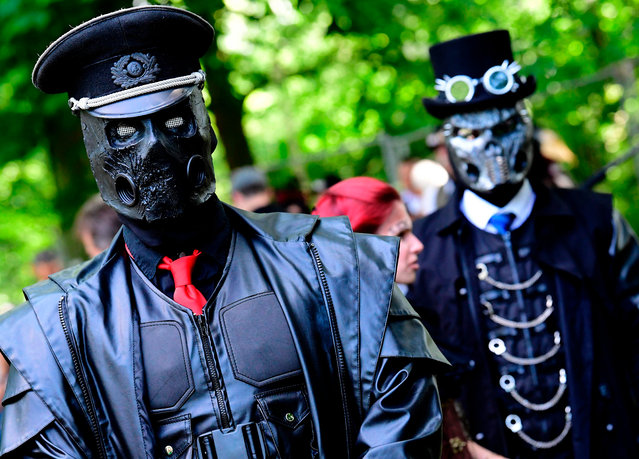
Participants of the so called “Victorian Picnic” walk in fancy costumes during the Wave Gothic Festival (WGT) in Leipzig, Germany, Friday, June 2, 2017. Approximately 20,000 goths and other dark subculture fans such as cybergoths, metalheads, steampunks, neo- Victorians, dark romantics, dark electro, industrial, medieval and fetish fans are expected to attend the world' s largest gothic and “dark” culture festival until June 5, 2017. (Photo by Tobias Schwarz/AFP Photo)

Participants of the so called “Victorian Picnic” walk in fancy costumes during the Wave Gothic Festival (WGT) in Leipzig, Germany, Friday, June 2, 2017. Approximately 20,000 goths and other dark subculture fans such as cybergoths, metalheads, steampunks, neo- Victorians, dark romantics, dark electro, industrial, medieval and fetish fans are expected to attend the world' s largest gothic and “dark” culture festival until June 5, 2017. (Photo by Tobias Schwarz/AFP Photo)
Details
05 Jun 2017 07:30:00


KALTENBERG, GERMANY - JULY 08: Actors dressed as knights perform during the traditional Kaltenberg knight tournament on July 8, 2007 in Kaltenberg, Germany. With around 120,000 visitors each year, the festival including knight tournaments, medieval styled markets and a variety of music performances, the event is one of the biggest of its kind. (Photo by Johannes Simon/Getty Images)
Details
14 Nov 2011 16:55:00
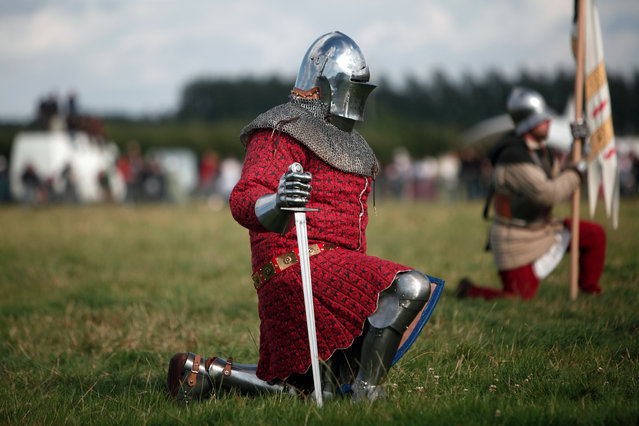
A man wearing an armor attends a reenactment of the Battle of Agincourt, in Agincourt, northern France, Saturday, July 25, 2015. (Photo by Thibault Camus/AP Photo)

A man wearing an armor attends a reenactment of the Battle of Agincourt, in Agincourt, northern France, Saturday, July 25, 2015. The French are hosting a reenactment of the clash with England this weekend. More than 800 people in Medieval garb are gathering at the site to commemorate the battle, which was a turning point in the Hundred Years' War. (Photo by Thibault Camus/AP Photo)
Details
27 Jul 2015 11:20:00


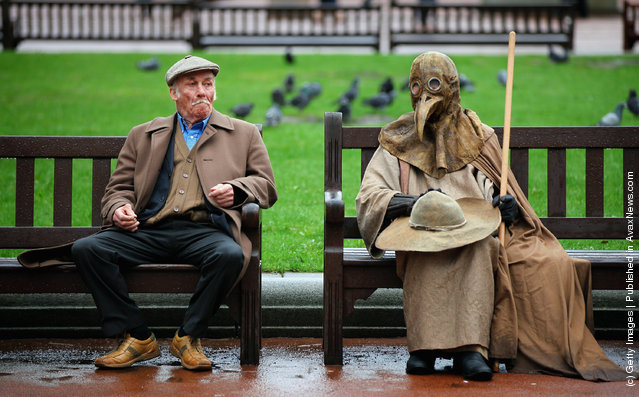
Glasgow based artist dressed Frank To dressed in a medieval Plague Doctor costume sits beside 72-year-old Willie Kennedy from Glasgow on March 31, 2011 in Glasgow, Scotland. The artist is promoting his first major exhibition in two years, “The Human Condition”, which opens tomorrow at the Leith Gallery in Edinburgh. The artist is showing a series of pictures which depict Mediaeval Plague Doctors, which have fascinated the artist for the last three years. (Photo by Jeff J Mitchell/Getty Images)
Details
01 Apr 2011 13:37:00
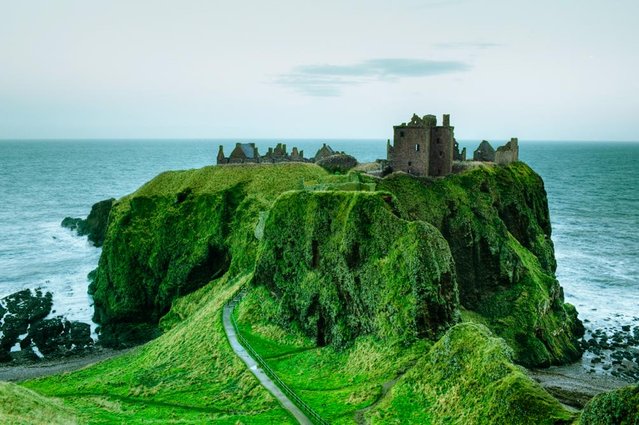
Dunnottar Castle In Scottish

Dunnottar Castleis a ruined medieval fortress located upon a rocky headland on the north-east coast of Scotland, about 3 kilometres (1.9 mi) south of Stonehaven. The surviving buildings are largely of the 15th and 16th centuries, but the site is believed to have been fortified in the Early Middle Ages. Dunnottar has played a prominent role in the history of Scotland through to the 18th-century Jacobite risings because of its strategic location and the strength of its situation. Dunnottar is best known as the place where the Honours of Scotland, the Scottish crown jewels, were hidden from Oliver Cromwell's invading army in the 17th century. The property of the Keiths from the 14th century, and the seat of the Earl Marischal, Dunnottar declined after the last Earl forfeited his titles by taking part in the Jacobite rebellion of 1715. The castle was restored in the 20th century and is now open to the public.
Details
13 Jan 2014 11:31:00


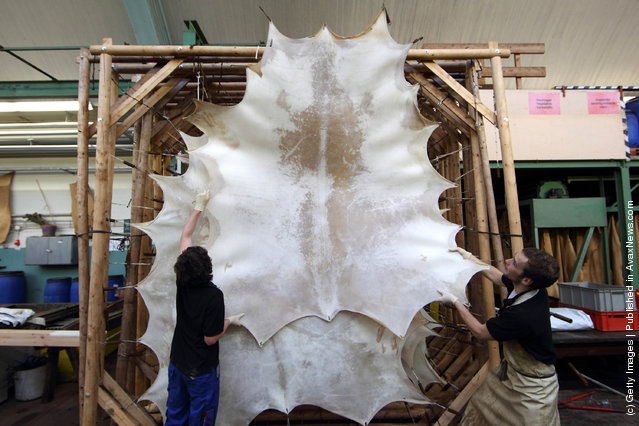
REUTLINGEN, GERMANY - NOVEMBER 17: Students hang out finished parchment leather at the LGR (Lederinstitut Gerberschule Reutlingen) tannery school on November 17, 2010 in Reutlingen, Germany. Even in early antiquity and up their hair or dried goat and sheep skins were used as material for documents. In the small Asian city Pergamon these skins were processed in large quantities for this purpose, so they formed the main trading arm of the city, of which the name is parchment is derived. In medieval times, reached the parchment is of great importance, it was such as France's production under the supervision of the University of Paris. Even now, important documents, placed on their unlimited shelf life as possible large value (eg diplomas, addresses, memory, writings, documents for primary and keystones) written on parchment...
Details
20 Nov 2011 18:17:00
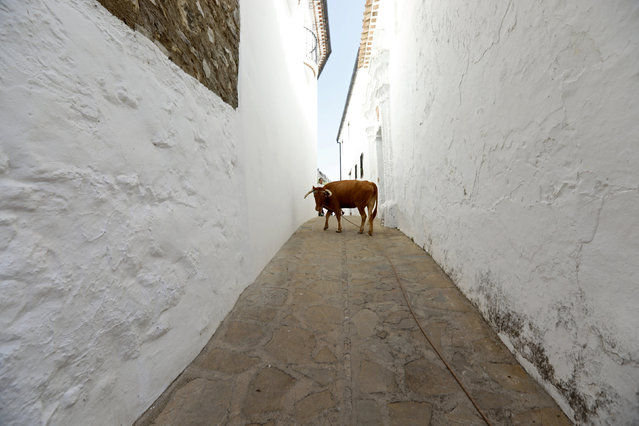
A heifer, tied with a rope, turns during “Toro de Cuerda” in the white village of Villaluenga del Rosario, southern Spain September 3, 2016. Dazzling clusters of cube-shaped houses perched on top of Andalusia's olive tree-studded mountains, the “Pueblos Blancos”, or white villages, of southern Spain are named for the lime wash the buildings are painted with to keep the interiors cool. The labyrinths of narrow alleyways are a throwback to when this region was known as Al-Andalus and was part of a medieval Muslim territory. While this region is stunningly beautiful and a big draw to tourists visiting the south of Spain, it is also one of the poorest areas in the country and has one of the highest unemployment rates in the European Union. (Photo by Marcelo del Pozo/Reuters)

A heifer, tied with a rope, turns during “Toro de Cuerda” in the white village of Villaluenga del Rosario, southern Spain September 3, 2016. Dazzling clusters of cube-shaped houses perched on top of Andalusia's olive tree-studded mountains, the “Pueblos Blancos”, or white villages, of southern Spain are named for the lime wash the buildings are painted with to keep the interiors cool. The labyrinths of narrow alleyways are a throwback to when this region was known as Al-Andalus and was part of a medieval Muslim territory. While this region is stunningly beautiful and a big draw to tourists visiting the south of Spain, it is also one of the poorest areas in the country and has one of the highest unemployment rates in the European Union. (Photo by Marcelo del Pozo/Reuters)
Details
20 Oct 2016 11:09:00
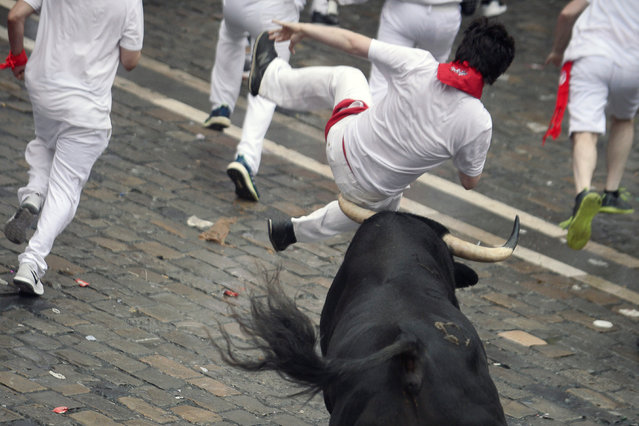
A bull hits a reveller during the first running of the bulls of the San Fermin festival in Pamplona, Spain, July 7, 2018. (Photo by Vincent West/Reuters)

A bull hits a reveller during the first running of the bulls of the San Fermin festival in Pamplona, Spain, July 7, 2018. Each day at 8am hundreds of people race with six bulls, charging along a winding, 848.6-metre (more than half a mile) course through narrow streets to the city's bull ring, where the animals are killed in a bullfight or corrida, during this festival dating back to medieval times and also featuring religious processions, folk dancing, concerts and round-the-clock drinking. (Photo by Vincent West/Reuters)
Details
11 Jul 2018 00:05:00