Loading...
Done
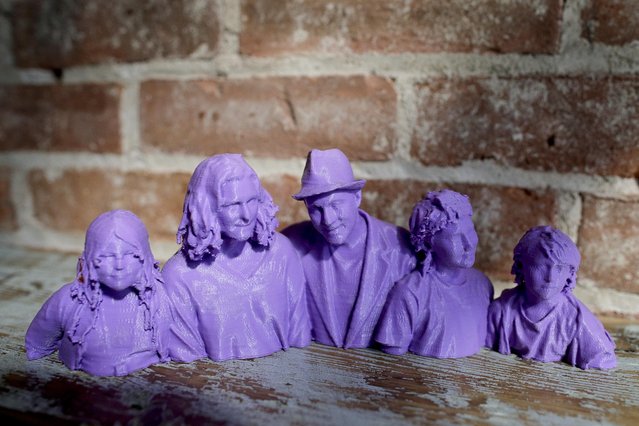
In this August 14, 2014 photo, a plastic bust statue of Kevin Micelli, center, and his family, made by a 3-D scanner and printer, sits on a shelf inside Micelli's coffee shop in New York. Micelli purchased the 3-D scanning and printing services at the Cubo toy store next door to his shop. With the old studio portrait supplanted by the selfie, 3-D scanning services provide a new reason for people to go to a store and stand stock-still in front of a camera. (Photo by Julie Jacobson/AP Photo)

“The advent of digital cameras and smartphones killed the traditional mall portrait studio, but 3-D printing has sparked a new trend. Overloaded with digital photos, statues may be moving in to fulfill our desire for portraits that stand out”. – Peter Svensson via The Associated Press. (Photo by Julie Jacobson/AP Photo)
Details
12 Oct 2014 12:28:00
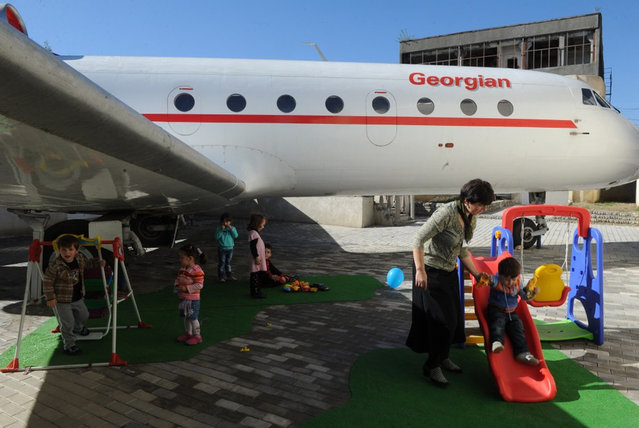
Aeroplane Turned Into Kindergarten

A headteacher in the Georgian city of Rustavi has found an unusual way to get children's early education off the ground -- by transforming an aeroplane into a kindergarten.

Gari Chapidze bought the old but fully functional Yakovlev Yak-42 from Georgian Airways and refurbished its interior with educational equipment, games and toys but left the cockpit instruments intact so they could be used as play tools
Details
02 Jan 2013 13:01:00


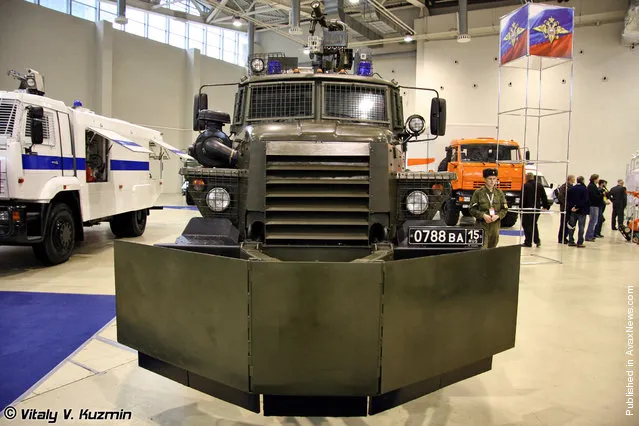
Special police vehicle Ural-4320-1880-30I Tornado


Interpolitex - the largest national forum of homeland security is the only national security fair of federal status and importance. It is held to provide manufacturers, suppliers and users special equipment and weaponry with an efficient tool for implementing a wide range of advertising and marketing objectives, monitoring of the market and deal-making. (Russia, Moscow, October 2011)
Details
20 Nov 2011 09:44:00
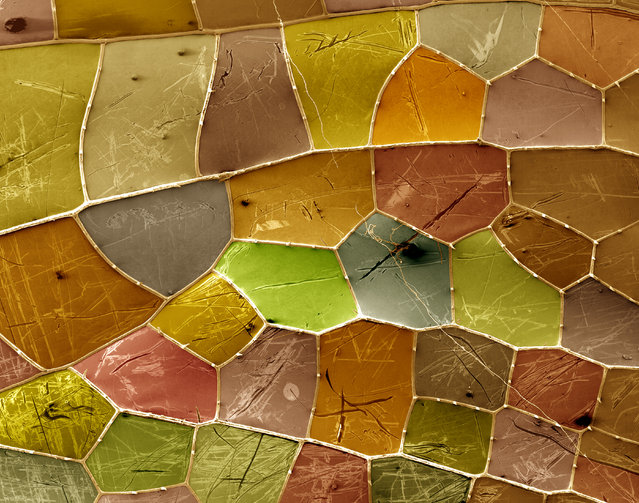
Micro or Macro? It's micro: this is an electron microscope image of the wing of a Green Darner dragonfly. (Photo by P. Kelly)

Macro or Micro? Scientists’ pictures baffle our sense of scale. It began when Stephen Young, a geography professor at Salem State University in Massachusetts, tricked his biologist colleague Paul Kelly into thinking a satellite image was one of his electron microscope scans. Can you guess whether they are close-up or very far away? (Photo by Paul Kelly)
Details
21 Apr 2014 10:24:00
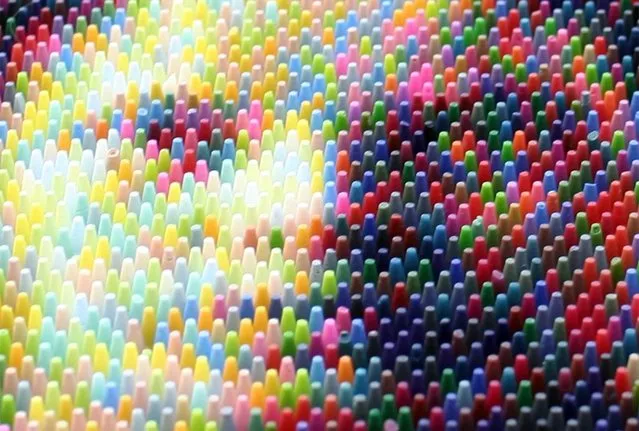
Art by Christian Faur

Christian Faur is an artist based in Granville, Ohio. Looking for a new technique, he experimented with painting with wax, but he didn’t feel the results were satisfactory.Then, at Christmas in 2005, his young daughter opened a box of 120 Crayola crayons he’d bought her, and everything clicked into place. Faur decided he would create pictures out of the crayons themselves, packing thousands of them together so they become like the colored pixels on a TV screen. He starts each work by scanning a photo into a computer and breaking the image down into colored blocks He then draws a grid that shows him exactly where to place each crayon The finished artworks are packed tightly into wooden frames. He actually makes the crayons himself, hand-casting each one in a mould.
Details
28 Jul 2012 10:03:00
Self-titled Pricasso – real name Tim Patch, 71, – is using his very own pen*s to create his masterpiece – and claims to have made close to £500k from his saucy paintings. Here: Pricasso gets to work with his tools - and paints The Sun's newspaper correspondent Amy Nickell with his bits in London, England on November 5, 2019. (Photo by Stewart Williams/The Sun)

Self-titled Pricasso – real name Tim Patch, 71, – is using his very own pen*s to create his masterpiece – and claims to have made close to £500k from his saucy paintings. Here: Pricasso gets to work with his tools - and paints The Sun's newspaper correspondent Amy Nickell with his bits in London, England on November 5, 2019. (Photo by Stewart Williams/The Sun)
Details
17 Jan 2020 00:05:00
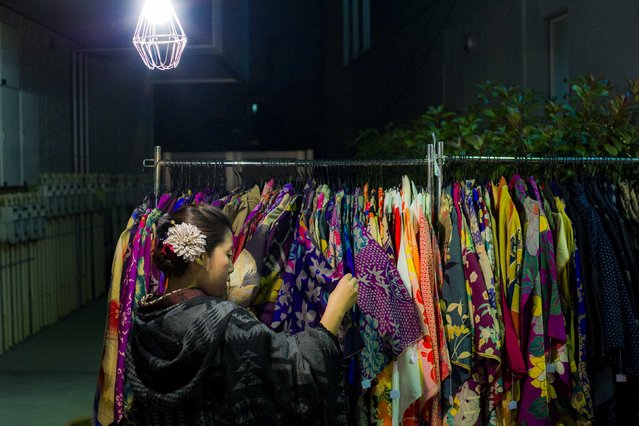
A woman browses through kimonos for sale at Boroichi flea market in Tokyo December 15, 2014. In the 16th century, Boroichi was a place for farmers to buy and sell rags, known as boro, for mending clothes and weaving sandals. Now in its 436th year, the original spirit lingers, with about 700 stands hawking fabric, used clothes and piles of rags. Others sell kitchen tools, pottery, seaweed and spices. (Photo by Thomas Peter/Reuters)

A woman browses through kimonos for sale at Boroichi flea market in Tokyo December 15, 2014. In the 16th century, Boroichi was a place for farmers to buy and sell rags, known as boro, for mending clothes and weaving sandals. Now in its 436th year, the original spirit lingers, with about 700 stands hawking fabric, used clothes and piles of rags. Others sell kitchen tools, pottery, seaweed and spices. About 200,000 people flock to the market, which is only open for four mid-winter days a year – two in December and two in January. (Photo by Thomas Peter/Reuters)
Details
19 Dec 2014 12:50:00
Winner of the NSW (New South Wales) prize: Peter Solness said: “I wanted to re-imagine the lost waterways, so I got my light-painting tools to work. In this image, water is being released from the top of the historic Centennial Park No. 2 Reservoir, which was built in 1925 and holds 90 megalitres of water. After 89 years of incarceration these waters now run free!”. (Photo by Peter Solness/Head On)

Touching and dramatic portraits and landscape shots have won prizes at Australia's prestigious photography prize. Photo: Winner of the NSW (New South Wales) prize: Peter Solness said: “I wanted to re-imagine the lost waterways, so I got my light-painting tools to work. In this image, water is being released from the top of the historic Centennial Park No. 2 Reservoir, which was built in 1925 and holds 90 megalitres of water. After 89 years of incarceration these waters now run free!”. (Photo by Peter Solness/Head On)
Details
21 May 2014 11:11:00