Loading...
Done
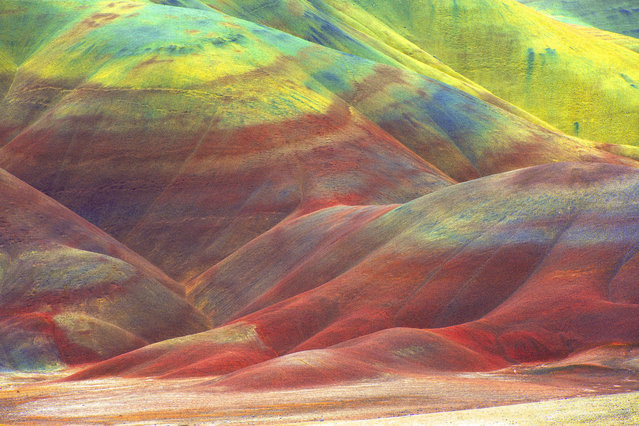
Layers of breathtaking colour streak the rolling hills of this vast desert, making the landscape appear as though it has been tie-dyed. The natural phenomenon, nicknamed the “Painted Desert”, was formed when the area was once a river floodplain. (Photo by Mark Brodkin/Solent News/SIPA Press)

Layers of breathtaking colour streak the rolling hills of this vast desert, making the landscape appear as though it has been tie-dyed. The natural phenomenon, nicknamed the “Painted Desert”, was formed when the area was once a river floodplain. Each colour corresponds to a different underground geological feature – rocks which have seemingly dyed the layers of earth above. Formed from volcanic activity, the hills at the John Day Fossil Beds National Monument in East Central Oregon, USA, are almost bursting with colour. Pictured: The colourful hills at the John Day Fossil Beds National Monument in East Central Oregon, USA. (Photo by Mark Brodkin/Solent News/SIPA Press)
Details
30 Jul 2014 11:00:00
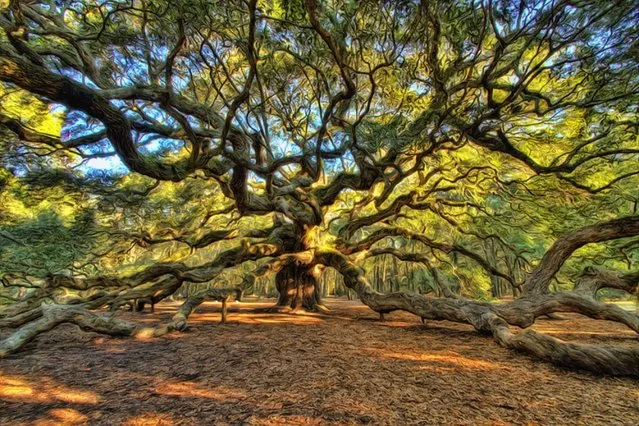
The Angel Oak Tree In South Carolina

The Angel Oak Tree is a Southern live oak located in Angel Oak Park on Johns Island near Charleston, South Carolina. The Angel Oak Tree is estimated to be at least 400 years old[citation needed]. It stands 66.5 ft (20 m) tall, measures 28 ft (8.5 m) in circumference, and produces shade that covers 17,200 square feet (1,600 m2). Its longest branch distance is 187 ft. in length. Angel Oak was the 210th tree to be registered with the Live Oak Society.
Details
18 May 2015 14:33:00
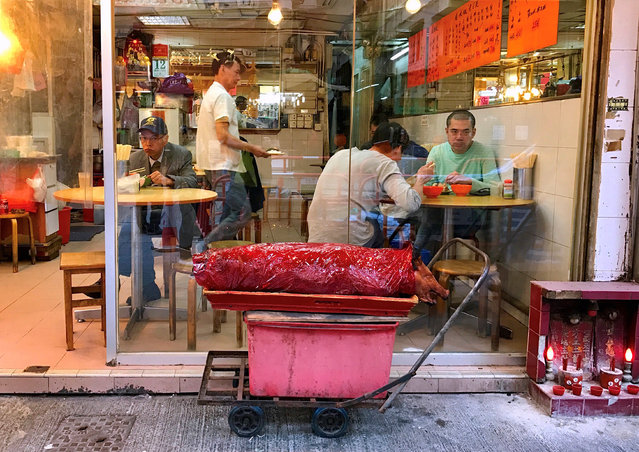
CHINA: Customers eat at a restaurant as a cooked pig sits on a cart on the street outside in Hong Kong, China, December 12, 2016. (Photo by David Gray/Reuters)

CHINA: Customers eat at a restaurant as a cooked pig sits on a cart on the street outside in Hong Kong, China, December 12, 2016. (Photo by David Gray/Reuters)
Details
26 Dec 2016 06:43:00
NEPAL: A devotee is smeared with a vermillion powder while celebrating the “Sindoor Jatra” vermillion powder festival at Thimi, in Bhaktapur, Nepal, April 14, 2016. (Photo by Navesh Chitrakar/Reuters)

NEPAL: A devotee is smeared with a vermillion powder while celebrating the “Sindoor Jatra” vermillion powder festival at Thimi, in Bhaktapur, Nepal, April 14, 2016. (Photo by Navesh Chitrakar/Reuters)
Details
26 Dec 2016 07:07:00
The Weird Shaped Trees Of Axel Erlandson

Axel Erlandson (December 15, 1884 – April 28, 1964) was a Swedish American farmer who shaped trees as a hobby, and opened a horticultural attraction in 1947 advertised as "See the World's Strangest Trees Here," and named "The Tree Circus."
The trees appeared in the column of Robert Ripley's Believe It or Not! twelve times. Erlandson sold his attraction shortly before his death. The trees were moved to Gilroy Gardens in 1985.
Details
20 Sep 2013 11:38:00
A Taiwanese woman takes a photo of a Christmas tree decoration at a street in Taipei, Taiwan,13 December 2015. (Photo by Ritchie B. Tongo/EPA)

A Taiwanese woman takes a photo of a Christmas tree decoration at a street in Taipei, Taiwan,13 December 2015. (Photo by Ritchie B. Tongo/EPA)
Details
15 Dec 2015 08:03:00
A couple hugs while standing near a Christmas tree made out of plastic bins and plastic hampers outside the Museum of History in Monterrey, Mexico, December 4, 2015. (Photo by Daniel Becerril/Reuters)

A couple hugs while standing near a Christmas tree made out of plastic bins and plastic hampers outside the Museum of History in Monterrey, Mexico, December 4, 2015. The humble Christmas tree has a rich history, from evergreen trees used to symbolise eternal life in Ancient Egypt to tree worship among pagan Europeans. The modern version has its origins in Germany, where the song “O Tannenbaum” is still a festive favourite. Today the traditional tree with lights and decorations appears in cities including Washington, Moscow and Beirut. Alternative constructions range from recycled rubbish in Mexico City to old window frames in Rakvere, Estonia. Whatever the shape or size, the message is the same: Merry Christmas. (Photo by Neil Hall/Reuters)
Details
23 Dec 2015 08:01:00
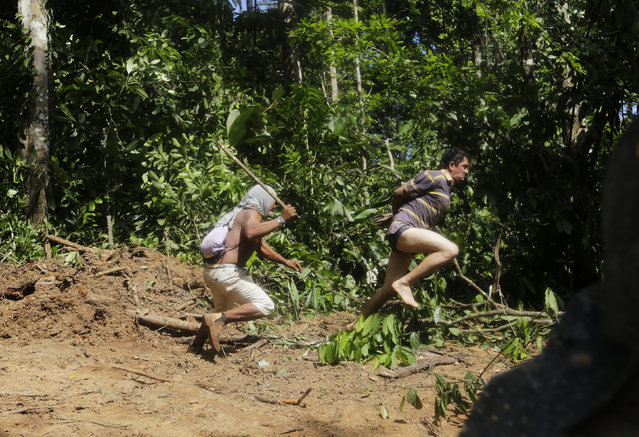
A Ka'apor Indian warrior (L) chases a logger who tried to escape after they captured him during a jungle expedition to search for and expel loggers from the Alto Turiacu Indian territory, near the Centro do Guilherme municipality in the northeast of Maranhao state in the Amazon basin, August 7, 2014. (Photo by Lunae Parracho/Reuters)

A Ka'apor Indian warrior (L) chases a logger who tried to escape after they captured him during a jungle expedition to search for and expel loggers from the Alto Turiacu Indian territory, near the Centro do Guilherme municipality in the northeast of Maranhao state in the Amazon basin, August 7, 2014. Tired of what they say is a lack of sufficient government assistance in keeping loggers off their land, the Ka'apor Indians, who along with four other tribes are the legal inhabitants and caretakers of the territory, have sent their warriors out to expel all loggers they find and set up monitoring camps in the areas that are being illegally exploited. (Photo by Lunae Parracho/Reuters)
Details
05 Sep 2014 11:41:00