Loading...
Done
Space Cats By Zippora Lux

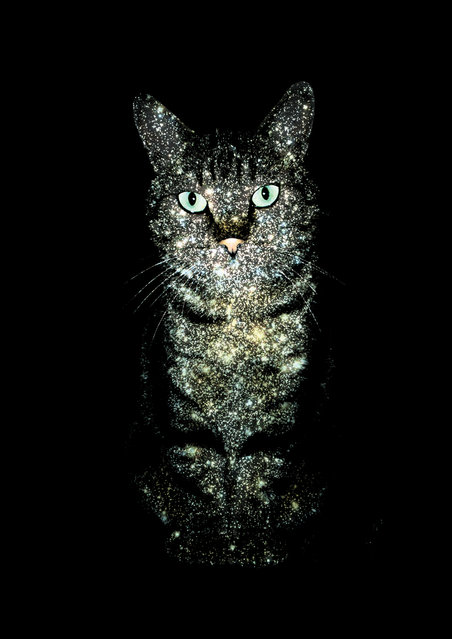
Boya Latumahina, alter ego, Zippora Lux is a Design student studying at Central St Martins in London. She has created these space age cats by combining two of her favourite things, cats and telescopic photographs.
Details
01 Dec 2013 10:34:00
The First U.S. Spacewalk – Gemini 4 Ed White made the United States' first spacewalk on June 3, 1965 during the Gemini 4 mission. The extra-vehicular activity (EVA) started at 19:45 UT (3:45 p.m. EDT) on the third orbit when White opened his hatch and used the hand-held manuevering oxygen-jet gun to push himself out of the capsule. (Photo by NASA)

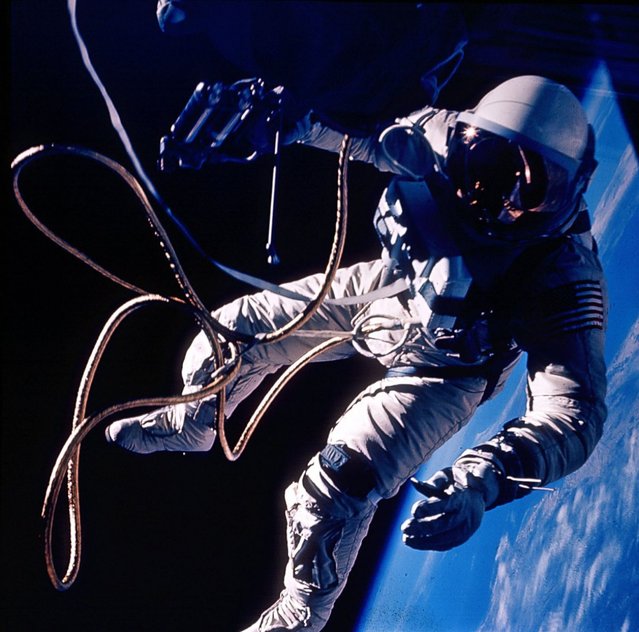
The First U.S. Spacewalk – Gemini 4 Ed White made the United States' first spacewalk on June 3, 1965 during the Gemini 4 mission. The extra-vehicular activity (EVA) started at 19:45 UT (3:45 p.m. EDT) on the third orbit when White opened his hatch and used the hand-held manuevering oxygen-jet gun to push himself out of the capsule. (Photo by NASA)
Details
11 Apr 2014 08:40:00
National Diving School director Jerome Vincent, wearing a Gandolfi space suit, executes training procedures in a swimming pool in Marseille October 22, 2014. (Photo by Jean-Paul Pelissier/Reuters)

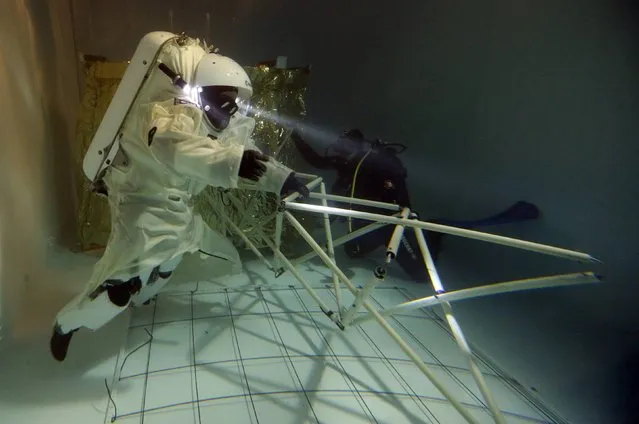
National Diving School director Jerome Vincent, wearing a Gandolfi space suit, executes training procedures in a swimming pool in Marseille October 22, 2014. The underwater test session develops European expertise in spacewalk simulations under partial gravity for exploring the Moon, asteroids and Mars.The training is organised by Comex, a French company specializing in engineering and deep sea diving operations, in collaboration with the European Space Agency (ESA) and with Apollo XI “Under the sea”. (Photo by Jean-Paul Pelissier/Reuters)
Details
26 Oct 2014 12:47:00
Biggest Cruise Ships By Jeffrey Milstein

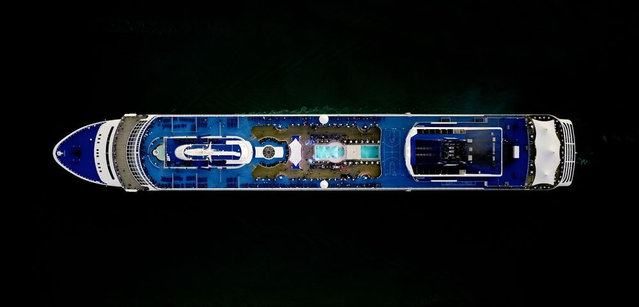
These spectacular photographs give a stunning birds-eye of view of the decks from some of the world's biggest cruise liners. New York based Photographer Jeffrey Milstein spent months hovering over the oceans using high-resolution camera equipment to capture views from a helicopter.
Details
06 Apr 2016 21:18:00
The Hoegh Osaka ro-ro cargo ship, operated by Hoegh Autoliners AS, sits grounded on Bramble Bank in the Solent near Cowes, on the Isle of Wight, U.K., on Monday, January 5, 2015. (Photo by Simon Dawson/Bloomberg)

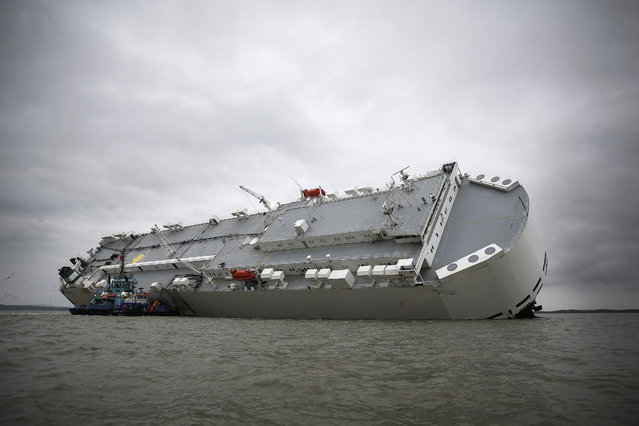
The “Hoegh Osaka” ro-ro cargo ship, operated by Hoegh Autoliners AS, sits grounded on Bramble Bank in the Solent near Cowes, on the Isle of Wight, U.K., on Monday, January 5, 2015. The car transporter was deliberately grounded after developing a list, shortly after it left the Port of Southampton. (Photo by Simon Dawson/Bloomberg)
Details
06 Jan 2015 11:44:00
Migrants react after boarding the Migrant Offshore Aid Station (MOAS) ship MV Phoenix some 20 miles (32 kilometres) off the coast of Libya, August 3, 2015. (Photo by Darrin Zammit Lupi/Reuters)

Migrants react after boarding the Migrant Offshore Aid Station (MOAS) ship MV Phoenix some 20 miles (32 kilometres) off the coast of Libya, August 3, 2015. Some 118 migrants were rescued from a rubber dinghy off Libya on Monday morning. The Phoenix, manned by personnel from international non-governmental organisations Medecins san Frontiere (MSF) and MOAS, is the first privately funded vessel to operate in the Mediterranean. (Photo by Darrin Zammit Lupi/Reuters)
Details
04 Aug 2015 11:56:00
Viewing The Earth From Space

Despite any political differences between the United States and Russia, the space agencies of the two countries continue their cooperative work in Earth's orbit, aboard the International Space Station. Apart from the research being done in microgravity, ISS crew members continue to send back amazing images of our home world, photographed from low Earth orbit. Gathered here are recent images of Earth from aboard the ISS, and from a handful of other NASA satellites.
Details
01 Jun 2014 12:36:00
An infrared portrait from NASA's Spitzer Space Telescope which shows generations of stars is seen in this undated NASA handout image released February 14, 2013. In this wispy star-forming region, called W5, the oldest stars can be seen as blue dots in the centers of the two hollow cavities (other blue dots are background and foreground stars not associated with the region). Red shows heated dust that pervades the region's cavities, while green highlights dense clouds. (Photo by NASA/Reuters/JPL-Caltech/Harvard-Smithsonian/Handout)

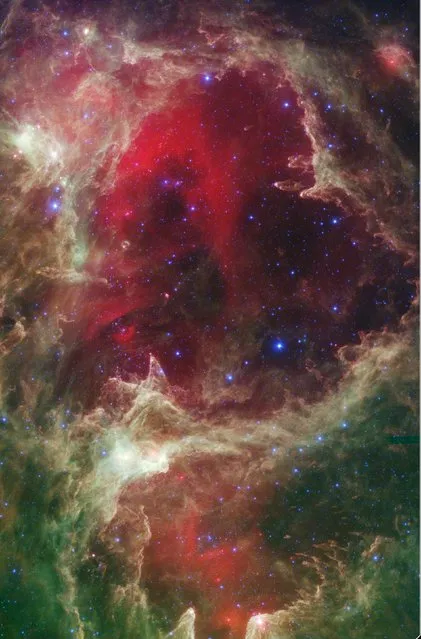
An infrared portrait from NASA's Spitzer Space Telescope which shows generations of stars is seen in this undated NASA handout image released February 14, 2013. In this wispy star-forming region, called W5, the oldest stars can be seen as blue dots in the centers of the two hollow cavities (other blue dots are background and foreground stars not associated with the region). Red shows heated dust that pervades the region's cavities, while green highlights dense clouds. (Photo by NASA/Reuters/JPL-Caltech/Harvard-Smithsonian/Handout)
Details
03 Mar 2013 08:44:00