Loading...
Done
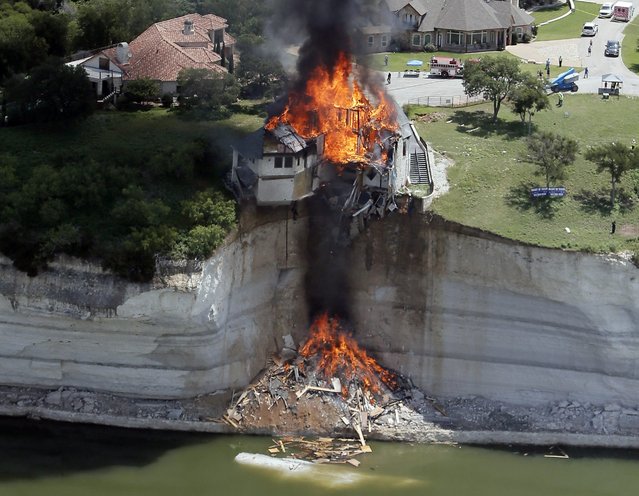
Smoke rises from a house days after part of the ground it was resting on collapsed into Lake Whitney, Texas in this June 13, 2014 file photo. I was covering the controlled burn of a house slowly falling into Lake Whitney due to the decaying cliff underneath.  Asked to take photos from an aerial perspective, an instructor and I took off from Grand Prairie Municipal Airport around 9am. (Photo and caption by Brandon Wade/Reuters)

Smoke rises from a house days after part of the ground it was resting on collapsed into Lake Whitney, Texas in this June 13, 2014 file photo. I was covering the controlled burn of a house slowly falling into Lake Whitney due to the decaying cliff underneath. Asked to take photos from an aerial perspective, an instructor and I took off from Grand Prairie Municipal Airport around 9am. The burn, scheduled to start an hour later, was delayed. I love flying, but patience proved challenging as circling for nearly three hours gets boring fast. Once the fire started we only had 15 minutes to take photos because the plane was booked at 1pm. The owners invested their retirement savings in the house and were even advised by geologists that the ground was stable. To watch your investment literally go up in flames must take its toll emotionally. The owners said they don't expect their insurance to cover the loss. (Photo and caption by Brandon Wade/Reuters)
Details
27 Nov 2014 15:01:00
In Extremis By Sandro Giordano

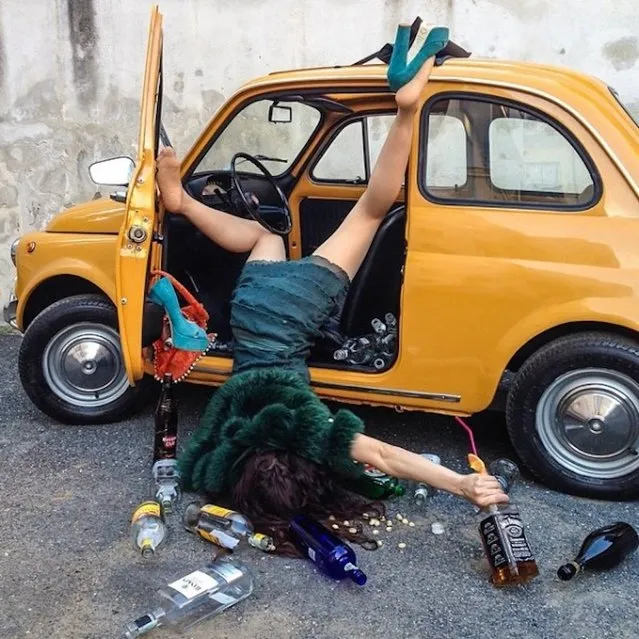
There is something strangely appealing about the set of pictures created by Sandro Giordano in a series “In Extremis (Bodies With No Regret)”. Could it be the absurdity of the situation? Or the fact that our brain tries to make up some bizarre story to justify what is happening in the pictures? Of course it is impossible to explain why a pair of tennis players ended up lying flat on the ground with a pack of bananas hanging on the net, even if we forget about the tennis racket lodged in the neck of one of the players. Nevertheless, it is fun to recreate these scenes in your mind just seconds before the tragedy took place. (Photo by Sandro Giordano)
Details
18 Oct 2014 07:09:00
Beards Of Christmas By Stephanie Jarstad

Why would you want to buy a Christmas tree if you have a luscious full beard? Or maybe you have a friend that is willing to volunteer? Just glue some ornaments onto his facial forest and make him stand in the corner. Just don’t forget to feed him! You don’t want your Christmas tree to go bad before the holidays are over! Stephanie Jarstad had created something similar in her project, The Twelve Bears of Christmas, in order to honor the Decembeard (much like Movember), in order to bring awareness to Men’s health problems. (Photo by Stephanie Jarstad)
Details
25 Dec 2014 13:22:00
Living Paintings By Alexa Meade

Creators of Mini Cooper continue on with their innovative way of promoting their product. First, it was the huge cardboard boxes, which looked like packaging for full sized Mini Coopers, left all over Amsterdam. Now they’ve hired a famous artist Alexa Meade, who is known for making 3-D objects look as if they are 2-D paintings. For this project, Alexa had to fly to Japan, where she turned a whole Mini Cooper into a “drawing”. Even if you know that what you’re seeing on the picture are 3-D objects, your brain refuses to accept this, making you think that Alexa is standing near a sloppy picture of a Mini Cooper.
Details
13 Nov 2014 13:48:00
Bus Home By Dennis Oppenheim

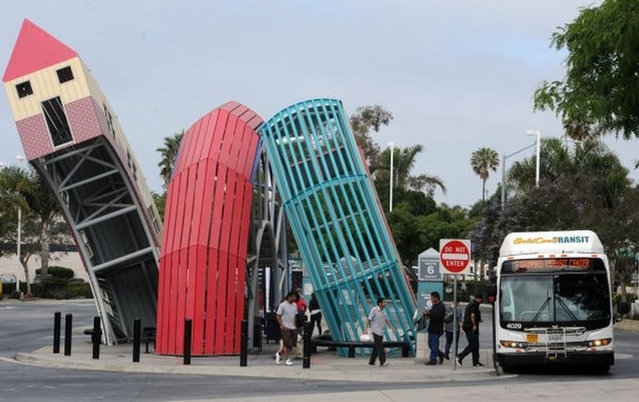
Since 2002 the Ventura bus stop at Telegraph Rd next to the Pacific View Mall remains as Ventura’s most controversial piece of public art. Created by renowned sculptor, Dennis Oppenheim, “Bus Home ” is a looping cork screw of steel, concrete, acrylic, paint, and electric light. It stands 36′ at its tallest height. For the artist: “The work depicts the metamorphosis of a bus becoming a house…entering the ground and coming up again. For the tired and often alienated traveler the experience of waiting wished to be intervened by the realization that the transaction will be complete. The passengers will arrive at their destination. They will arrive home
Details
16 Jul 2013 11:21:00


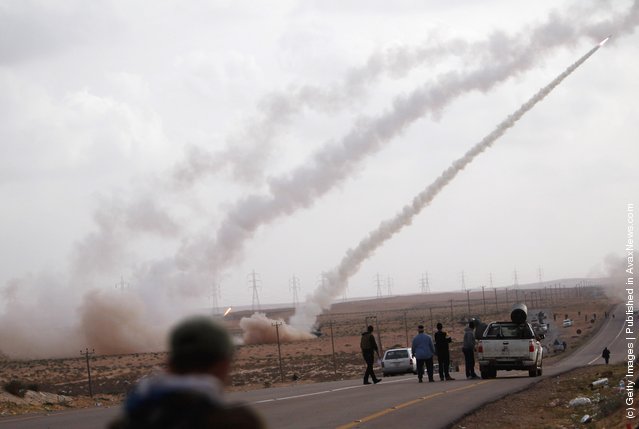
Libyan rebel soldiers watch as they fire rockets (background) toward Libyan government troops near front-line positions April 6, 2011 outside of Brega, Libya. Rebel militias fighting against Libyan government loyalist soldiers continued their stand-off in the eastern Libyan desert today, regaining ground toward a key oil port while awaiting further NATO airstrikes in their quest to unseat longtime Libyan ruler Muammar Gaddafi. (Photo by Chris Hondros/Getty Images)
Details
08 Apr 2011 10:27:00
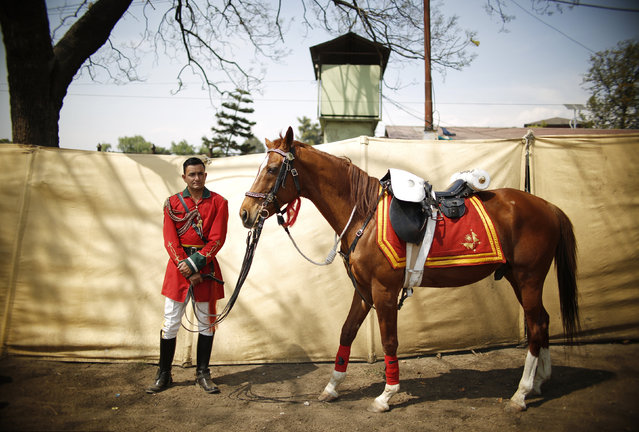
A Nepalese army solder stand next to a horse during the “Ghodejatra” Horse Race festival, which is organised by the Nepal Army, in Kathmandu, Nepal, April 7, 2016. Ghode Jatra, the horse racing festival of Nepal, celebrated on the New Moon day of mid March or early April is among the important celebrations of the Kathmandu Valley. exists a tree in the South-East part of the Tundikhel where Gurumapa supposed to be resides. (Photo by Navesh Chitrakar/Reuters)

A Nepalese army solder stand next to a horse during the “Ghodejatra” Horse Race festival, which is organised by the Nepal Army, in Kathmandu, Nepal, April 7, 2016. Ghode Jatra, the horse racing festival of Nepal, celebrated on the New Moon day of mid March or early April is among the important celebrations of the Kathmandu Valley. Grand horse parade including various acrobatic style of shows are performed by Nepal military at Tundikhel-a fenced parade ground located in the heart of Kathmandu city. (Photo by Navesh Chitrakar/Reuters)
Details
08 Apr 2016 14:33:00
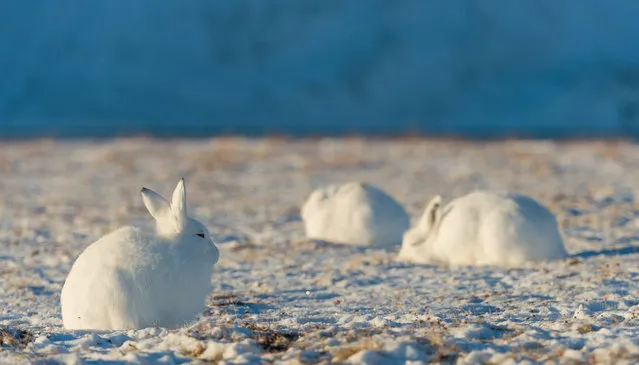
Arctic Hare

The arctic hare, or polar rabbit, is a species of hare which is adapted largely to polar and mountainous habitats. The arctic hare survives with a thick coat of fur and usually digs holes in the ground or under snow to keep warm and sleep. Arctic hares look like rabbits but have shorter ears, are taller when standing, and, unlike rabbits, can thrive in cold climates. They can travel together with many other hares, sometimes huddling with dozens or more, but are usually found alone, taking, in some cases, more than one partner. The arctic hare can run up to 60 kilometres per hour (40 mph). Its predators include the arctic wolf, arctic fox, and ermine.
Details
17 Mar 2014 13:56:00