Loading...
Done
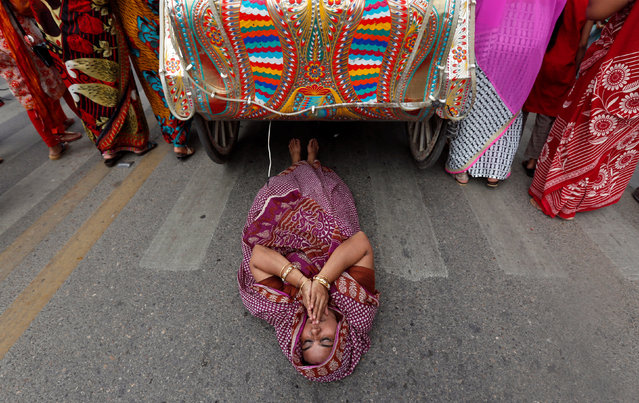
A Hindu devotee lies on a road as the holy “Rath”, or the chariot of lord Jagannath, passed over her during the Rath Yatra, or chariot procession in Karachi, Pakistan, July 17, 2016. Ratha-jatra is derived from two Odia words ratha/rotho meaning “chariot” and jatra meaning “journey”. The festival involves an annual procession (journey) of a deity's idols. Other names for the festival include ratha jatra or chariot festival. (Photo by Akhtar Soomro/Reuters)

A Hindu devotee lies on a road as the holy “Rath”, or the chariot of lord Jagannath, passed over her during the Rath Yatra, or chariot procession in Karachi, Pakistan, July 17, 2016. Ratha-jatra is derived from two Odia words ratha/rotho meaning “chariot” and jatra meaning “journey”. The festival involves an annual procession (journey) of a deity's idols. Other names for the festival include ratha jatra or chariot festival. (Photo by Akhtar Soomro/Reuters)
Details
18 Jul 2016 12:42:00
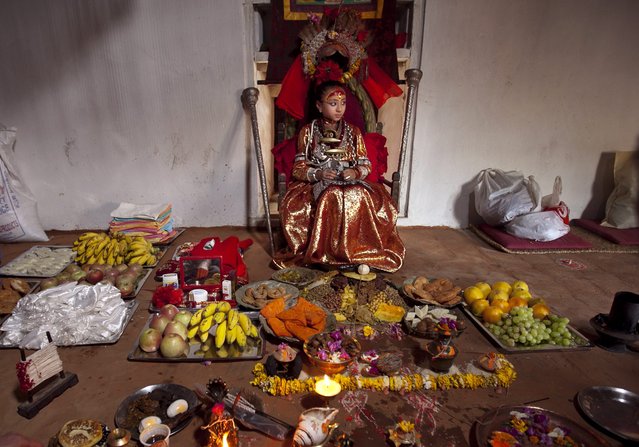
Kumari Samita Bajracharya sits in front of devotees offers during a special puja at Kumari Ghar in Patan, Nepal, 09 April 2011. It is believed that worshipping Kumari and receiving tika from her reduces illness and avoid problems. Kumari, or Kumari Devi, is a “living goddess”. The word literally means virgin in Nepali. The Living Goddesses are young pre-pubescent girls that are considered to be incarnations of the Hindu Goddess of Power, Kali. The Kumari retires when she reaches puberty. (Photo by Narendra Shrestha/EPA)

Kumari Samita Bajracharya sits in front of devotees offers during a special puja at Kumari Ghar in Patan, Nepal, 09 April 2011. It is believed that worshipping Kumari and receiving tika from her reduces illness and avoid problems. Kumari, or Kumari Devi, is a “living goddess”. The word literally means virgin in Nepali. The Living Goddesses are young pre-pubescent girls that are considered to be incarnations of the Hindu Goddess of Power, Kali. The Kumari retires when she reaches puberty. (Photo by Narendra Shrestha/EPA)
Details
18 Jun 2014 12:31:00
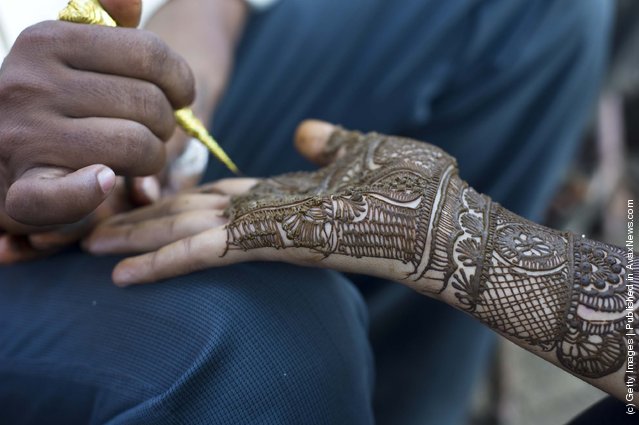
Application of henna or “Mehndi”  to a girls hand in a market in Jaipur, India

“Mehndi or menhdi is the application of henna as a temporary form of skin decoration in India, as well as by expatriate communities from the country. The word mehndi is derived from the Sanskrit word mendhikā. The use of mehndi and turmeric is described in the earliest Vedic ritual books. Haldi (Staining oneself with turmeric paste) as well as mehndi are important Vedic customs as a symbolic representation of the Outer and the Inner Sun. Vedic customs are meant to awaken the “inner light” and so the gold of the inner Sun has an important symbolic function”. – Wikipedia

Photo: Application of henna or “Mehndi” to a girls hand in a market on October 18, 2010 in Jaipur, India. (Photo by Simon de Trey-White/Getty Images)
Details
23 Nov 2011 13:33:00
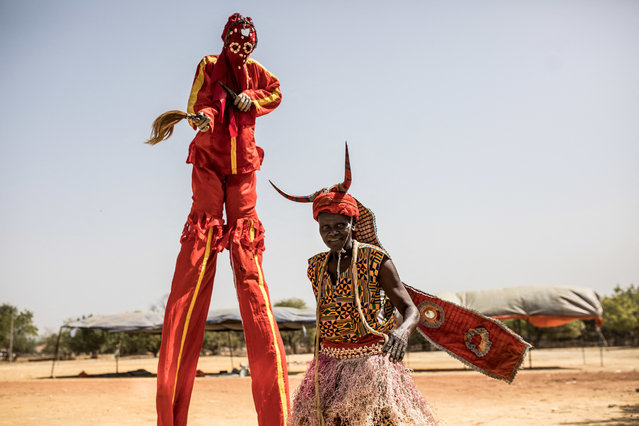
A masquerade dances to drums along the streets during the kankurang Festival in Janjanbureh on January 27, 2024. Listed as a UNESCO World Heritage Site since 2005, Kankurang, a combination of the Mandingo words “kango” and “Kurango”, literally translated as “voice” and “force”, ensures the transmission and teaching of the values and practices that form the basis of Mandingo cultural identity, a West African people whose historical home was the Mali empire. (Photo by Muhamadou Bittaye/AFP Photo)

A masquerade dances to drums along the streets during the kankurang Festival in Janjanbureh on January 27, 2024. Listed as a UNESCO World Heritage Site since 2005, Kankurang, a combination of the Mandingo words “kango” and “Kurango”, literally translated as “voice” and “force”, ensures the transmission and teaching of the values and practices that form the basis of Mandingo cultural identity, a West African people whose historical home was the Mali empire. (Photo by Muhamadou Bittaye/AFP Photo)
Details
13 Mar 2025 01:44:00
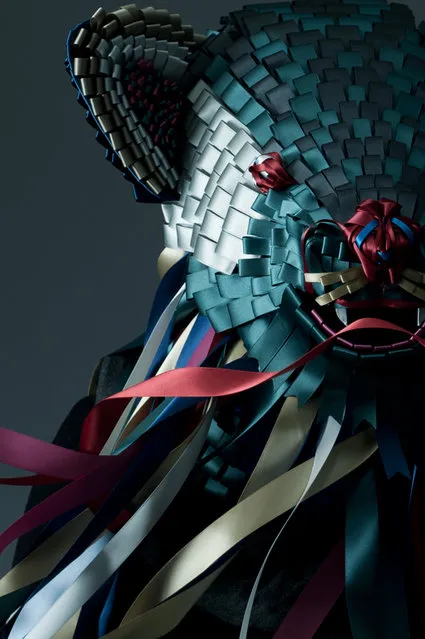
Ribbonesia By Baku Maeda

Ribbonesia is a modern ribbon company created by Japanese artist Baku Maeda. The word “ribbon” and ‘modern’ is an understatement when describing Ribbonesia because these are more like life-size modern sculptures made with satin and silk. I wouldn’t be shocked if he starts creating apparel in the near future.
Details
18 Apr 2014 13:24:00
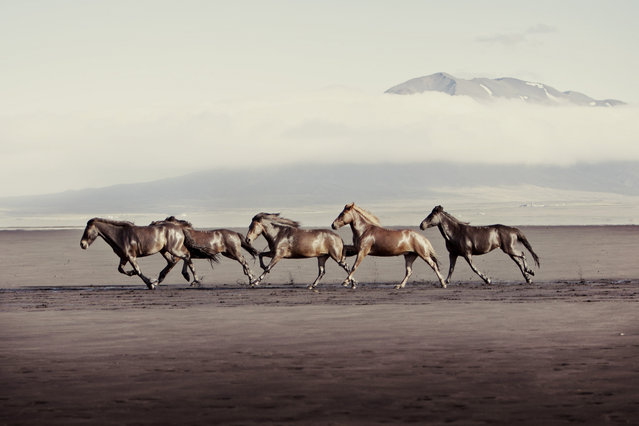
“Runners”. (Photo by Gigja Einarsdottir)

“As you can see I love the Icelandic Horse. Born and raised with them, I love to work with them and watch them ... they have unbelievable network of communication and energy I can´t explain with words”. – Gigja Einarsdottir. Photo: “Runners”. (Photo by Gigja Einarsdottir)
Details
06 Oct 2013 10:04:00
Nigerian fashion models are made up for their fashion show to promote ethnic fashion June 13, 2006 in Tel Aviv, Israel

Nigerian fashion models are made up for their fashion show to promote ethnic fashion June 13, 2006 in Tel Aviv, Israel. The models said they hope to use the travelling show as a springboard to international fame, in the words of one, “to be the next Naomi Campbell”. (Photo by Uriel Sinai/Getty Images)
Details
31 Jul 2011 14:23:00
A humanoid robot named “Robi” sits during a promotional event for the launch of a weekly Robi Magazine in Tokyo, Japan, 20 January 2015. Created by roboticist Tomotaka Takahashi, the 34-centimeter tall humanoid robot can recognize and respond to more than 200 words and phrases, walk and dance. (Photo by Franck Robichon/EPA)

A humanoid robot named “Robi” sits during a promotional event for the launch of a weekly Robi Magazine in Tokyo, Japan, 20 January 2015. Created by roboticist Tomotaka Takahashi, the 34-centimeter tall humanoid robot can recognize and respond to more than 200 words and phrases, walk and dance. Parts of the robot will be put on sale in a weekly magazine to be fully assembled with 70 issues. (Photo by Franck Robichon/EPA)
Details
21 Jan 2015 13:19:00