Loading...
Done
A tale of two foxes. Surprising behaviour, witnessed in Wapusk national park, on Hudson Bay, Canada, in early winter. Red foxes don’t actively hunt Arctic foxes, but where the ranges of two predators overlap, there can be conflict. Though the light was poor, the snow-covered tundra provided the backdrop for the moment that the red fox paused with the smaller fox in its mouth in a grim pose. (Photo by Don Gutoski/2015 Wildlife Photographer of the Year)

A tale of two foxes. Surprising behaviour, witnessed in Wapusk national park, on Hudson Bay, Canada, in early winter. Red foxes don’t actively hunt Arctic foxes, but where the ranges of two predators overlap, there can be conflict. Though the light was poor, the snow-covered tundra provided the backdrop for the moment that the red fox paused with the smaller fox in its mouth in a grim pose. (Photo by Don Gutoski/2015 Wildlife Photographer of the Year)
Details
20 Oct 2015 08:02:00
Arctic treasure by Sergey Gorshkov (Russia). An arctic fox carries its egg trophy from a raid on a snow goose nest and heads for a suitable burial spot. Finalist 2017, Animal Portraits. (Photo by  Sergey Gorshkov/2017 Wildlife Photographer of the Year)

Arctic treasure by Sergey Gorshkov (Russia). An arctic fox carries its egg trophy from a raid on a snow goose nest and heads for a suitable burial spot. Finalist 2017, Animal Portraits. (Photo by Sergey Gorshkov/2017 Wildlife Photographer of the Year)
Details
12 Sep 2017 09:33:00
Coast and marine winner: Storm Gull (Lesser black-backed gull), New Haven, East Sussex. (Photo by Craig Denford/British Wildlife Photography Awards)

Coast and marine winner: Storm Gull (Lesser black-backed gull), New Haven, East Sussex. (Photo by Craig Denford/British Wildlife Photography Awards)
Details
07 Nov 2018 00:05:00
A frog appears to have a big smile for the camera, Russia. (Photo by Artyom Krivosheev/Barcroft Images/Comedy Wildlife Photography Awards 2016)

A frog appears to have a big smile for the camera, Russia. Things are heating up at the Comedy Wildlife Photography Awards as the shortlisted final 40 entries are revealed. This year's competition has featured over 2200 hilarious entries from around the world with photos including a fox face planting in the snow, a dancing brown bear and a pair of seemingly headless penguins – all beautifully photographed with perfect comedy timing and a strong conservation message. (Photo by Artyom Krivosheev/Barcroft Images/Comedy Wildlife Photography Awards 2016)
Details
08 Oct 2016 11:57:00
Mountains Gorilla is making grimaces, as he came out of the bush after the rain, in Virunga National Park, Rwanda. (Photo by Josef Friedhuber/Comedy Wildlife Photography Awards/Barcroft Media)

Prepare yourself for some rib-tickling laughter because the Comedy Wildlife Awards has announced its finalists. Founded by Tanzania-based photographers Paul Joynson-Hicks MBE and Tom Sullam, the aim of the awards is to put a spotlight on wildlife conservation efforts while simultaneously injecting some humour into the world of wildlife photography. Here: Mountains Gorilla is making grimaces, as he came out of the bush after the rain, in Virunga National Park, Rwanda. (Photo by Josef Friedhuber/Comedy Wildlife Photography Awards/Barcroft Media)
Details
07 Nov 2017 07:57:00
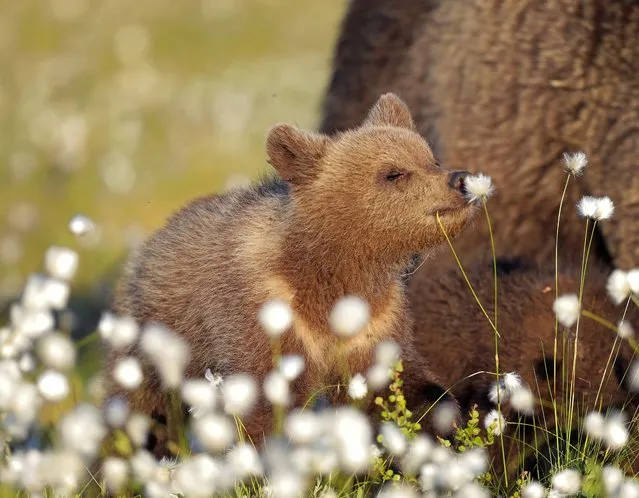
“Romantic”. A brown bear in Martinselkonen, Finland. (Photo by Valtteri Mulkahainen/Comedy Wildlife Photography Awards)

“Romantic”. A brown bear in Martinselkonen, Finland. (Photo by Valtteri Mulkahainen/Comedy Wildlife Photography Awards)
Details
22 Oct 2022 04:44:00
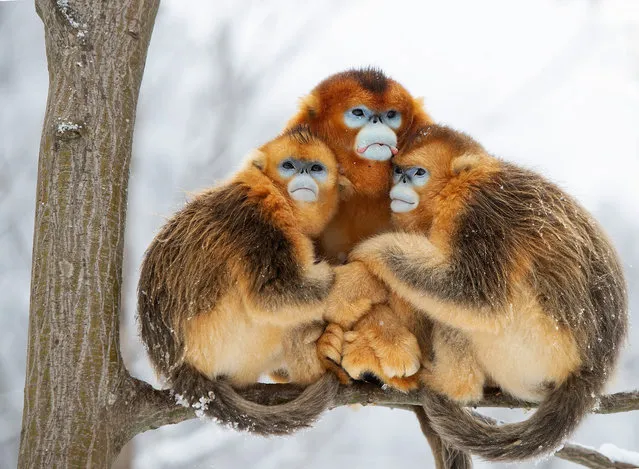
A golden huddle by Minqiang Lu, China. Two females and a male golden snub-nosed monkey huddle together to keep warm in the extreme cold. Threatened by forest loss and fragmentation, this endangered species is confined to central China. Restricted to living high up in the temperate forests, these monkeys – here in the Qinling mountains in Shaanxi province – feed mostly in the trees, on leaves, bark, buds and lichen. In heavy wind and snow, Minqiang walked up the mountain carrying his equipment. He stayed for half an hour in temperatures of –10C opposite the tree where the group was huddled before achieving this eye-level composition. (Photo by Minqiang Lu/Wildlife Photographer of the Year)

A golden huddle by Minqiang Lu, China. Two females and a male golden snub-nosed monkey huddle together to keep warm in the extreme cold. Threatened by forest loss and fragmentation, this endangered species is confined to central China. Restricted to living high up in the temperate forests, these monkeys – here in the Qinling mountains in Shaanxi province – feed mostly in the trees, on leaves, bark, buds and lichen. In heavy wind and snow, Minqiang walked up the mountain carrying his equipment. He stayed for half an hour in temperatures of –10C opposite the tree where the group was huddled before achieving this eye-level composition. (Photo by Minqiang Lu/Wildlife Photographer of the Year)
Details
12 Jan 2023 01:19:00
Highly commended, mammals: Gelada after the storm – Marco Gaiotti (Italy). “Gelada baboons are the only monkey species in the world that feed on grasses. They are native to the tableland of Ethiopia. Every morning large family groups wander from their sleeping places in the steep rock face, up to 1,000 metres high, to the feeding grounds at the tablelands. This image clearly depicts their feeding strategy: they pull out bunches of grass, sort the stalks and then lift them to their mouth. This shot was taken towards the end of the rainy season after a heavy storm”. (Photo by Marco Gaiotti/2019 GDT European Wildlife Photographer of the Year)

Highly commended, mammals: Gelada after the storm – Marco Gaiotti (Italy). “Gelada baboons are the only monkey species in the world that feed on grasses. They are native to the tableland of Ethiopia. Every morning large family groups wander from their sleeping places in the steep rock face, up to 1,000 metres high, to the feeding grounds at the tablelands. This image clearly depicts their feeding strategy: they pull out bunches of grass, sort the stalks and then lift them to their mouth. This shot was taken towards the end of the rainy season after a heavy storm”. (Photo by Marco Gaiotti/2019 GDT European Wildlife Photographer of the Year)
Details
31 Oct 2019 00:03:00