British television presenter Maya Jama at “Love Island All: Stars” TV show in London, United Kingdom on December 16, 2023. (Photo by ITV/Love Island/Rex Features/Shutterstock)
A Ukrainian serviceman of the 47th “Magura” Separate Mechanized Brigade plays with a cat, which his unit evacuated from a frontline, amid Russia's attack on Ukraine, at undisclosed location in Donetsk region, Ukraine on February 8, 2024. (Photo by Alina Smutko/Reuters)
Andrea Spendolini Sirieix and Lois Toulson of Britain in action during the women's synchronized 10m diving at the Paris Olympics on July 31, 2024. (Photo by Leah Millis/Reuters)
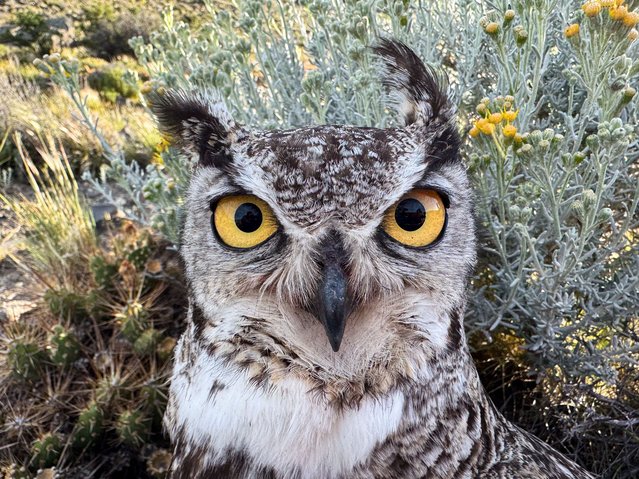
Lesser Horned Owl (Bubo magellanicus) is seen at the meadows of Patagonian valley in Santa Cruz, Argentina on December 21, 2024. Lesser Horned Owl is a large owl of the genus Bubo found in southern South America, with its distinctive “horns”, black-rimmed face and heavily striped abdomen. (Photo by Mehmet Emin Yogurtcuoglu/Anadolu via Getty Images)
Japanese dancers perform the Awa-odori in the pitlane during the driver parade before the 2025 Formula 1 Japanese Grand Prix at the Suzuka Circuit, in Suzuka, Japan, 06 April 2025. (Photo by Franck Robichon/EPA)
A competitor takes part in the Shrove Tuesday Pancake Race at the City of London's Leadenhall Market on February 13, 2024. (Photo by Isabel Infantes/Reuters)
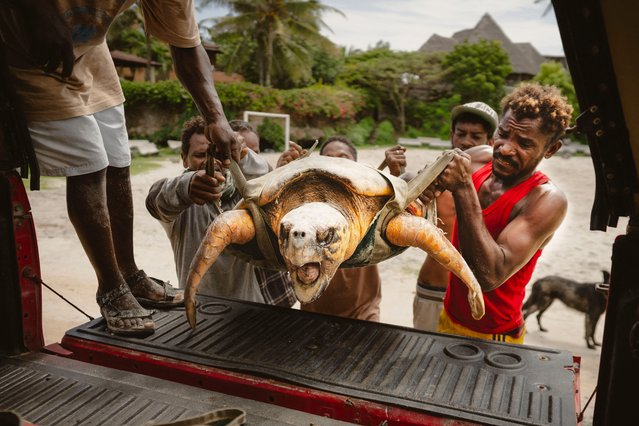
Staff from Local Ocean Conservation and fishermen lifting a mature Loggerhead sea turtle into a car, after the turtle was hooked out on the open water and needs to be taken to observation in the rehabilitation centre before being released back into the ocean, in Watamu, Kenya on May 22, 2025. (Photo by Fredrik Lerneryd/AFP Photo)
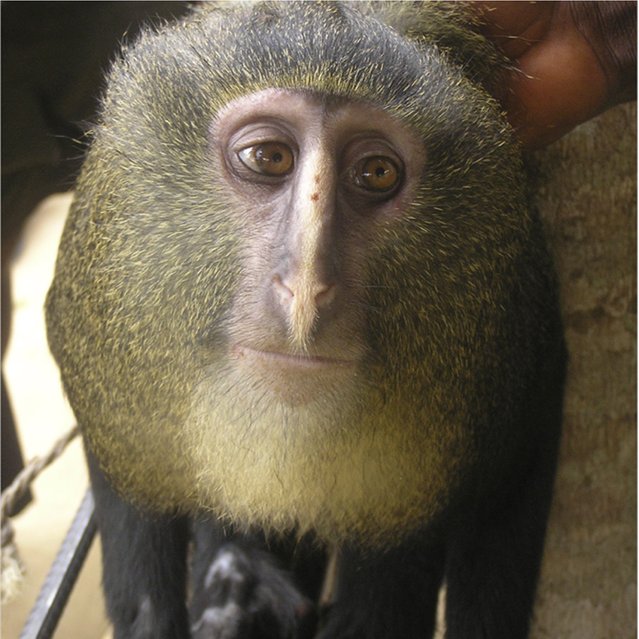
A new species of monkey found in the Democratic Republic of the Congo and identified as Lesula (Cercopithecus lomamiensis) is seen in this undated photograph from an article published September 12, 2012 in the science journal PLOS One. The monkey was first seen in 2007 by researchers John and Terese Hart of the Peabody Museum of Natural History at Yale Research Project. The finding of C. lomamiensis represents only the second new species of African monkey to be discovered in the past 28 years, according to the research article. (Photo by Hart J. A., Detwiler K. M., Gilbert C. C./Reuters)