Loading...
Done
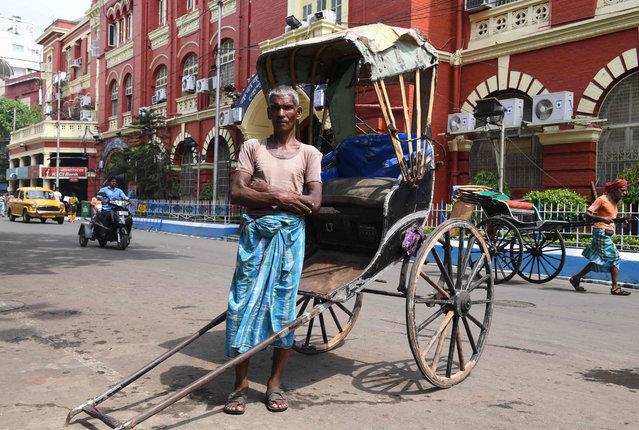
Mohammad Ashgar, 65, an Indian rickshaw puller, poses for a photograph next to his rickshaw in Kolkata on April 21, 2018. A mainstay of 19 th century transportation options, the hand- pulled rickshaw survives in India only in Kolkata after being outlawed elsewhere. The local puller's union puts the number of pullers in the city at 3,000. The union has resisted all previous attempts to ban their livelihood, previously organising mass protests of their members against moves to stamp out the practice. (Photo by Dibyangshu Sarkar/AFP Photo)

Ahead of May Day, AFP' s video and photo teams spoke to men and women around the globe whose jobs are becoming increasingly rare, particularly as technology transforms societies. Here: Mohammad Ashgar, 65, an Indian rickshaw puller, poses for a photograph next to his rickshaw in Kolkata on April 21, 2018. (Photo by Dibyangshu Sarkar/AFP Photo)
Details
02 May 2018 00:01:00
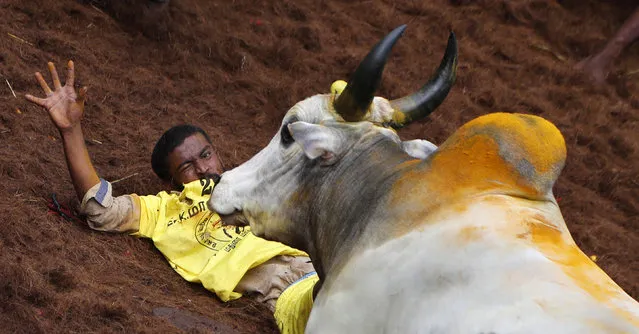
In this Thursday, January 17, 2019, photo, an Indian tamer reacts as a bull charges towards him during a traditional bull-taming festival called Jallikattu, in the village of Allanganallur, near Madurai, Tamil Nadu state, India. (Photo by Aijaz Rahi/AP Photo)

In this Thursday, January 17, 2019, photo, an Indian tamer reacts as a bull charges towards him during a traditional bull-taming festival called Jallikattu, in the village of Allanganallur, near Madurai, Tamil Nadu state, India. Jallikattu involves releasing a bull into a crowd of people who are expected to hang on to the animal's hump for a stipulated distance or hold on to the hump for a minimum of three jumps made by the bull. The sport, performed during the four-day “Pongal” or winter harvest festival, is hugely popular in Tamil Nadu. (Photo by Aijaz Rahi/AP Photo)
Details
21 Jan 2019 00:01:00
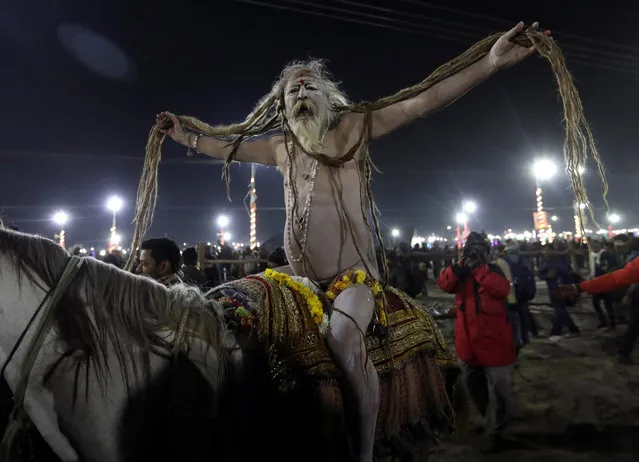
Indian Naga Sadhus, or naked holy men, participate in a procession before taking a “shahi snans”, or holy bath, at the Sangam river, the confluence of three of the holiest rivers in Hindu mythology, the Ganga, the Yamuna and the Saraswati, during Kumbh Mela festival in Allahabad, Uttar Pradesh, India, 15 January 2019. The Hindu festival is one of the biggest in India and will be held from 15 January to 04 March 2019 in Allahabad. (Photo by Rajat Gupta/EPA/EFE)

Indian Naga Sadhus, or naked holy men, participate in a procession before taking a “shahi snans”, or holy bath, at the Sangam river, the confluence of three of the holiest rivers in Hindu mythology, the Ganga, the Yamuna and the Saraswati, during Kumbh Mela festival in Allahabad, Uttar Pradesh, India, 15 January 2019. The Hindu festival is one of the biggest in India and will be held from 15 January to 04 March 2019 in Allahabad. (Photo by Rajat Gupta/EPA/EFE)
Details
26 Jan 2019 00:01:00
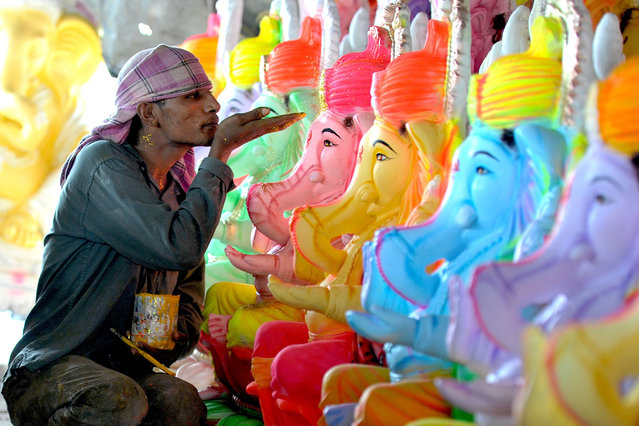
An Indian artists uses sparkles to decorate statues of the Hindu god Lord Ganesh ahead of the forthcoming Ganesh Chaturthi festival at a workshop in Hyderabad on August 29, 2016. The statues are being prepared for the Ganesh Chaturthi festival a popular eleven-day long Hindu religious festival in India which will be celebrated from September 5 to 15. (Photo by Noah Seelam/AFP Photo)

An Indian artists uses sparkles to decorate statues of the Hindu god Lord Ganesh ahead of the forthcoming Ganesh Chaturthi festival at a workshop in Hyderabad on August 29, 2016. The statues are being prepared for the Ganesh Chaturthi festival a popular eleven-day long Hindu religious festival in India which will be celebrated from September 5 to 15. (Photo by Noah Seelam/AFP Photo)
Details
31 Aug 2016 11:54:00
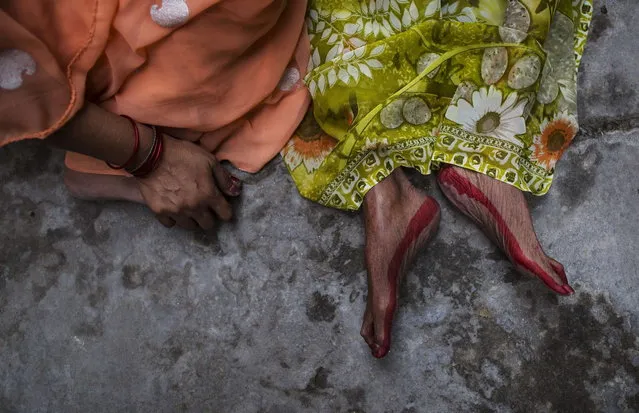
A relative (L) of Champa Devi, 88, sits next to her body, minutes after her death at Mukti Bhavan (Salvation House) at Varanasi, in the northern Indian state of Uttar Pradesh, June 21, 2014. (Photo by Danish Siddiqui/Reuters)

A relative (L) of Champa Devi, 88, sits next to her body, minutes after her death at Mukti Bhavan (Salvation House) at Varanasi, in the northern Indian state of Uttar Pradesh, June 21, 2014. The city of Varanasi, on the banks of the River Ganges, is widely considered Hinduism's holiest city and many Hindus believe that dying there and having their remains scattered in the Ganges allows their soul to escape a cycle of death and rebirth, attaining “moksha” or salvation. “Mukti Bhavan” or “Salvation House”, is a charity-run hostel that caters for people who wish to come to Varanasi to die. Guests can normally stay up to two weeks after which, if they haven't yet passed away, they are gently asked to leave. (Photo by Danish Siddiqui/Reuters)
Details
24 Jul 2014 12:32:00
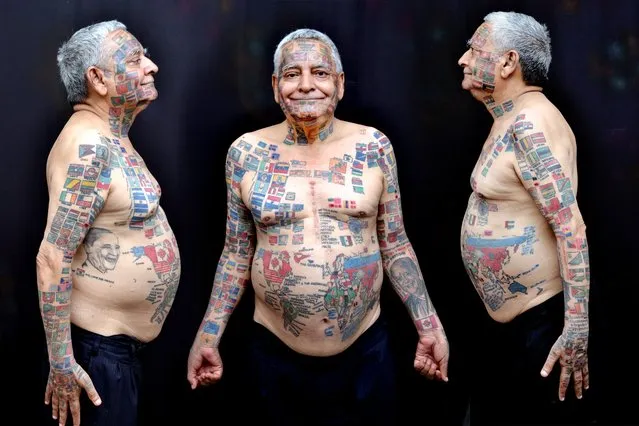
Guinness Rishi – The Human Flag

67-year-old Guinness Rishi constantly tries to make his family and the entire Indian people by constantly setting new records. He previously became father of the world’s oldest adoptee, after taking custody of his 61-year-old brother-in-law, and built the tallest sugar-cube tower in the world, which stood at 64 inches.
Details
09 Oct 2014 12:16:00
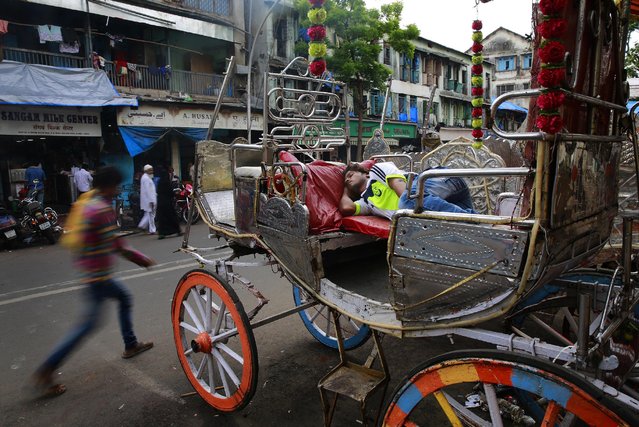
In this June 16, 2015 photo, an Indian coachman sleeps on his Victoria horse-drawn carriage outside a stable in Mumbai, India. Drivers of Mumbai's iconic horse-drawn carriages can't imagine not plying the roads pulling photo-snapping tourists atop their kitsch-covered chariots. Yet that time is coming, thanks to a court order calling such superfluous “joyrides” a form of animal cruelty and banning them in India's financial capital from June 2016. (Photo by Rafiq Maqbool/AP Photo)

In this June 16, 2015 photo, an Indian coachman sleeps on his Victoria horse-drawn carriage outside a stable in Mumbai, India. Drivers of Mumbai's iconic horse-drawn carriages can't imagine not plying the roads pulling photo-snapping tourists atop their kitsch-covered chariots. Yet that time is coming, thanks to a court order calling such superfluous “joyrides” a form of animal cruelty and banning them in India's financial capital from June 2016. (Photo by Rafiq Maqbool/AP Photo)
Details
03 Jul 2015 12:46:00
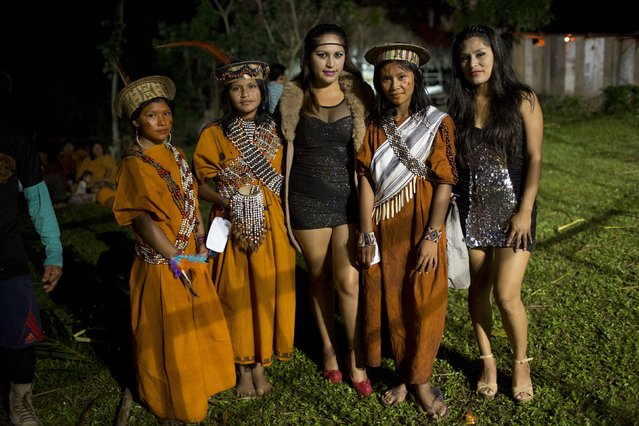
In this June 23, 2015 photo, Ashaninka Indian beauty contestants pose for a photo with members of a visiting music group, hired to perform during the annual founding anniversary festivities, in Otari Nativo, Pichari, Peru. The contestants wear the simple brown dresses of the Ashaninka woman, their faces dotted in a traditional design with a red dye extracted from a spice called achiote. (Photo by Rodrigo Abd/AP Photo)

In this June 23, 2015 photo, Ashaninka Indian beauty contestants pose for a photo with members of a visiting music group, hired to perform during the annual founding anniversary festivities, in Otari Nativo, Pichari, Peru. The contestants wear the simple brown dresses of the Ashaninka woman, their faces dotted in a traditional design with a red dye extracted from a spice called achiote. (Photo by Rodrigo Abd/AP Photo)
Details
16 Jul 2015 11:12:00