Loading...
Done
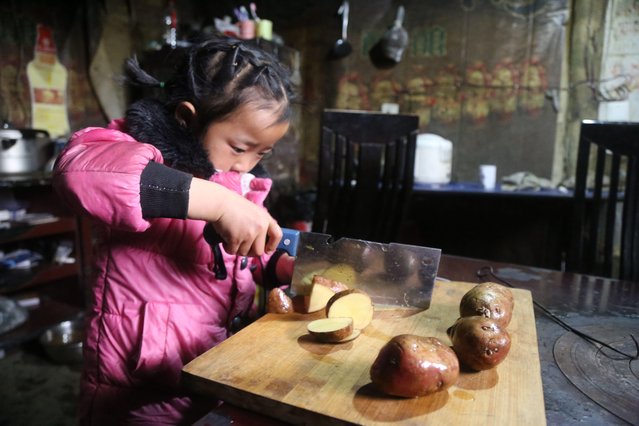
5-year-old Chinese girl Wang Anna prepares meals for her grandmother and great-grandmother at home in Zhuyuan village, Guizhou province, China on March 3, 2017. (Photo by Imaginechina/Rex Features/Shutterstock)

5-year-old Chinese girl Wang Anna prepares meals for her grandmother and great-grandmother at home in Zhuyuan village, Guizhou province, China on March 3, 2017. Chinese girl called Wang Anna, 5, takes care of her ill grandmother and 92-year-old great-grandmother on her own every day in a mountainous village in Zhima town, Zunyi city, southwest China's Guizhou province. Her father went to jail before she was born and her mother remarried after gave birth to her. Although she is just five years old, she started to shoulder the responsibility to look after ill grandmother and elderly great-grandmother. (Photo by Imaginechina/Rex Features/Shutterstock)
Details
09 Mar 2017 00:05:00
Human Barbie Doll Valeria Lukyanova aka Naamah From The Ukraine

This is a “swami” - Valeria Lukyanova (born August 23, 1985), from Odessa, Ukraine. Her other names: Naamah (Нахема; Na'amah (Hebrew: נעמה‎) – is a demonic legendary creature, the mother of divination), Amatue, Nagval and Goddess (бАгиня). She is fond of esoteric, believes that 2012 will be the end of the world, and waits for the planet Nibiru (I'm not kidding). This girl had amused the Russian-language Internet (because the Russians are cynical and heartless people). IMHO she is very beautiful (technical characteristics – Chest: 88cm (34,64 in; may be longer already); Waist: 47cm (18,5 in; may be lesser already) and Hips: 88cm (34,64 in)). Enjoy. (Photos by Valeria Lukyanova)
Details
06 Aug 2012 11:35:00
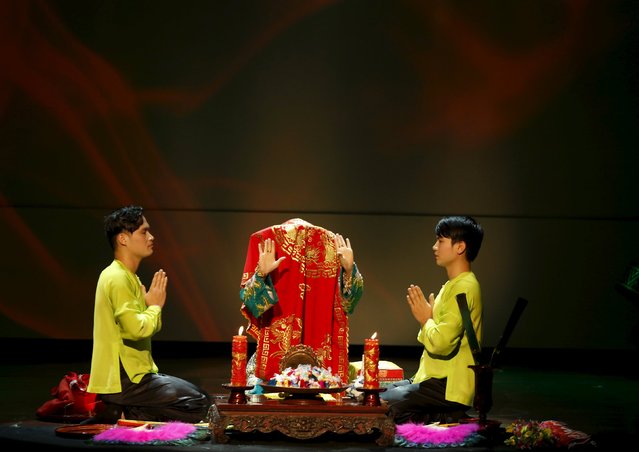
A Vietnamese artist acting as a medium, performs the "Hau Dong" ritual at Viet Theatre in Hanoi January 16, 2016. (Photo by Reuters/Kham)

A Vietnamese artist acting as a medium, performs the “Hau Dong” ritual at Viet Theatre in Hanoi January 16, 2016. For the first time, Vietnamese drama director Viet Tu has brought the ritual from religious temples to the theatre partly to draw tourists. The “Hau Dong” is a ritual where a medium puts on special costumes and tells stories of gods and heroes while being accompanied by “Chau Van” music, as part of the act of Dao Mau – the worship of mother goddesses in Vietnam. It is believed that the medium is capable of having a direct contact with spirits during the ritual. (Photo by Reuters/Kham)
Details
18 Jan 2016 08:00:00
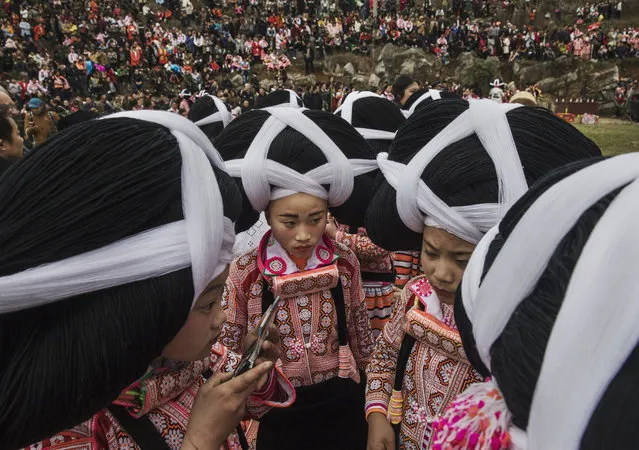
Girls of the Long Horn Miao ethnic minority group wear headdresses as they prepare gather for Tiaohua or Flower Festival as part of the Lunar New Year on February 6, 2017 in Longga village, Guizhou province, southern China. The Long Horn Miao are recognized for their declining practice of wrapping a blend of linen, wool, and the hair of their ancestors around animal horns or a wooden clip to make headdresses. Many young women say they now wear the headdresses only for special occasions and festivals, as the ornaments, which are attached by the horns to their real hair, have proved impractical for modern daily life in a fast changing world. China officially recognizes 56 different ethnic minorities, and statistics show over 7 million Chinese identifying themselves as Miao. But the small Long Horn Miao community counts only around 5000 people living in 12 villages, whose age-old traditions, language, and culture are fading. It is increasingly difficult in a modernizing China, as young people are drawn from remote rural villages to opportunities in bigger cities amongst wide-scale urbanization. Farming and labour remain the mainstays of life for the Long Horn Miao, leaving the area relatively poor in comparison with many parts of China. The government has invested significant amounts into local infrastructure and the tourism industry to try to bolster the local economy. (Photo by Kevin Frayer/Getty Images)

Girls of the Long Horn Miao ethnic minority group wear headdresses as they prepare gather for Tiaohua or Flower Festival as part of the Lunar New Year on February 6, 2017 in Longga village, Guizhou province, southern China. (Photo by Kevin Frayer/Getty Images)
Details
13 Feb 2017 00:01:00
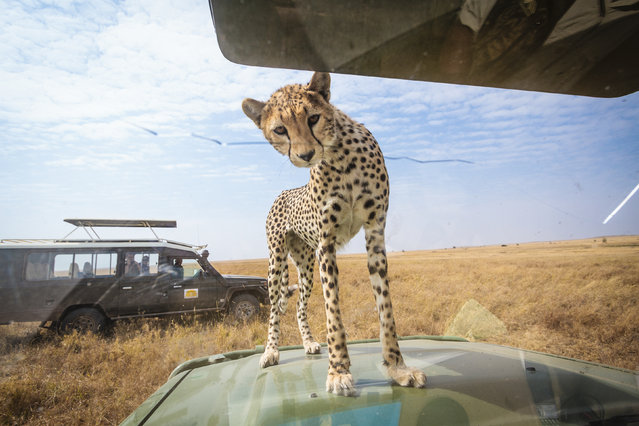
The cheetah peers inside the car to see who is inside. (Photo by Bobby-Jo Clow/Caters News)

“This is the heart-stopping moment a photographer came within inches of a young cheetah when it stuck its head through her sun roof. Australian Bobby-Jo Clow, 31, was on safari in Tanzania when the juvenile started heading towards her Landrover with his sibling. She snapped away as the young male dangled its paws in front of her face and smelt her hair before its mother called it away into the wilds of the Serengeti National Park. But not until Bobby-Jo, a full-time elephant keeper at a Tanzanian Zoo, had leaned forward enough to capture the perfect shot, causing the cheetah to hiss and bare its teeth”. – Caters News. (Photo by Bobby-Jo Clow/Caters News)
Details
16 Mar 2014 08:22:00
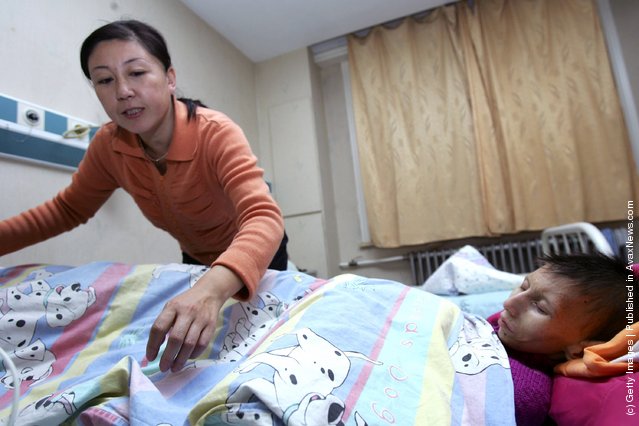
12-year-old Chinese girl Sun Yangyang suffering from Cockayne syndrome

“Cockayne syndrome (also called Weber-Cockayne syndrome, or Neill-Dingwall Syndrome) is a rare autosomal recessive congenital disorder characterized by growth failure, impaired development of the nervous system, abnormal sensitivity to sunlight (photosensitivity), and premature aging. Hearing loss and eye abnormalities (pigmentary retinopathy) are other common features, but problems with any or all of the internal organs are possible. It is associated with a group of disorders called leukodystrophies. The underlying disorder is a defect in a DNA repair mechanism. It is named after English physician Edward Alfred Cockayne (1880–1956)”. – Wikipedia

Photo: Mother of 12-year-old Chinese girl Sun Yangyang suffering from Cockayne syndrome, tends her at the First Affiliated Hospital of Jilin University on November 11, 2006 in Changchun of Jilin Province, China. The disease results in the senile appearance of Yangyang and also causes eyesight, hearing weakness and other problems. Doctors failed to cure the girl... (Photo by China Photos/Getty Images)
Details
08 Aug 2011 11:17:00
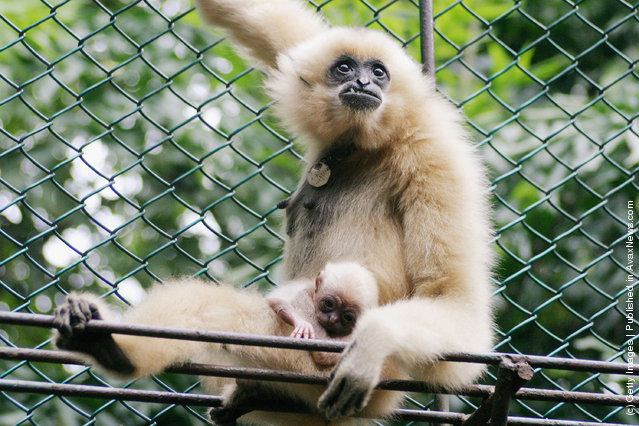
Newborn White-Cheeked Gibbon Nomascus

“Nomascus is the second most speciose genus of gibbons (family Hylobatidae). Originally this genus was a subgenus of Hylobates, and all individuals were considered one species, Hylobates concolor. Species within Nomascus are characterized by 52 chromosomes. Some species are all black, some light with a distinct black tuft of crown fur, and some by distinct, light-colored cheek patches. Nomascus is found from southern China (Yunnan) to southern Vietnam, and also on Hainan Island. One of the genus' species, Nomascus nasutus, has been deemed “the most critically endangered ape species in the world”. All of the species in this genus are endangered or critically endangered”. – Wikipedia

Photo: A newborn White-Cheeked Gibbon clings to its mother in the Nanning Zoo on April 12, 2004 in Nanning, Guangxi province, China. The White-Cheeked Gibbon's natural habitat is Southern China as well as Vietnam and Laos. They are classified as highly endangered and are on the brink of extinction due to poaching and reduction of natural rainforests. (Photo by Getty Images)
Details
12 Aug 2011 11:51:00
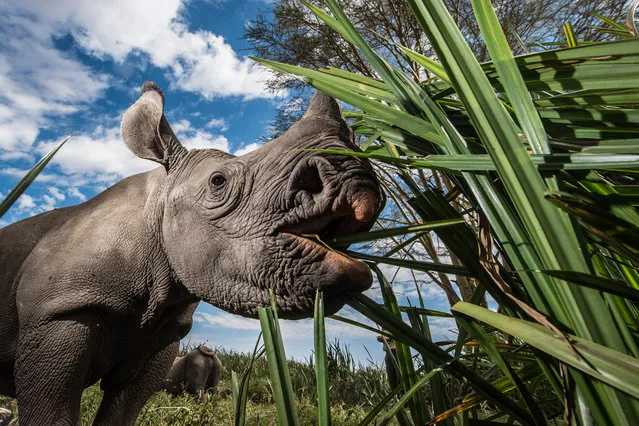
Orphaned baby rhinos seen on August 28, 2014 in Lewa Wildlife Conservancy, Ngare Ndare Forest, Kenya. (Photo by Luca Ghidoni/Barcroft Media)

Orphaned baby rhinos seen on August 28, 2014 in Lewa Wildlife Conservancy, Ngare Ndare Forest, Kenya. Lewa Wildlife Conservancy in Kenya is hand-raising three orphaned baby rhinos; Nicky, Hope and Kilifi. Baby rhino Hope was rescued by rangers when the poachers killed his mother – now he is been taken care off 24 hours-a-day at Lewa Wildlife Conservancy. The wildlife reserve hit the headlines when Prince William proposed to Kate Middleton there in 2010. Rhinos around the world are becoming extinct as a result of the brutal poaching fuelled by an illegal international market for their horns. (Photo by Luca Ghidoni/Barcroft Media)
Details
14 Sep 2014 10:27:00