Loading...
Done
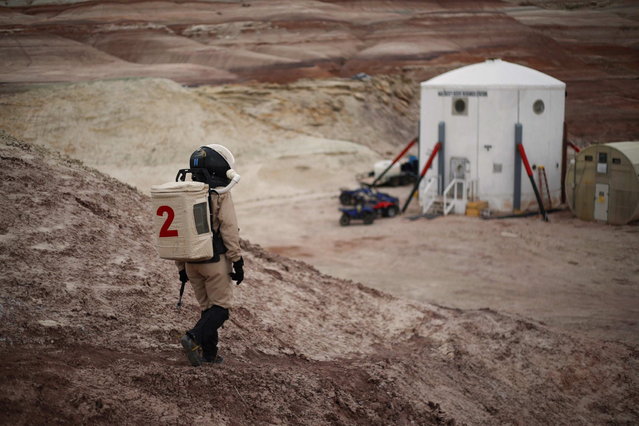
Csilla Orgel, a geologist of Crew 125 EuroMoonMars B mission, makes her way back to the Mars Desert Research Station (MDRS) in the Utah desert March 3, 2013. (Photo by Jim Urquhart/Reuters)

NASA says it could be another 20 years before humans touch down on Mars, but in a sense, the Mars Society has been exploring the red planet for more than a decade – in Utah. Photo: Csilla Orgel, a geologist of Crew 125 EuroMoonMars B mission, makes her way back to the Mars Desert Research Station (MDRS) in the Utah desert March 3, 2013. The MDRS aims to investigate the feasibility of a human exploration of Mars and uses the Utah desert's Mars-like terrain to simulate working conditions on the red planet. Scientists, students and enthusiasts work together developing field tactics and studying the terrain. All outdoor exploration is done wearing simulated spacesuits and carrying air supply packs and crews live together in a small communication base with limited amounts of electricity, food, oxygen and water. Everything needed to survive must be produced, fixed and replaced on site. (Photo by Jim Urquhart/Reuters)
Details
14 Mar 2013 12:11:00
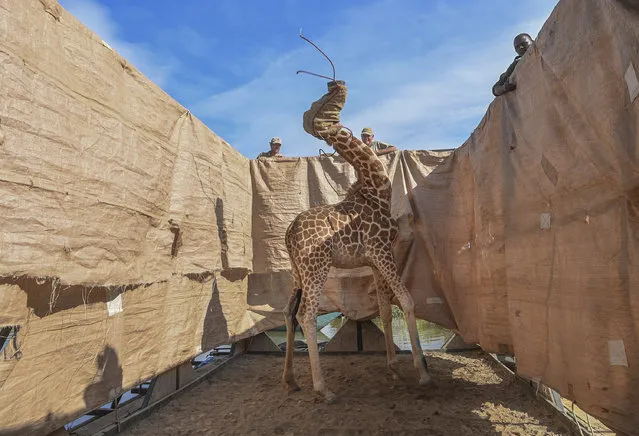
In this image released by World Press Photo, Thursday April 15, 2021, by Ami Vitale for CNN, titled Rescue of Giraffes from Flooding Island, which won the first prize in the Nature Singles category, shows A Rothschild's giraffe (Giraffa camelopardalis rothschildi) is transported to safety in a custom-built barge from a flooded Longicharo Island, Lake Baringo, in western Kenya, on Dec. 3, 2020. (Photo by Ami Vitale for CNN, World Press Photo via AP Photo)

In this image released by World Press Photo, Thursday April 15, 2021, by Ami Vitale for CNN, titled Rescue of Giraffes from Flooding Island, which won the first prize in the Nature Singles category, shows A Rothschild's giraffe (Giraffa camelopardalis rothschildi) is transported to safety in a custom-built barge from a flooded Longicharo Island, Lake Baringo, in western Kenya, on Dec. 3, 2020. (Photo by Ami Vitale for CNN, World Press Photo via AP Photo)
Details
16 Apr 2021 09:45:00
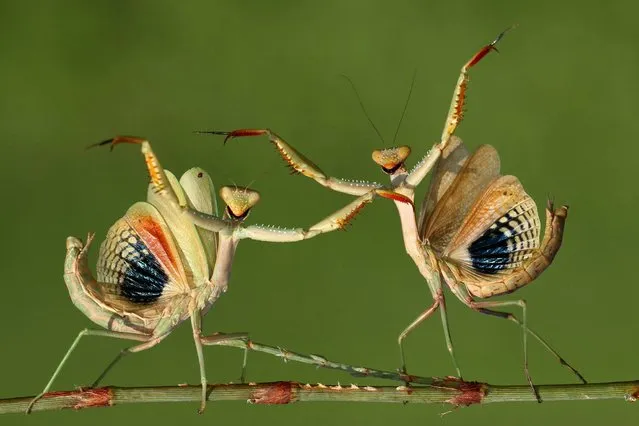
“Zeybeks”. That's Dance, Sunward and Zeybeks. (Photo by Hasan Baglar/2014 Sony World Photography Awards)

“Zeybeks”. That's Dance, Sunward and Zeybeks. (Photo by Hasan Baglar/2014 Sony World Photography Awards)
Details
07 Feb 2014 08:57:00
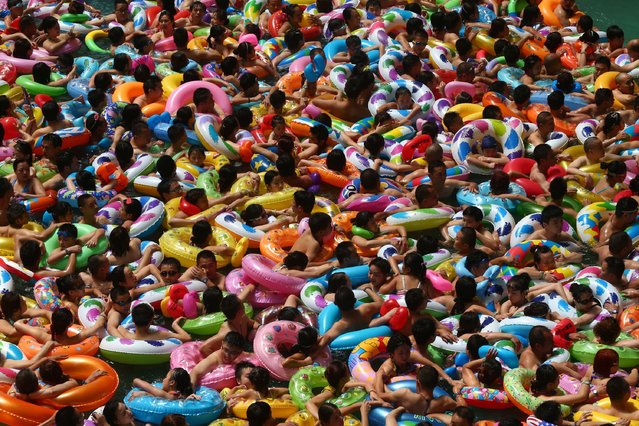
This picture taken on July 25, 2014 shows people cooling off in a waterpark in Suining, southwest China's Sichuan province. Meteorological departments issued an orange alert for high temperature as a heat wave embraces Sichuan province, with temperature of most area topped 37, local media reported. (Photo by AFP Photo)

This picture taken on July 25, 2014 shows people cooling off in a waterpark in Suining, southwest China's Sichuan province. Meteorological departments issued an orange alert for high temperature as a heat wave embraces Sichuan province, with temperature of most area topped 37, local media reported. (Photo by AFP Photo)
Details
02 Aug 2014 13:36:00
Contorsionist Rich Miteku performs during the opening of the 41st Monte-Carlo International Circus Festival in Monaco on January 19, 2017. (Photo by Valery Hache/AFP Photo)

Contorsionist Rich Miteku performs during the opening of the 41st Monte-Carlo International Circus Festival in Monaco on January 19, 2017. (Photo by Valery Hache/AFP Photo)
Details
21 Jan 2017 11:40:00
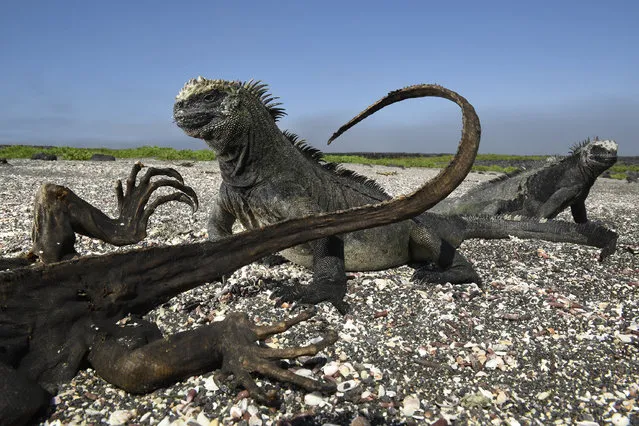
Galapagos – Rocking the Cradle: Four major ocean currents converge along the Galapagos archipelago, creating the conditions for an extraordinary diversity of animal life, April 25, 2016. The islands are home to at least 7,000 flora and fauna species, of which 97 percent of the reptiles, 80 percent of the land birds, 50 percent of the insects and 30 percent of the plants are endemic. The local ecosystem is highly sensitive to the changes in temperature, rainfall and ocean currents that characterize the climatic events known as El Niño and La Niña. These changes cause marked fluctuations in weather and food availability. Many scientists expect the frequency of El Niño and La Niña to increase as a result of climate change, making the Galapagos a possible early-warning location for its effects. (Photo by Thomas P. Peschak for National Geographic/World Press Photo)

Galapagos – Rocking the Cradle: Four major ocean currents converge along the Galapagos archipelago, creating the conditions for an extraordinary diversity of animal life, April 25, 2016. The islands are home to at least 7,000 flora and fauna species, of which 97 percent of the reptiles, 80 percent of the land birds, 50 percent of the insects and 30 percent of the plants are endemic. (Photo by Thomas P. Peschak for National Geographic/World Press Photo)
Details
16 Apr 2018 00:01:00
Little tom and his half sister, judy... by DONALD ROLLER WILSON

Little tom and his half sister, judy... by DONALD ROLLER WILSON

Details
22 May 2012 00:04:00
A man performs a split as he practices Kung Fu at Beihai Park in Beijing, China August 20, 2017. (Photo by Reuters/China Stringer Network)

A man performs a split as he practices Kung Fu at Beihai Park in Beijing, China August 20, 2017. (Photo by Reuters/China Stringer Network)
Details
30 Aug 2017 07:14:00