Loading...
Done
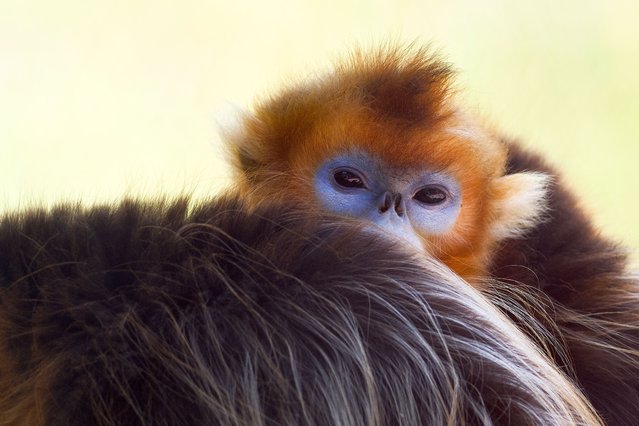
A golden snub-nosed monkeys (Rhinopitheque de Roxelane) looks through its enclosure after quarantine during its presentation at the Beauval Zoopark in Saint-Aignan Central France, on May 7, 2025. ZooParc de Beauval (Loir-et-Cher) welcomed three golden snub-nosed monkeys on April 3, 2025, an endangered species from China, as part of a conservation program, becoming the first zoo outside Asia to house these long-haired, red-furred primates with bluish faces. (Photo by Guillaume Souvant/AFP Photo)

A golden snub-nosed monkeys (Rhinopitheque de Roxelane) looks through its enclosure after quarantine during its presentation at the Beauval Zoopark in Saint-Aignan Central France, on May 7, 2025. ZooParc de Beauval (Loir-et-Cher) welcomed three golden snub-nosed monkeys on April 3, 2025, an endangered species from China, as part of a conservation program, becoming the first zoo outside Asia to house these long-haired, red-furred primates with bluish faces. (Photo by Guillaume Souvant/AFP Photo)
Details
18 May 2025 02:44:00
A street artist, calling on people to visit an amusement park, walks past the military-themed street exhibition “Together to Victory” in Saint Petersburg on February 3, 2025. (Photo by Olga Maltseva/AFP Photo)

A street artist, calling on people to visit an amusement park, walks past the military-themed street exhibition “Together to Victory” in Saint Petersburg on February 3, 2025. (Photo by Olga Maltseva/AFP Photo)
Details
18 Jun 2025 03:49:00
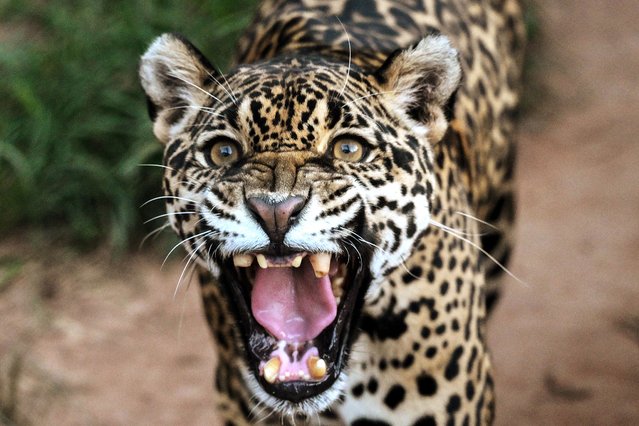
A jaguar (Panthera onca) growls at the Mata Ciliar association, an organization for the conservation of biodiversity, in Jundiai, Sao Paulo state, Brazil on May 29, 2025. Twenty-five pumas and ten jaguars are currently recovering at the Brazilian Center for the Conservation of Neotropical Felines at Mata Ciliar, a site as large as 40 football fields where monkeys, wild dogs, maned wolves, ocelots, and other regional animals are also rehabilitated. (Photo by Nelson Almeida/AFP Photo)

A jaguar (Panthera onca) growls at the Mata Ciliar association, an organization for the conservation of biodiversity, in Jundiai, Sao Paulo state, Brazil on May 29, 2025. Twenty-five pumas and ten jaguars are currently recovering at the Brazilian Center for the Conservation of Neotropical Felines at Mata Ciliar, a site as large as 40 football fields where monkeys, wild dogs, maned wolves, ocelots, and other regional animals are also rehabilitated. (Photo by Nelson Almeida/AFP Photo)
Details
22 Jun 2025 02:21:00
Passengers with their pet dogs take a pet-friendly train on the Jinyidong Line of the Jinhua Rail Transit on June 22, 2025 in Jinhua, Zhejiang Province of China. (Photo by Shi Bufa/VCG via Getty Images)

Passengers with their pet dogs take a pet-friendly train on the Jinyidong Line of the Jinhua Rail Transit on June 22, 2025 in Jinhua, Zhejiang Province of China. (Photo by Shi Bufa/VCG via Getty Images)
Details
25 Jul 2025 02:35:00
Denver Broncos cheerleaders perform during the first half of a preseason NFL football game between the Denver Broncos and the Arizona Cardinals, Saturday, August 16, 2025, in Denver. (Photo by David Zalubowski/AP Photo)

Denver Broncos cheerleaders perform during the first half of a preseason NFL football game between the Denver Broncos and the Arizona Cardinals, Saturday, August 16, 2025, in Denver. (Photo by David Zalubowski/AP Photo)
Details
25 Aug 2025 04:34:00
Fashion model Irina Shayk prepares backstage at the Victoria's Secret Fashion Show 2025 on October 15, 2025 in New York City. (Photo by Dimitrios Kambouris/Getty Images for Victoria's Secret)

Fashion model Irina Shayk prepares backstage at the Victoria's Secret Fashion Show 2025 on October 15, 2025 in New York City. (Photo by Dimitrios Kambouris/Getty Images for Victoria's Secret)
Details
12 Dec 2025 04:22:00
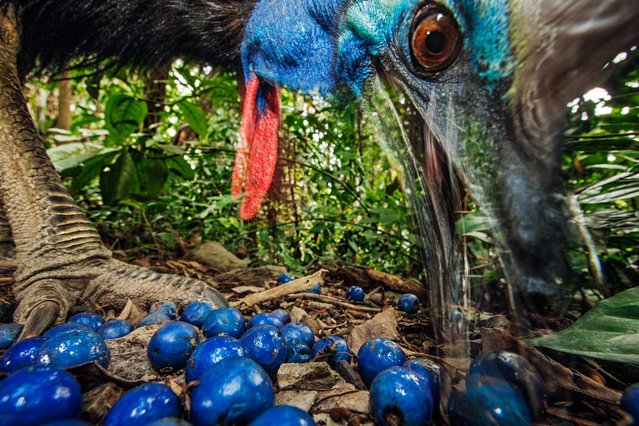
“Cassowaries are large, flightless birds related to emus and (more distantly) to ostriches, rheas, and kiwis”, writes Olivia Judson in the September issue of National Geographic magazine. (Photo by Christian Ziegler/National Geographic)

“Cassowaries are large, flightless birds related to emus and (more distantly) to ostriches, rheas, and kiwis”, writes Olivia Judson in the September issue of National Geographic magazine. How large? People-size: Adult males stand well over five foot five and top 110 pounds. Females are even taller, and can weigh more than 160 pounds. Dangerous when roused, they’re shy and peaceable when left alone. But even birds this big and tough are prey to habitat loss. The dense New Guinea and Australia rain forests where they live have dwindled. Today cassowaries might number 1,500 to 2,000. And because they help shape those same forests – by moving seeds from one place to another – “if they vanish”, Judson writes, “the structure of the forest would gradually change” too. (Photo by Christian Ziegler/National Geographic)
Details
06 Jan 2014 12:21:00
Kyaiktiyo, Burma, 1978. The Golden Rock at Shwe Pyi Daw (the Golden Country), the Buddhist holy place. Hiroji Kubota writes: “I was desperate to keep a distance from America for a while; luckily, I found Burma and its gentle and compassionate people. In the spring of 1978, on the top of the hill where I took this photo, I had two Leica bodies: the one with Tri-X and the other with Kodachrome 64. Soon after, I realised that the colour one looked very colourful and was more powerful. That was my decisive moment, to become a colour photographer”. (Photo by Hiroji Kubota/Magnum Photos)

Kyaiktiyo, Burma, 1978. The Golden Rock at Shwe Pyi Daw (the Golden Country), the Buddhist holy place. Hiroji Kubota writes: “I was desperate to keep a distance from America for a while; luckily, I found Burma and its gentle and compassionate people. In the spring of 1978, on the top of the hill where I took this photo, I had two Leica bodies: the one with Tri-X and the other with Kodachrome 64. Soon after, I realised that the colour one looked very colourful and was more powerful. That was my decisive moment, to become a colour photographer”. (Photo by Hiroji Kubota/Magnum Photos)
Details
10 Jun 2016 13:30:00