Revelers celebrate during fireworks marking the start of the New Year on Copacabana beach on January 1, 2017 in Rio de Janeiro, Brazil. (Photo by Mario Tama/Getty Images)
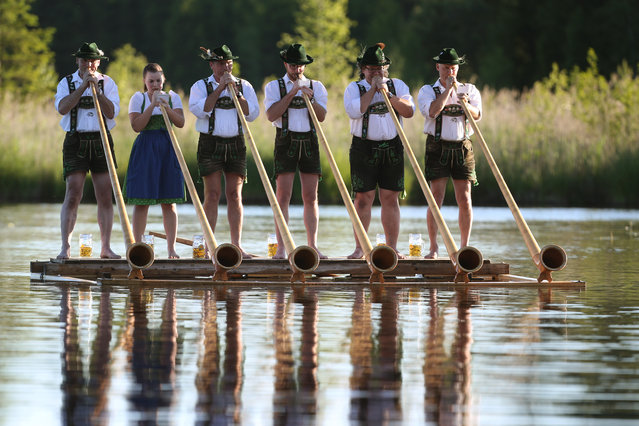
Musicians of the alphorn band "Holdersberger Alp- Traum- Blaeser" perform their skills on a raft floating on the Elbsee lake near Aitrang, southern Germany, on June 11, 2017. (Photo by Karl-Josef Hildenbrand/AFP Photo/DPA)
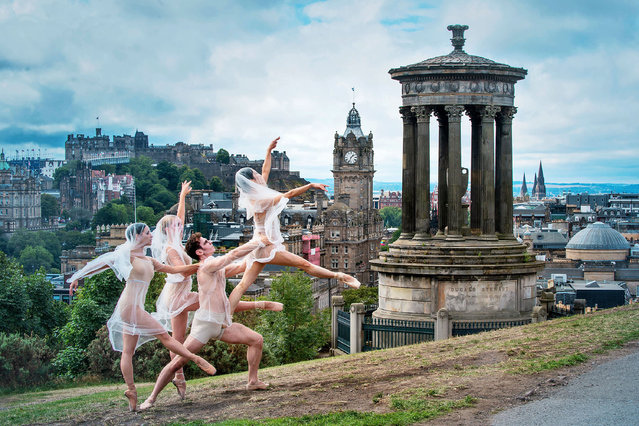
Undated handout photo of members of Ballet Ireland during a photocall on Edinburgh's Calton Hill before taking part in the Edinburgh Festival 2018 in Edinburgh, Scotland. Issue date: Tuesday, August 7, 2018. (Photo by Julie Howden/Culture Ireland/PA Wire)
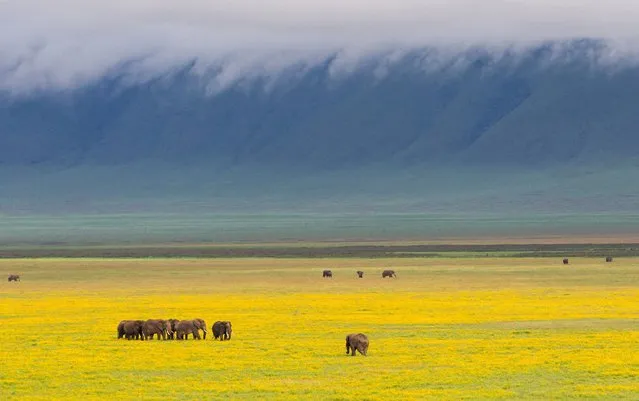
Ngorongoro Crater (Tanzania). At 610m deep and 260 sq km, this is the largest unflooded caldera in the world. A blue-green vision from above it's a haven for engangered wildlife and Maasai livestock. The crater was formed three million years ago when a giant volcano, which could have been as high as Kilimanjaro, exploded and collapsed. The caldera formed the concentric fractures in the crust cracked down to a magma reservoir deep underground. (Photo by John Bryant/Getty Images)
A robot, developed by start-up firm Asimov Robotics, holds a tray with face masks and sanitizer after the two robots were launched to spread awareness about the coronavirus, in Kochi, India, March 17, 2020. (Photo by Sivaram V/Reuters)
A South Korea fan smiles ahead of the Qatar 2022 World Cup Group H football match between Uruguay and South Korea at the Education City Stadium in Al-Rayyan, west of Doha on November 24, 2022. (Photo by Jewel Samad/AFP Photo)
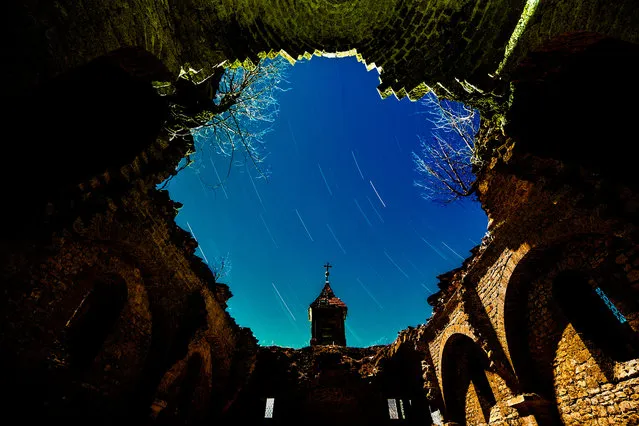
A long exposure image shows star trails from the abandoned submerged orthodox church of St. Nicholas without roof, submerged in the Mavrovo Lake, near Mavrovi Anovi, North Macedonia, 17 March 2019. Constructed in 1850 and submerged in 1952 due to the construction of the hydro system Mavrovo, the church St. Nicholas continues to attract the attention of almost every visitor as it peaks from the water. (Photo by Georgi Licovski/EPA/EFE)