Loading...
Done
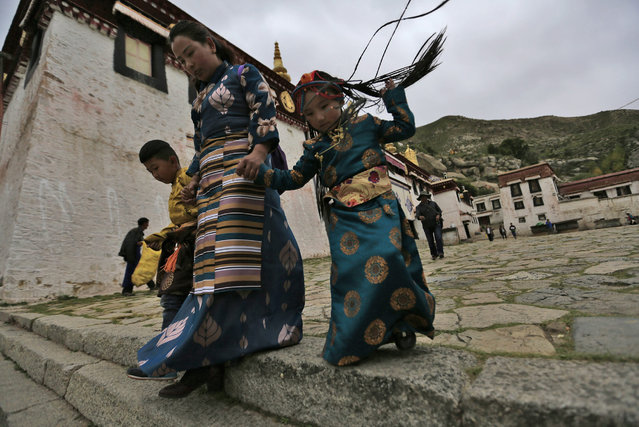
Tibetan pilgrims walk outside the Sera Monastery in Lhasa, Tibet Autonomous Region, China, 11 September 2016. Sera Monastery is known as one of the “great three” Gelug university monasteries of Tibet founded in 1419. (Photo by How Hwee Young/EPA)

Tibetan pilgrims walk outside the Sera Monastery in Lhasa, Tibet Autonomous Region, China, 11 September 2016. Sera Monastery is known as one of the “great three” Gelug university monasteries of Tibet founded in 1419. (Photo by How Hwee Young/EPA)
Details
22 Sep 2016 09:59:00
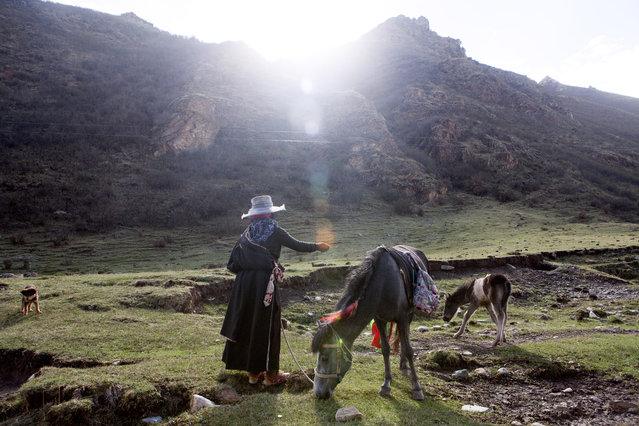
A Tibetan woman with horses in a remote area of the Yushu Autonomous Prefecture of the Tibetan Plateau on May 31, 2016. (Photo by Giulia Marchi/The Washington Post)

A Tibetan woman with horses in a remote area of the Yushu Autonomous Prefecture of the Tibetan Plateau on May 31, 2016. (Photo by Giulia Marchi/The Washington Post)
Details
03 Jul 2016 11:10:00
In this Sunday, March 11, 2017 photo, children fight in a boxing ring in Chitungwiza, Zimbabwe. (Photo by Tsvangirayi Mukwazhi/AP Photo)

In this Sunday, March 11, 2017 photo, children fight in a boxing ring in Chitungwiza, Zimbabwe. Zimbabwean boys as young as 10 hurry every weekend to a boxing ring whose nickname, Wafa Wafa, in the local Shona language suggests that whoever enters will be lucky to come out alive. (Photo by Tsvangirayi Mukwazhi/AP Photo)
Details
22 Apr 2017 09:02:00
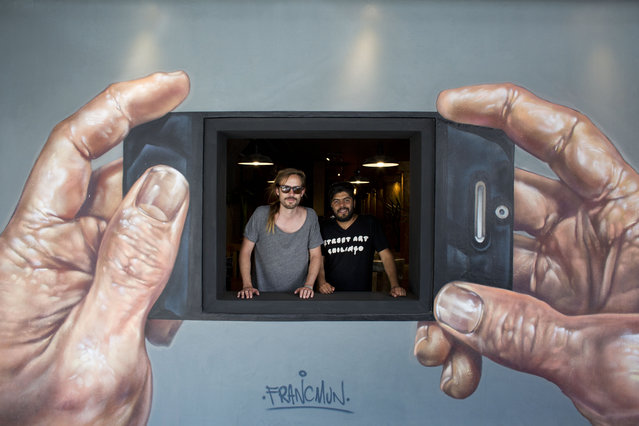
In this September 1, 2015 photo, street artists Jenaro de Rosenzweig, left, and Alejandro Revilla pose for a portrait behind a restaurant's window covered with a mural by artist Francisco Munoz, signed with his artist's name below, in the Roma Norte neighborhood of Mexico City. Rosenzweig and Revilla founded the “Street Art Chilango” cooperative in March 2013, which is filling neighborhoods with public art by local street artists. (Photo by Rebecca Blackwell/AP Photo)

In this September 1, 2015 photo, street artists Jenaro de Rosenzweig, left, and Alejandro Revilla pose for a portrait behind a restaurant's window covered with a mural by artist Francisco Munoz, signed with his artist's name below, in the Roma Norte neighborhood of Mexico City. Rosenzweig and Revilla founded the “Street Art Chilango” cooperative in March 2013, which is filling neighborhoods with public art by local street artists. (Photo by Rebecca Blackwell/AP Photo)
Details
08 Sep 2015 11:42:00
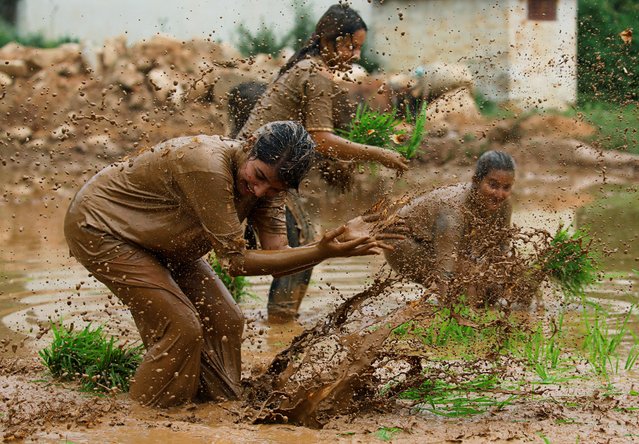
Participants play in the mud as they plant rice samplings during National Paddy Day, also called Asar Pandra, that marks the commencement of rice crop planting in paddy fields as monsoon season arrives, in Dhading, Nepal, June 30, 2019. (Photo by Navesh Chitrakar/Reuters)

Participants play in the mud as they plant rice samplings during National Paddy Day, also called Asar Pandra, that marks the commencement of rice crop planting in paddy fields as monsoon season arrives, in Dhading, Nepal, June 30, 2019. (Photo by Navesh Chitrakar/Reuters)
Details
22 Aug 2019 00:01:00
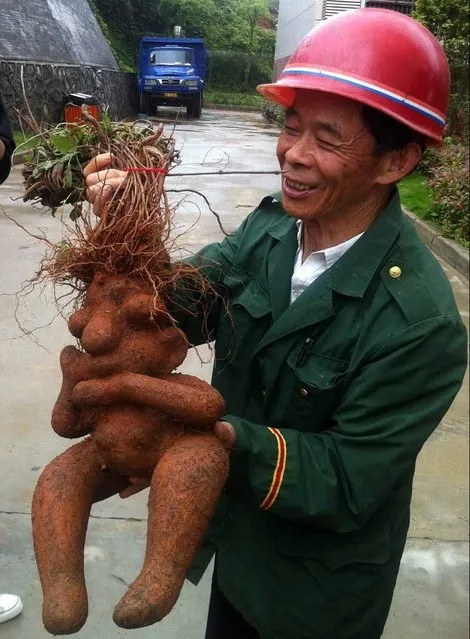
Two Chinese farmers got more than they bargained for when they pulled up the root of a fleece flower – and came face-to-face with the doppelganger of Homer Simpson, on May 17, 2013. The large root appears to have two bulging eyes and a prominent nose – giving it an uncanny resemblance to the famous cartoon character. With two offshoot roots shaped like arms, it even looks like it is pondering or confused – just what you would expect from the real Homer. (Photo by ImagineChina)

Two Chinese farmers got more than they bargained for when they pulled up the root of a fleece flower – and came face-to-face with the doppelganger of Homer Simpson, on May 17, 2013. The large root appears to have two bulging eyes and a prominent nose – giving it an uncanny resemblance to the famous cartoon character. With two offshoot roots shaped like arms, it even looks like it is pondering or confused – just what you would expect from the real Homer. (Photo by ImagineChina)
Details
18 May 2013 11:52:00
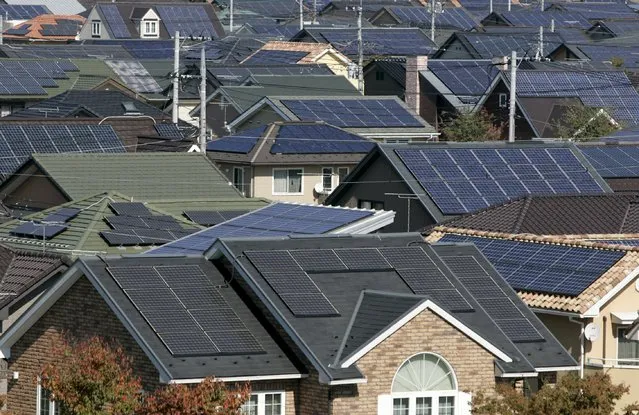
Rooftops of solar powered houses are pictured in Ota, 80 km northwest of Tokyo in this October 28, 2008 file photo. One by one, Japan is turning off the lights at the giant oil-fired power plants that propelled it to the ranks of the world's top industrialised nations. With nuclear power in the doldrums after the Fukushima disaster, it's solar energy that is becoming the alternative. (Photo by Yuriko Nakao/Reuters)

Rooftops of solar powered houses are pictured in Ota, 80 km northwest of Tokyo in this October 28, 2008 file photo. One by one, Japan is turning off the lights at the giant oil-fired power plants that propelled it to the ranks of the world's top industrialised nations. With nuclear power in the doldrums after the Fukushima disaster, it's solar energy that is becoming the alternative. Solar power is set to become profitable in Japan as early as this quarter, according to the Japan Renewable Energy Foundation (JREF), freeing it from the need for government subsidies and making it the last of the G7 economies where the technology has become economically viable. (Photo by Yuriko Nakao/Reuters)
Details
24 Nov 2015 08:04:00
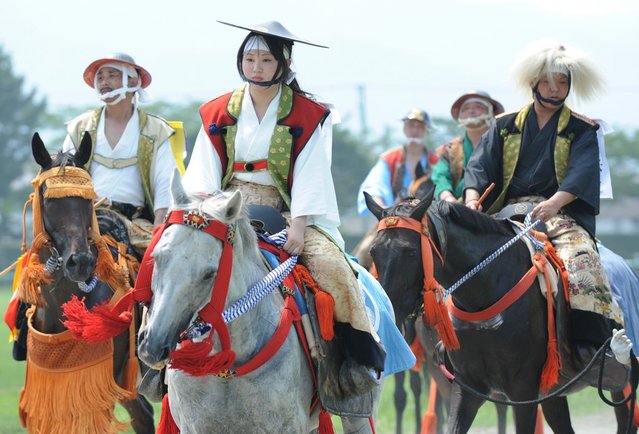
A young woman (C) clad in samurai costume leads other local poeple as she rides her horse during a parade at the annual Soma Nomaoi festival in Minamisoma, Fukushima Prefecture, on July 28, 2012.  The traditional full-scale festival kicked off for the first time after the accident of the Fukushima Dai-ichi Nuclear Power Plant following the massive earthquake and the tsunami on March 11, 2011. (Photo by Toru Yamanaka/AFP Photo)

Soma-Nomaoi is a festival that recreates a battle scene from more than 1,000 years ago. It is annually held for 4 days from July 22 to 25 in Haramachi City, Fukushima Prefecture, in the eastern part of Japan. In this historical event, 600 mounted samurai in traditional Japanese armor, with long swords at their side and ancestral flagstaffs streaming from their backs, ride across open fields. Soma-Nomaoi has been designated an Important Intangible Folk Cultural Property.

Photo: A young woman (C) clad in samurai costume leads other local poeple as she rides her horse during a parade at the annual Soma Nomaoi festival in Minamisoma, Fukushima Prefecture, on July 28, 2012. The traditional full-scale festival kicked off for the first time after the accident of the Fukushima Dai-ichi Nuclear Power Plant following the massive earthquake and the tsunami on March 11, 2011. (Photo by Toru Yamanaka/AFP Photo)
Details
02 Aug 2012 12:59:00