Loading...
Done
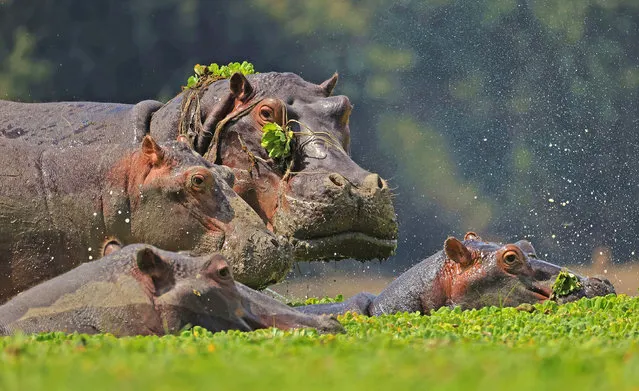
While many of us would pay good money for a spa mud bath, these fortunate hippos in South Luangwa National Park, Zambia, have nature to thank as they take a plunge in a lagoon in the second decade of February 2024. (Photo by Dimitar Nedelchev/Solent News)

While many of us would pay good money for a spa mud bath, these fortunate hippos in South Luangwa National Park, Zambia, have nature to thank as they take a plunge in a lagoon in the second decade of February 2024. (Photo by Dimitar Nedelchev/Solent News)
Details
10 Mar 2024 07:40:00
Ocean voyage

Do you think that history is a science? Well, not exactly. First, and foremost, history is the state's “legend of wars”, it’s official regalia. Of course, public historians are not interested in scientific truth – quite the opposite. In this respect, any attempt to present a state’s history as altruistic and benevolent as possible is welcomed and encouraged – as opposed to any revisionism attempts that may be more accurate. In this matter, Chinese have surpassed us all – they revised in highly creative manner (but rather shamelessly) the technology already invented by Europeans, a process that resulted in oldest state on the planet. Here is an interesting paradox: ask any sinologist about the Middle Kingdom during second century B.C., and he will describe it to you in such a vivid manner as if he has been living there all his life – but as soon as you will ask him to describe Chinese history in the 19-20th centuries… let's say, his eagerness will be greatly diminished. However, we will discuss China in a different article, and in the meantime we will try to understand how exactly historic “legend of wars” is formed and functions – based on a specific and well-known example. A great example is Ferdinand Magellan's first voyage around the world.

Details
14 Nov 2011 09:11:00
A performer dressed as a lobster is seen during a lobster-themed electronic music party at a water park on August 01, 2020 in Hangzhou, Zhejiang Province of China. (Photo by Lian Guoqing/VCG via Getty Images)

A performer dressed as a lobster is seen during a lobster-themed electronic music party at a water park on August 01, 2020 in Hangzhou, Zhejiang Province of China. (Photo by Lian Guoqing/VCG via Getty Images)
Details
12 Aug 2020 00:03:00
A young girl sits on a mat, as worshippers arrive to pray to mark the Muslim Eid-al-Adha (Festival of Sacrifices) without observationg precautionary measures to curb the spread of COVID-19, in Kara, Ogun State in southwest Nigeria, on July 31, 2020. Nigerian Muslim faithfuls joined their counterparts across the world to celebrate Eid-El-Adha, Islamic festival of sacrifice. (Photo by Pius Utomi Ekpei/AFP Photo)

A young girl sits on a mat, as worshippers arrive to pray to mark the Muslim Eid-al-Adha (Festival of Sacrifices) without observationg precautionary measures to curb the spread of COVID-19, in Kara, Ogun State in southwest Nigeria, on July 31, 2020. Nigerian Muslim faithfuls joined their counterparts across the world to celebrate Eid-El-Adha, Islamic festival of sacrifice. (Photo by Pius Utomi Ekpei/AFP Photo)
Details
21 Aug 2020 00:03:00
Two women in traditional kimonos wear face masks to help curb the spread of the coronavirus as they visit the Sensoji temple in Tokyo on Friday, August 7, 2020. (Photo by Hiro Komae/AP Photo)

Two women in traditional kimonos wear face masks to help curb the spread of the coronavirus as they visit the Sensoji temple in Tokyo on Friday, August 7, 2020. (Photo by Hiro Komae/AP Photo)
Details
03 Sep 2020 00:01:00
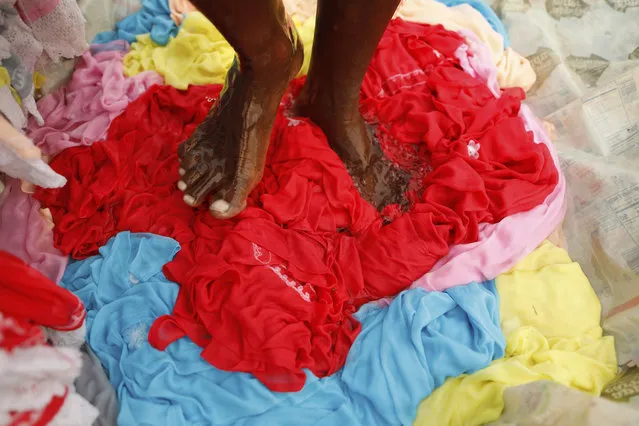
A dhobi, or a washerman washes cloths on the banks of the River Gomti in Lucknow, India, Saturday, September 12, 2020. Dhobis are traditional laundry workers who wash clothes by hand and dry them in the sun, an occupation which has been in existence for generations. Most cities in India have a Dhobi Ghat, or washermen's area, where the city's pile of clothes is laundered. This practice is still popular in India, despite of modern technology. Around 1,000 families work in Lucknow's Dhobi Ghat. However, in light of the novel coronavirus, their wages have decreased drastically. With each family earning around US$100-200 per month. (Photo by Rajesh Kumar Singh/AP Photo)

A dhobi, or a washerman washes cloths on the banks of the River Gomti in Lucknow, India, Saturday, September 12, 2020. Dhobis are traditional laundry workers who wash clothes by hand and dry them in the sun, an occupation which has been in existence for generations. Most cities in India have a Dhobi Ghat, or washermen's area, where the city's pile of clothes is laundered. This practice is still popular in India, despite of modern technology. Around 1,000 families work in Lucknow's Dhobi Ghat. However, in light of the novel coronavirus, their wages have decreased drastically. With each family earning around US$100-200 per month. (Photo by Rajesh Kumar Singh/AP Photo)
Details
25 Sep 2020 00:03:00
A woman jumps out of a street art object in the center of the Ukrainian capital of Kiev during a warm autumn day on September 25, 2020. (Photo by Sergei Supinsky/AFP Photo)

A woman jumps out of a street art object in the center of the Ukrainian capital of Kiev during a warm autumn day on September 25, 2020. (Photo by Sergei Supinsky/AFP Photo)
Details
09 Oct 2020 00:05:00
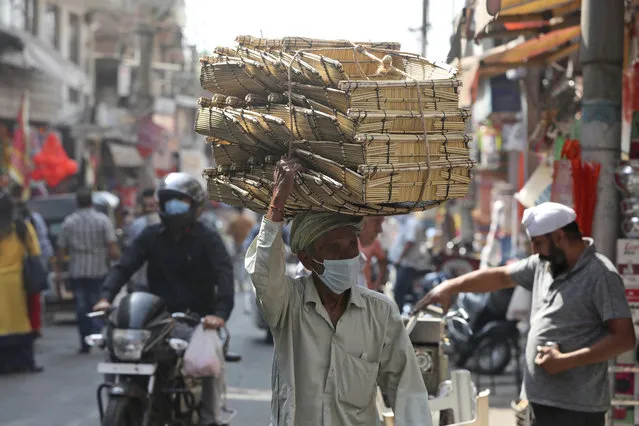
An Indian villager wearing a face mask as a precaution against the coronavirus sells his ware at market in Jammu, India, Friday, October 9, 2020. (Photo by Channi Anand/AP Photo)

An Indian villager wearing a face mask as a precaution against the coronavirus sells his ware at market in Jammu, India, Friday, October 9, 2020. (Photo by Channi Anand/AP Photo)
Details
14 Oct 2020 00:05:00