Loading...
Done
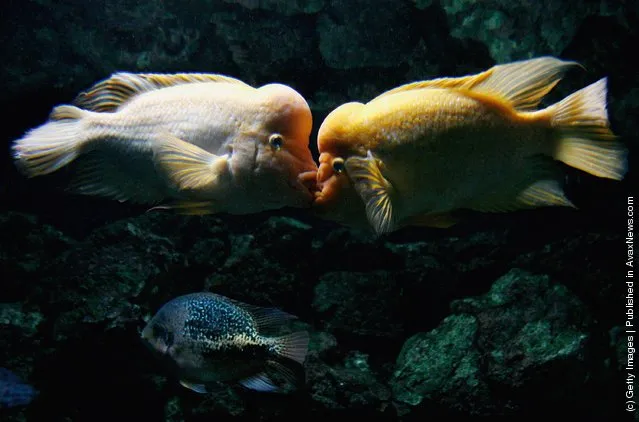
Midas Cichlid a.k.a. Amphilophus Citrinellus

“Amphilophus citrinellus is a large cichlid fish endemic to the San Juan River and adjacent watersheds in Costa Rica and Nicaragua. In the aquarium trade A. citrinellus is often sold under the trade name of Midas cichlid. A. citrinellus are omnivorous and their diet consists of plant material, molluscs and smaller fish”. – Wikipedia

Photo: Two Midas Cichlid (lat: amphilophus citrinellus) fish are seen in an aquarium at Hellabrunn zoo on December 23, 2009 in Munich, Germany. (Photo by Alexandra Beier/Getty Images)
Details
17 Aug 2011 11:29:00
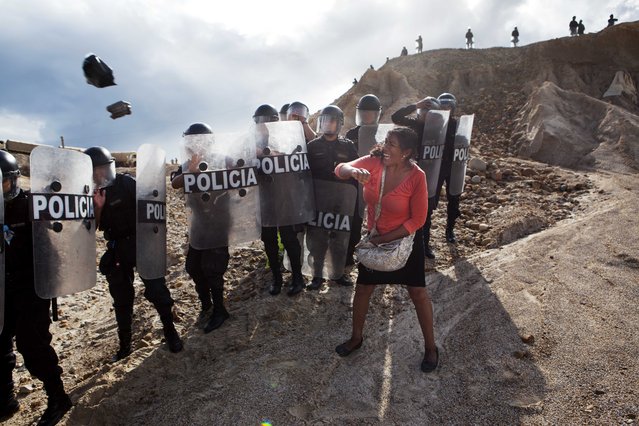
In this April 28, 2014 file photo, a woman throws a rock and a bag at police blocking her from getting home in the Huepetuhe district of the Madre de Dios region of Peru. Security forces began destroying illegal gold mining machinery in Peru's southeastern jungle region of Madre de Dios, as authorities began enforcing a ban on illegal mining. (Photo by Rodrigo Abd/AP Photo)

In this April 28, 2014 file photo, a woman throws a rock and a bag at police blocking her from getting home in the Huepetuhe district of the Madre de Dios region of Peru. Security forces began destroying illegal gold mining machinery in Peru's southeastern jungle region of Madre de Dios, as authorities began enforcing a ban on illegal mining. (Photo by Rodrigo Abd/AP Photo)
Details
16 Dec 2014 12:51:00
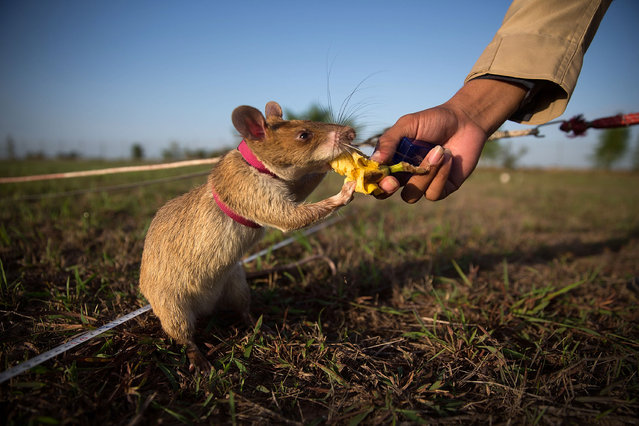
A mine detection rat is given banana as a reward after successfully identifying an inactive mine on July 2, 2015 in Siem Reap, Cambodia. (Photo by Taylor Weidman/Getty Images)

A mine detection rat is given banana as a reward after successfully identifying an inactive mine on July 2, 2015 in Siem Reap, Cambodia. The Cambodian Mine Action Center (CMAC) working with the Belgian NGO APOPO has recently begun testing the feasability of using large mine detection rats from Tanzania to help clear fields of mines and unexploded ordnance in one of the most bombed and mined countries in the world. (Photo by Taylor Weidman/Getty Images)
Details
03 Jul 2015 13:31:00
A dune buggy driver trains before competing in a sand dune drag racing event on January 8, 2016, as part of the Liwa 2016 Moreeb Dune Festival in the Liwa desert, some 250 kilometres southwest of Abu Dhabi. The festival, which attracts participants from around the Gulf region, includes a variety of races (cars, bikes, falcons, camels and horses) or other activities aimed at promoting the country's folklore. (Photo by Karim Sahib/AFP Photo)

A dune buggy driver trains before competing in a sand dune drag racing event on January 8, 2016, as part of the Liwa 2016 Moreeb Dune Festival in the Liwa desert, some 250 kilometres southwest of Abu Dhabi. The festival, which attracts participants from around the Gulf region, includes a variety of races (cars, bikes, falcons, camels and horses) or other activities aimed at promoting the country's folklore. (Photo by Karim Sahib/AFP Photo)
Details
09 Jan 2016 13:45:00
A Tibetan mastiff dog is displayed for sale at a mastiff show in Baoding, Hebei province, south of Beijing on March 9, 2013. Fetching prices up to around 750,000 USD, mastiffs have become a prized status-symbol amongst China's wealthy, with rich buyers across the country sending prices skyrocketing. Owners say the mastiffs, descendents of dogs used for hunting by nomadic tribes in central Asia and Tibet are fiercely loyal and protective. (Photo by Ed Jones/AFP Photo)

A Tibetan mastiff dog is displayed for sale at a mastiff show in Baoding, Hebei province, south of Beijing on March 9, 2013. Fetching prices up to around 750,000 USD, mastiffs have become a prized status-symbol amongst China's wealthy, with rich buyers across the country sending prices skyrocketing. Owners say the mastiffs, descendents of dogs used for hunting by nomadic tribes in central Asia and Tibet are fiercely loyal and protective. Breeders still travel to the Himalayan plateau to collect young puppies, although many are unable to adjust to the low altitudes and die during the journey. (Photo by Ed Jones/AFP Photo)
Details
02 May 2014 09:40:00
A man makes traditional candy “Matang” in preparation for the upcoming Chinese Lunar New Year in Yuqing County, Zunyi, Guizhou Province, China, January 18, 2016. (Photo by Reuters/China Daily)

A man makes traditional candy “Matang” in preparation for the upcoming Chinese Lunar New Year in Yuqing County, Zunyi, Guizhou Province, China, January 18, 2016. (Photo by Reuters/China Daily)
Details
21 Jan 2016 08:06:00
Bareback rider Trevor Kay of the Univeristy of Montana – Western rides during a college rodeo hosted by the University of Montana on April 30, 2022 in Missoula, Montana. (Photo by Tommy Martino/University of Montana via Getty Images)

Bareback rider Trevor Kay of the Univeristy of Montana – Western rides during a college rodeo hosted by the University of Montana on April 30, 2022 in Missoula, Montana. (Photo by Tommy Martino/University of Montana via Getty Images)
Details
10 May 2022 06:21:00
A girl stands with arms outstretched at North Narrabeen on January 27, 2024 in Sydney, Australia. Around 30 indigenous children from Brewarrina, Weilmoringle, and Goodooga in the far North West NSW travelled to Sydney to participate in the program. The initiative is part of the Bush to Beach programme, which now in its 19th year, gives indigenous children a unique opportunity to learn and explore Sydney's beach culture. The efforts are made possible entirely by volunteers, donations and sponsorship. Bush to Beach is a charity dedicated to inspiring hope, confidence, and self-esteem and promoting education for Aussie bush kids, a release by the charity said. This trip is a reward for school attendance and an opportunity for the kids to see that there is another world outside their community and help develop confidence and self-esteem, according to Bush to Beach co-founder Jack Cannons. (Photo by Jenny Evans/Getty Images)

A girl stands with arms outstretched at North Narrabeen on January 27, 2024 in Sydney, Australia. Around 30 indigenous children from Brewarrina, Weilmoringle, and Goodooga in the far North West NSW travelled to Sydney to participate in the program. The initiative is part of the Bush to Beach programme, which now in its 19th year, gives indigenous children a unique opportunity to learn and explore Sydney's beach culture. (Photo by Jenny Evans/Getty Images)
Details
10 Feb 2024 09:26:00