Loading...
Done
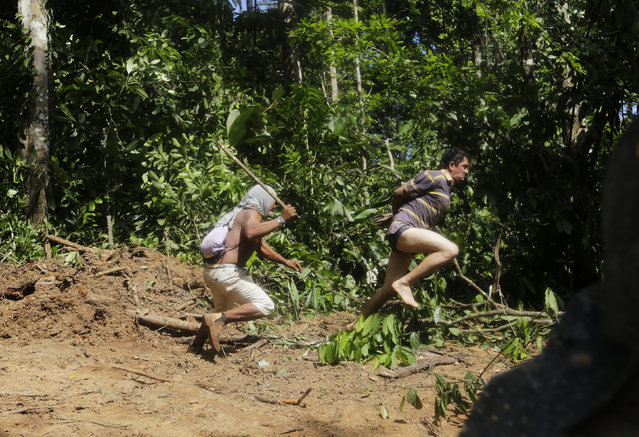
A Ka'apor Indian warrior (L) chases a logger who tried to escape after they captured him during a jungle expedition to search for and expel loggers from the Alto Turiacu Indian territory, near the Centro do Guilherme municipality in the northeast of Maranhao state in the Amazon basin, August 7, 2014. (Photo by Lunae Parracho/Reuters)

A Ka'apor Indian warrior (L) chases a logger who tried to escape after they captured him during a jungle expedition to search for and expel loggers from the Alto Turiacu Indian territory, near the Centro do Guilherme municipality in the northeast of Maranhao state in the Amazon basin, August 7, 2014. Tired of what they say is a lack of sufficient government assistance in keeping loggers off their land, the Ka'apor Indians, who along with four other tribes are the legal inhabitants and caretakers of the territory, have sent their warriors out to expel all loggers they find and set up monitoring camps in the areas that are being illegally exploited. (Photo by Lunae Parracho/Reuters)
Details
05 Sep 2014 11:41:00
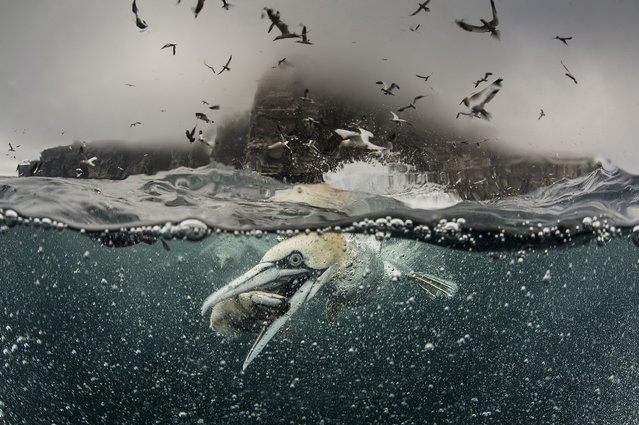
A gannet grabs a fish by its beak, 2014, in Shetland, Scotland. Hundreds of gannets crash into the sea in search of food – leaving a trail of air bubbles in their wake. Richard Shucksmith, 41, on the Shetland Isles, Scotland captured the remarkable scene as he took a boat to feed the large colony of seabirds that nested on the cliffs. The photographer has taken images of the gannets every summer for the last three years as the birds gather on the cliffs to breed. (Photo by Richard Shucksmith/Barcroft media)

A gannet grabs a fish by its beak, 2014, in Shetland, Scotland. Hundreds of gannets crash into the sea in search of food – leaving a trail of air bubbles in their wake. Richard Shucksmith, 41, on the Shetland Isles, Scotland captured the remarkable scene as he took a boat to feed the large colony of seabirds that nested on the cliffs. The photographer has taken images of the gannets every summer for the last three years as the birds gather on the cliffs to breed. (Photo by Richard Shucksmith/Barcroft media)
Details
26 Sep 2014 13:54:00
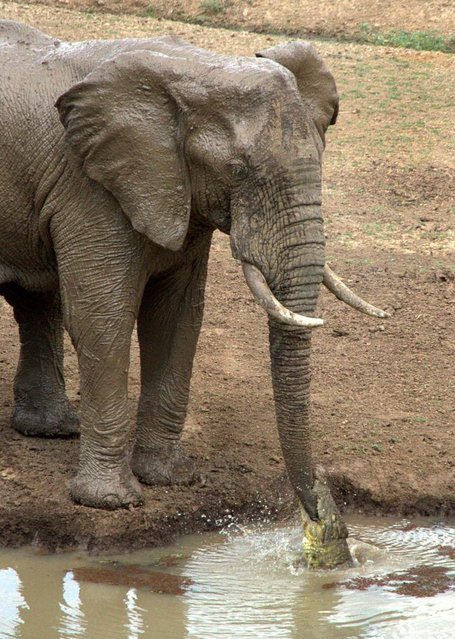
The remarkable scene was captured by amateur wildlife photographer Ian Salisbury, 62, at the South Luangwa National park in Zambia. The crocodile grabs hold of the elephant's trunk, but it soon becomes clear that he has bitten off a lot more than he can chew by grabbing the huge beast. Mr Salisbury said the elephant ‘fled rapidly into the bush’ after the attack. (Photo by Ian Salisbury/Caters News)

The remarkable scene was captured by amateur wildlife photographer Ian Salisbury, 62, at the South Luangwa National park in Zambia. The crocodile grabs hold of the elephant's trunk, but it soon becomes clear that he has bitten off a lot more than he can chew by grabbing the huge beast. Mr Salisbury said the elephant “fled rapidly into the bush” after the attack. (Photo by Ian Salisbury/Caters News)
Details
16 Nov 2013 12:55:00
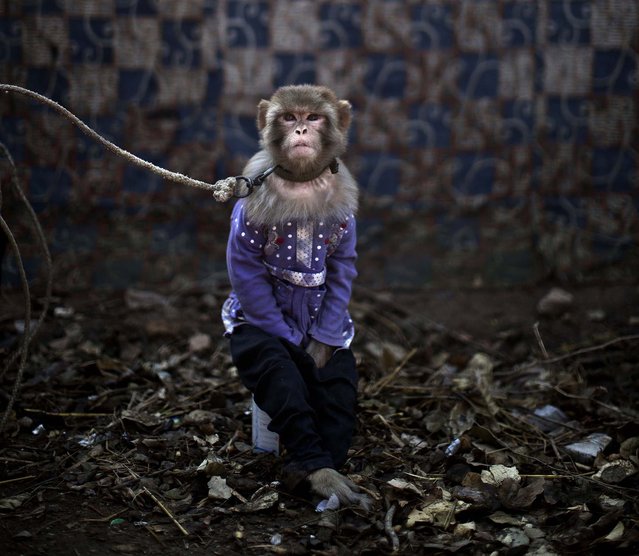
In this Tuesday, February 11, 2014, photo, a trained monkey, that makes a living for her Pakistani owner by performing to a crowd in public and private places, sits held by a leash, in Rawalpindi, Pakistan. For Pakistanis who raise and train the monkeys they are an important source of income in an impoverished country, and they form a strong bond with the animals. The monkeys are usually captured in the wild when they are babies and then trained. A trained monkey can fetch 20,000 to 30,000 rupees ($190 to $285). (Photo by Muhammed Muheisen/Associated Press)

In this Tuesday, February 11, 2014, photo, a trained monkey, that makes a living for her Pakistani owner by performing to a crowd in public and private places, sits held by a leash, in Rawalpindi, Pakistan. For Pakistanis who raise and train the monkeys they are an important source of income in an impoverished country, and they form a strong bond with the animals. The monkeys are usually captured in the wild when they are babies and then trained. A trained monkey can fetch 20,000 to 30,000 rupees ($190 to $285). (Photo by Muhammed Muheisen/Associated Press)
Details
23 Feb 2014 09:50:00
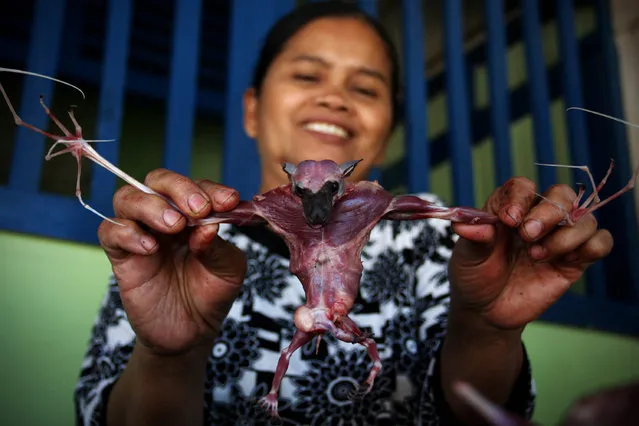
Bat seller Sukarwati shows a skinned bat on July 30, 2009 in Yogyakarta, Indonesia. Sukarwati and her family have hunted bats in the Imogiri region for generations, capturing more than 800 bats per month. The Sukarwati family believe that the meat from the bat heals asthma and respiratory problems and it is a great honour for them knowing that the meat that they provide will help ease people's health ailments

Bat seller Sukarwati shows a skinned bat on July 30, 2009 in Yogyakarta, Indonesia. Sukarwati and her family have hunted bats in the Imogiri region for generations, capturing more than 800 bats per month. The Sukarwati family believe that the meat from the bat heals asthma and respiratory problems and it is a great honour for them knowing that the meat that they provide will help ease people's health ailments. (Photo by Ulet Ifansasti)
Details
20 Sep 2012 08:57:00
Syrian government troops patrol the newly captured al- Sakhour neighbourhood in the eastern part of the northern city of Aleppo on December 7, 2016 Rebels in Aleppo called for a five- day truce and the evacuation of civilians Wednesday after losing more than three quarters of their territory including the Old City to a Syrian army offensive. (Photo by George Ourfalian/AFP Photo)

Syrian government troops patrol the newly captured al- Sakhour neighbourhood in the eastern part of the northern city of Aleppo on December 7, 2016 Rebels in Aleppo called for a five- day truce and the evacuation of civilians Wednesday after losing more than three quarters of their territory including the Old City to a Syrian army offensive. (Photo by George Ourfalian/AFP Photo)
Details
08 Dec 2016 12:35:00
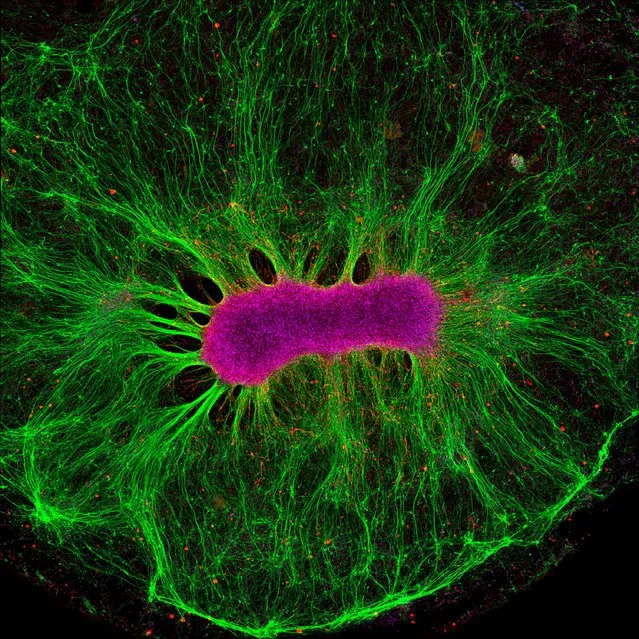
Brain-on-a-chip. Dazzling in green and magenta this image shows the nerve fibres (in green) produced by neural stem cells (in magenta) as they grow on a synthetic gel. Captured by a technique known as confocal microscopy, the image is part of research shedding light on how tinkering with the environment can affect the way in which nerve fibres grow. (Photo by Collin Edington and Iris Lee/Massachusetts Institute of Technology/Wellcome Images)

Brain-on-a-chip. Dazzling in green and magenta this image shows the nerve fibres (in green) produced by neural stem cells (in magenta) as they grow on a synthetic gel. Captured by a technique known as confocal microscopy, the image is part of research shedding light on how tinkering with the environment can affect the way in which nerve fibres grow. (Photo by Collin Edington and Iris Lee/Massachusetts Institute of Technology/Wellcome Images)
Details
17 Mar 2017 00:01:00
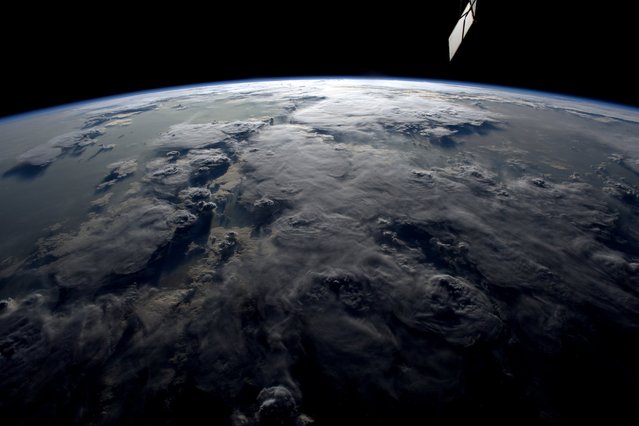
European Space Agency astronaut Tim Peake will return home after a six-month long mission on the International Space Station,on June 18, 2016. Peake was the first British ESA astronaut to visit the ISS and captured hundreds of photographs of the Earth during his mission. Here: “Lots of sun-glint right now during our whole orbit – we haven't seen a sunset for over 3 days”, he wrote. (Photo by Tim Peake/ESA/NASA)

European Space Agency astronaut Tim Peake will return home after a six-month long mission on the International Space Station,on June 18, 2016. Peake was the first British ESA astronaut to visit the ISS and captured hundreds of photographs of the Earth during his mission. Here: “Lots of sun-glint right now during our whole orbit – we haven't seen a sunset for over 3 days”, he wrote. (Photo by Tim Peake/ESA/NASA)
Details
18 Jun 2016 13:08:00