Loading...
Done


“Chameleons (family Chamaeleonidae) are a distinctive and highly specialized clade of lizards. They are distinguished by their parrot-like zygodactylous feet, their separately mobile and stereoscopic eyes, their very long, highly modified, and rapidly extrudable tongues, their swaying gait, the possession by many of a prehensile tail, crests or horns on their distinctively shaped heads, and the ability of some to change color. Uniquely adapted for climbing and visual hunting, the approximately 160 species of chameleon range from Africa, Madagascar, Spain and Portugal, across south Asia, to Sri Lanka, have been introduced to Hawaii, California and Florida, and are found in warm habitats that vary from rain forest to desert conditions”. – Wikipedia

Photo: A woman with the latest fashion accessory, a chameleon. (Photo by Fox Photos/Getty Images). Circa 1926
Details
20 Mar 2011 15:45:00
In this Monday, July 20, 2015 photo, Bill Lattin, the Southern California Timing Association president and Speed Week race director, stands in the Bonneville Salt Flats in Utah. (Photo by Rick Bowmer/AP Photo)

In this Monday, July 20, 2015 photo, Bill Lattin, the Southern California Timing Association president and Speed Week race director, stands in the Bonneville Salt Flats in Utah. A small city of tents, trailers and thousands of visitors appears almost every August in the Utah desert to watch cars, motorcycles and anything with wheels rocket across gleaming white sheets of salt at speeds of 400 mph. But wet weather has forced the cancellation of Speed Week for the second straight year and revived a debate about whether nearby mining is depleting the Bonneville Salt Flats of their precious resource. (Photo by Rick Bowmer/AP Photo)
Details
28 Jul 2015 13:01:00
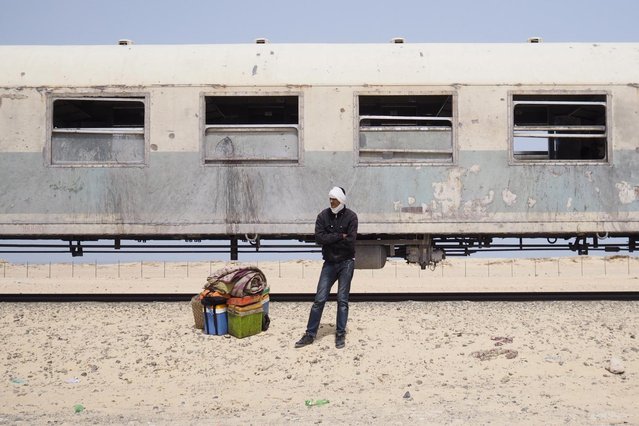
A passenger on a SNIM train carrying iron ore and mine workers waits for transport after arriving in Nouadhibou June 25, 2014. (Photo by Joe Penney/Reuters)

A passenger waits after his train arrived in Nouadhibou, Mauritania’s second largest city and the main export port for the country’s iron ore industry, on June 25, 2014. The mining company’s employees proudly call their firm the lung of their nation's economy and the train that ferries the ore to the coast stretches some two kilometres, making it one of the world's longest. SNIM mines black iron ore in the northern town of Zouerate, a remote desert location which nevertheless attracts people from all over the country looking for work. (Photo by Joe Penney/Reuters)
Details
27 Oct 2014 11:51:00
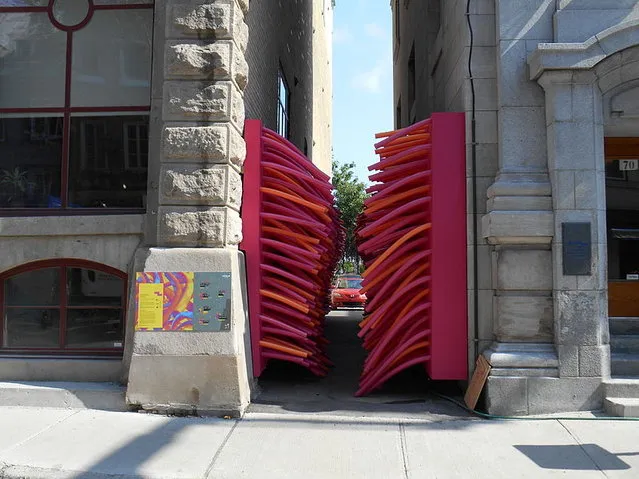
Delirious Frites Installation By Les Astronautes

The creator of this architectural installation, placed in a deserted alley in the city of Quebec, probably got his inspiration after looking at French fries while being on acid. This might be the reason why Les Astronautes called his creation Delirious Frites (frites is another name for French fries). This colorful installation attracts passersby like a magnet, making everyone want to enter the narrow passage between hundreds of foam noodles. Though it may look peculiar during the day, this installation looks even better during the night. The light, shining from above, creates a lot of shadows as it encounters all the “tendrils” that seemingly grow from the very walls of the buildings. This will leave even the sanest person wondering if he isn’t having a delusion.
Details
11 Nov 2014 11:45:00
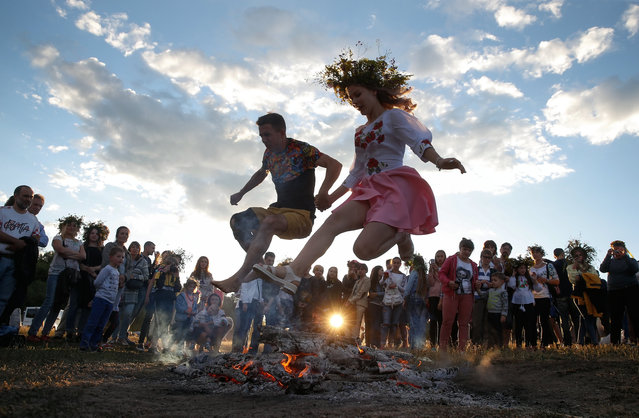
Ukrainians jump over a fire in Kiev, Ukraine, 06 July 2017, as they celebrate the traditional pagan holiday of Ivana Kupala. Ivana Kupala is celebrated, during the summer solstice, on the shortest night of the year, marking the beginning of summer and is celebrated in Ukraine, Belarus, Poland and Russia on the night of 06 July. People sing and dance around bonfires, play games and perform traditional rituals. Young people jump over bonfires in order to test their bravery. Couples holding hands jump over the flames to test their love. If the couple does not succeed it is predicted to split up. Traditionally, children and young unmarried women wear wreaths of wild flowers on their heads to symbolize purity. (Photo by Sergey Dolzhenko/EPA)

Ukrainians jump over a fire in Kiev, Ukraine, 06 July 2017, as they celebrate the traditional pagan holiday of Ivana Kupala. Ivana Kupala is celebrated, during the summer solstice, on the shortest night of the year, marking the beginning of summer and is celebrated in Ukraine, Belarus, Poland and Russia on the night of 06 July. People sing and dance around bonfires, play games and perform traditional rituals. Young people jump over bonfires in order to test their bravery. Couples holding hands jump over the flames to test their love. If the couple does not succeed it is predicted to split up. Traditionally, children and young unmarried women wear wreaths of wild flowers on their heads to symbolize purity. (Photo by Sergey Dolzhenko/EPA)
Details
08 Jul 2017 09:05:00
Scanning electron micrograph (SEM) of an Arabidopsis thaliana flower, also commonly known as thale cress. Some of the anthers are open, revealing pollen grains ready for dispersal. Arabidopsis was the first plant to have its entire genome sequenced and is widely used as a model organism in molecular and plant biology. Horizontal width of image is 1200 microns. Magnification 100x. (Photo by Stefan Eberhard/Wellcome Images)

Beautiful, strange and occasionally alarming pictures from the shortlist for this year’s Wellcome image awards – which celebrate the very best in science photography and imaging – from an x-ray of a bat to a micrograph of a kidney stone. The exhibition opens on 12 March at three science centres and the Museum of Science and Industry in Manchester. Photo: Scanning electron micrograph (SEM) of an Arabidopsis thaliana flower, also commonly known as thale cress. Some of the anthers are open, revealing pollen grains ready for dispersal. Arabidopsis was the first plant to have its entire genome sequenced and is widely used as a model organism in molecular and plant biology. Horizontal width of image is 1200 microns. Magnification 100x. (Photo by Stefan Eberhard/Wellcome Images)
Details
11 Mar 2014 05:58:00
Fire Pit By Melissa Crisp

A burning flame and a broad expanse of water are among the few things which do not tire us with their beauty. However, while we have many sources of water around us, it is quite hard to marvel at a burning flame on a daily basis. Melissa Crisp is one of the few people who were able to subdue the element of fire. She is the person who is behind the design of the uniquely-shaped fire pits, which feature mystifying themes, including a pair of lovers, a fire on the rodeo arena, a forest fire, a fiery flower, and a number of others. Each of the fire pits entrances you, and it almost seems like the characters are alive, as the hot fire burns deep within the spheres, casting dancing shadows all around. (Photo by Melissa Crisp)
Details
15 Jan 2015 13:35:00
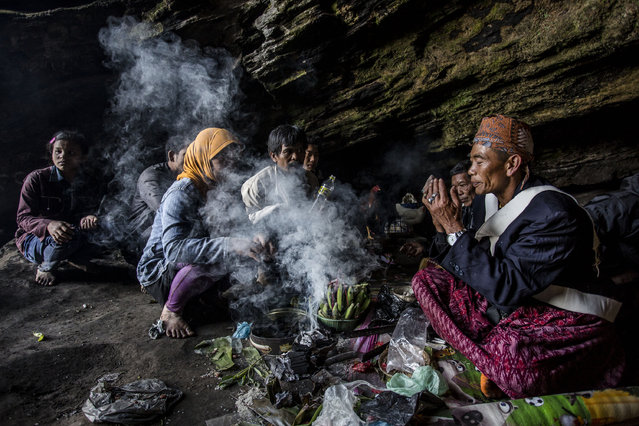
A Tenggerese shaman praying for worshippers at Widodaren cave during the Tenggerese Hindu Yadnya Kasada festival on July 31, 2015 in Probolinggo, East Java, Indonesia. The festival is the main festival of the Tenggerese people and lasts about a month. On the fourteenth day, the Tenggerese make the journey to Mount Bromo to make offerings of rice, fruits, vegetables, flowers and livestock to the mountain gods by throwing them into the volcano's caldera. (Photo by Ulet Ifansasti/Getty Images)

A Tenggerese shaman praying for worshippers at Widodaren cave during the Tenggerese Hindu Yadnya Kasada festival on July 31, 2015 in Probolinggo, East Java, Indonesia. The festival is the main festival of the Tenggerese people and lasts about a month. On the fourteenth day, the Tenggerese make the journey to Mount Bromo to make offerings of rice, fruits, vegetables, flowers and livestock to the mountain gods by throwing them into the volcano's caldera. The origin of the festival lies in the 15th century when a princess named Roro Anteng started the principality of Tengger with her husband Joko Seger, and the childless couple asked the mountain Gods for help in bearing children. The legend says the Gods granted them 24 children but on the provision that the 25th must be tossed into the volcano in sacrifice. The 25th child, Kesuma, was finally sacrificed in this way after initial refusal, and the tradition of throwing sacrifices into the caldera to appease the mountain Gods continues today. (Photo by Ulet Ifansasti/Getty Images)
Details
01 Aug 2015 12:07:00