Loading...
Done
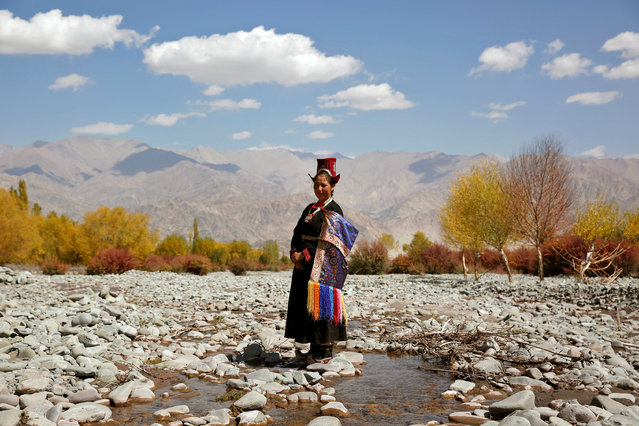
Tsewang Dolma, 33, a farmer and housewife poses for a photograph in Matho, a village nestled high in the Indian Himalayas, India September 29, 2016. When asked how living in the world's fastest growing major economy had affected life, Dolma replied: “Our culture is spoiled now. We don't wear our traditional dress”. (Photo by Cathal McNaughton/Reuters)

Tsewang Dolma, 33, a farmer and housewife poses for a photograph in Matho, a village nestled high in the Indian Himalayas, India September 29, 2016. When asked how living in the world's fastest growing major economy had affected life, Dolma replied: “Our culture is spoiled now. We don't wear our traditional dress”. (Photo by Cathal McNaughton/Reuters)
Details
13 Oct 2016 11:32:00
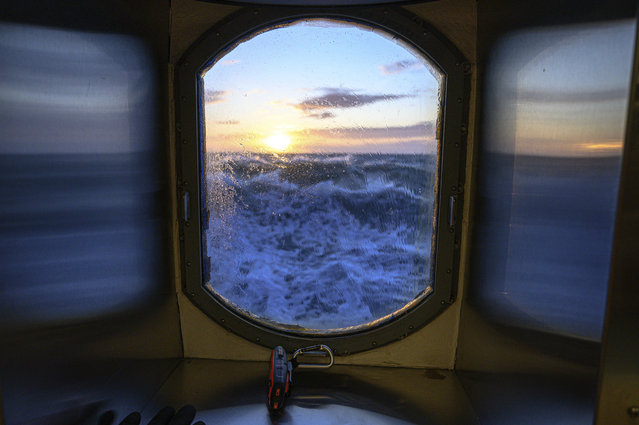
This November 8, 2019, photo provided by John Guillote shows a view from the main lab of the Sikuliaq in the Chukchi Sea. University of Washington scientists onboard the research vessel are studying the changes and how less sea ice will affect coastlines, which already are vulnerable to erosion because increased waves delivered by storms. More erosion would increase the chance of winter flooding in villages and danger to hunters in small boats. (Photo by John Guillote via AP Photo)

This November 8, 2019, photo provided by John Guillote shows a view from the main lab of the Sikuliaq in the Chukchi Sea. University of Washington scientists onboard the research vessel are studying the changes and how less sea ice will affect coastlines, which already are vulnerable to erosion because increased waves delivered by storms. More erosion would increase the chance of winter flooding in villages and danger to hunters in small boats. (Photo by John Guillote via AP Photo)
Details
26 Aug 2021 08:22:00
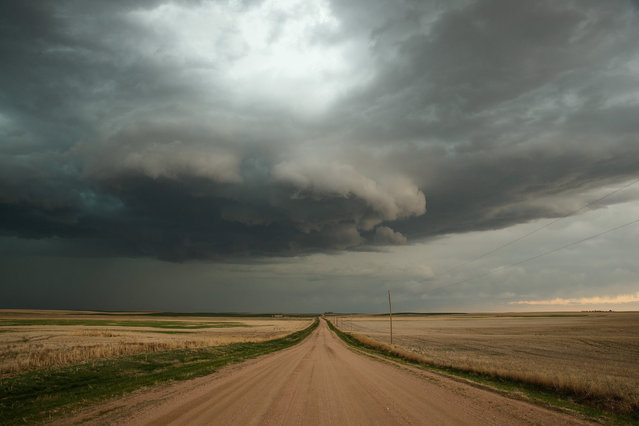
A supercell thunderstorm develops, May 8, 2017 in Elbert County outside of Limon, Colorado. With funding from the National Science Foundation and other government grants, scientists and meteorologists from the Center for Severe Weather Research try to get close to supercell storms and tornadoes trying to better understand tornado structure and strength, how low-level winds affect and damage buildings, and to learn more about tornado formation and prediction. (Photo by Drew Angerer/Getty Images)

A supercell thunderstorm develops, May 8, 2017 in Elbert County outside of Limon, Colorado. With funding from the National Science Foundation and other government grants, scientists and meteorologists from the Center for Severe Weather Research try to get close to supercell storms and tornadoes trying to better understand tornado structure and strength, how low-level winds affect and damage buildings, and to learn more about tornado formation and prediction. (Photo by Drew Angerer/Getty Images)
Details
16 Jun 2017 06:20:00
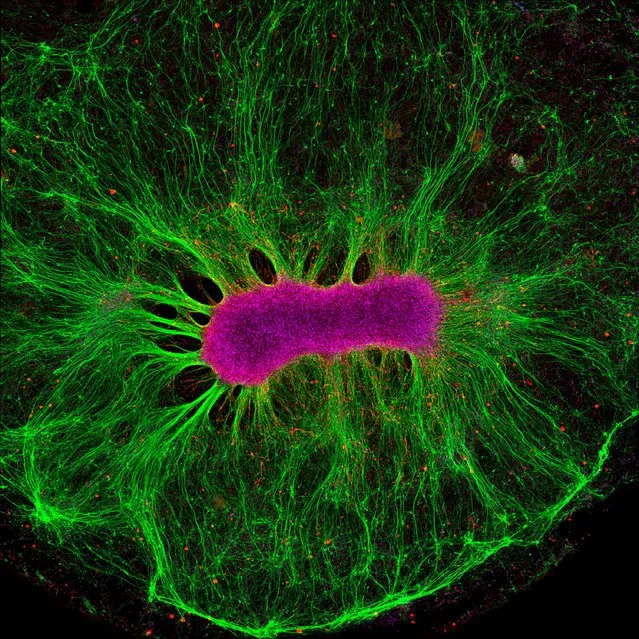
Brain-on-a-chip. Dazzling in green and magenta this image shows the nerve fibres (in green) produced by neural stem cells (in magenta) as they grow on a synthetic gel. Captured by a technique known as confocal microscopy, the image is part of research shedding light on how tinkering with the environment can affect the way in which nerve fibres grow. (Photo by Collin Edington and Iris Lee/Massachusetts Institute of Technology/Wellcome Images)

Brain-on-a-chip. Dazzling in green and magenta this image shows the nerve fibres (in green) produced by neural stem cells (in magenta) as they grow on a synthetic gel. Captured by a technique known as confocal microscopy, the image is part of research shedding light on how tinkering with the environment can affect the way in which nerve fibres grow. (Photo by Collin Edington and Iris Lee/Massachusetts Institute of Technology/Wellcome Images)
Details
17 Mar 2017 00:01:00
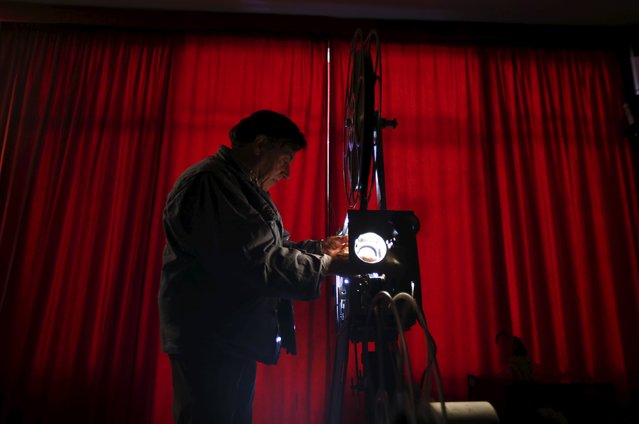
Projectionist Antonio Feliciano, 75, checks his projector before showing a film in Monforte, Portugal May 16, 2015. (Photo by Rafael Marchante/Reuters)

Projectionist Antonio Feliciano, 75, checks his projector before showing a film in Monforte, Portugal May 16, 2015. Shades of Oscar-winning classic "Cinema Paradiso" run through the life of Feliciano, a sprightly 75-year-old who fears he may be the last of Portugal's travelling film projectionists.After six decades travelling four million km (2.5 million miles) to screen 4,000 films in Portugal's far-flung villages, Feliciano does not plan to retire just yet. But he is resigned to the fact that the Internet, digital TV and distribution monopolies have made his craft obsolete. (Photo by Rafael Marchante/Reuters)
Details
12 Nov 2015 08:06:00
What 200 Calories Looks Like In Different Foods Part 1

Some foods have significantly more Calories than others but what does the difference actually look like. Each of the photographs below represents 200 Calories of the particular type of food; the images are sorted from low to high calorie density. When you consider that an entire plate of broccoli contains the same number of Calories as a small spoonful of peanut butter, you might think twice the next time you decide what to eat. According to the U.S. Department of Agriculture, the average adult needs to consume about 2000 - 2500 Calories to maintain their weight. In other words, you have a fixed amount of Calories to "spend" each day; based on the following pictures, which would you eat?


See Also: Ppart 2 _ Part 3
Details
30 Jul 2014 10:18:00
Vinyl Clock By Pavel Sidorenko Part 2

Pavel Sidorenko is an award winning Estonian designer who was born in 1980 in Tallinn and studied product design at Estonian Academy of Arts and Graduated in 2006. Not only does he incorporate pragmatic necessity, but also transmits an emotional qualities within the everyday environment. His fantastic collection of Re Vinyl designs are a result of upcycling a product fashioned from old vinyl records. Beautifully crafted and working with a range of themes from scenography to animal creatures, there is sure to be something for everyone with these stylish selection of recycled vinyl clocks!


See also: Part 1
Details
01 Mar 2014 11:09:00
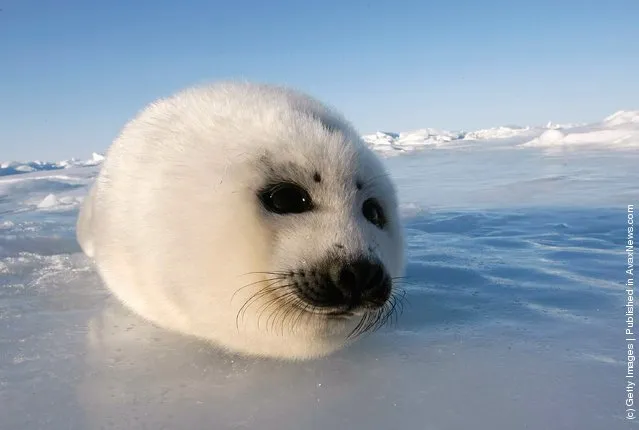
A harp seal pup

“The harp seal or saddleback seal is a species of earless seal native to the northernmost Atlantic Ocean and adjacent parts of the Arctic Ocean. Newborn pups weigh around 11 kilograms (24 lb) and are 80–85 centimetres (31–33 in) long. After birth, the mother only feeds that pup. During the 12 day nursing period, the mother does not eat, losing up to 3 kilograms (7 lb) per day. Harp seal milk contains up to 48% fat, so pups gain over 2.2 kilograms (4.9 lb) per day. During this time, the juvenile's “greycoat” grows in beneath the white neonatal coat, and it weighs 80 pounds (36 kg)”. – Wikipedia

Photo: A harp seal pup lies on an ice floe in the Gulf of Saint Lawrence March 24, 2008 in Charlottetown, Canada. (Photo by Joe Raedle/Getty Images)
Details
19 Sep 2011 15:49:00