Loading...
Done
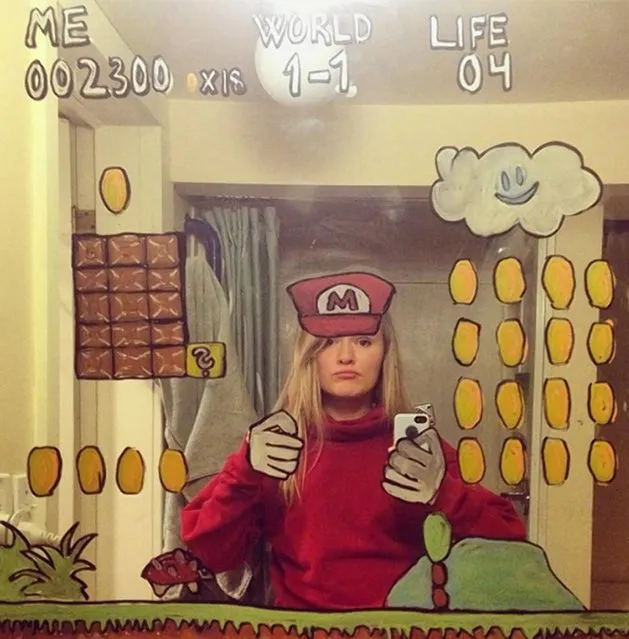
Funny Selfies By Helene Meldahl

The time of selfies with duck faces is long gone and ridiculed, though some persist in doing it. Helene Meldahl, however, didn’t want to give up the trend, but had to think of a creative way to keep doing it. So she decided to create comical pictures by drawing over the selfies that she has made. Some people just can’t stop taking pictures of themselves. It makes you wonder, what they would do in an era before the existence of cameras… Oh, poor souls, they would definitely suffer greatly without the possibility of sharing on instagram their “stunning looks” and the pictures of food that they eat every 2 seconds. (Photo by Helene Meldahl)
Details
07 Nov 2014 12:31:00
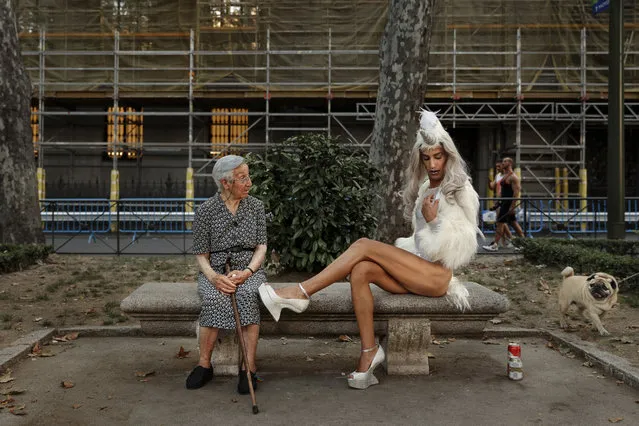
A woman looks across as a gay parade participant poses for pictures during Gay Pride parade in Madrid, Spain, Saturday, July 2, 2016. Hundreds of thousands of people defied high temperatures and relative security concerns and turned out in Madrid to march in Saturday's LGTB Pride parade, one of the biggest in Europe, along the streets of the Spanish capital, just three weeks after members of the gay, lesbian, bisexual and transgender community were tragically victimized in a shooting massacre at a United States nightclub. (Photo by Daniel Ochoa de Olza/AP Photo)

A woman looks across as a gay parade participant poses for pictures during Gay Pride parade in Madrid, Spain, Saturday, July 2, 2016. Hundreds of thousands of people defied high temperatures and relative security concerns and turned out in Madrid to march in Saturday's LGTB Pride parade, one of the biggest in Europe, along the streets of the Spanish capital, just three weeks after members of the gay, lesbian, bisexual and transgender community were tragically victimized in a shooting massacre at a United States nightclub. (Photo by Daniel Ochoa de Olza/AP Photo)
Details
03 Jul 2016 11:20:00
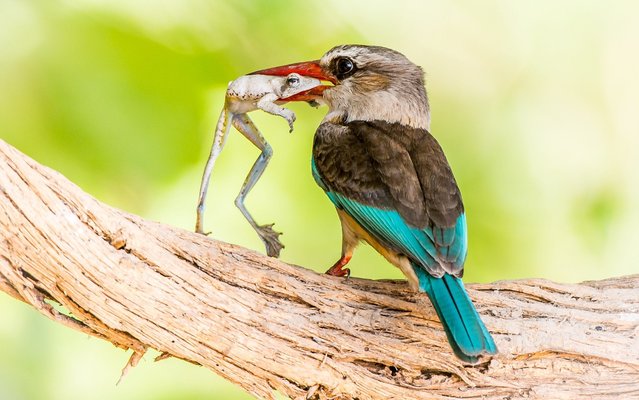
A brown-hooded kingfisher sits on a branch with a freshly caught frog in it's beak. Riaan Marais who took the photo said, “We were doing a boat safari on the Rufiji river in Selous Game Reserve, Tanzania when I spotted the bird with the frog on an overhanging branch on the river bank. It most probably caught the frog in the reeds along the river’s edge as this is where these frogs stay. The kingfisher must have caught the Common Reed Frog just before I took the image, as the frog was still alive, I had a brief moment to take the image before the bird flew off with the frog”. (Photo by Riaan Marais/Solent News and Photo Agency)

A brown-hooded kingfisher sits on a branch with a freshly caught frog in it's beak. Riaan Marais who took the photo said, “We were doing a boat safari on the Rufiji river in Selous Game Reserve, Tanzania when I spotted the bird with the frog on an overhanging branch on the river bank. It most probably caught the frog in the reeds along the river’s edge as this is where these frogs stay. The kingfisher must have caught the Common Reed Frog just before I took the image, as the frog was still alive, I had a brief moment to take the image before the bird flew off with the frog”. (Photo by Riaan Marais/Solent News and Photo Agency)
Details
10 Jun 2018 00:03:00
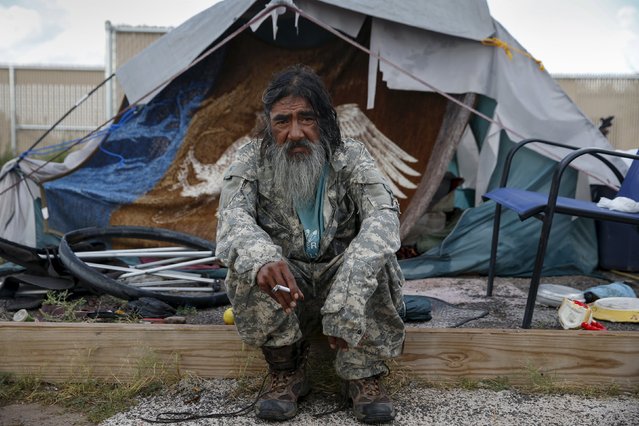
Daniel J. Wabsey, a 58-year-old war veteran, sits outside his tent at Camp Hope in Las Cruces, New Mexico October 6, 2015. “I've been traveling for 35 or 38 years. Getting inside would take a while to get used to. I just want to be able to eat, sleep and be safe. We all get along and understand in Camp Hope. We've all been there. With common sense you can survive out here”, Wabsey said. Camp Hope describe themselves as an “alternative transitional living project for the homeless”. Around 50 people live at the camp. (Photo by Shannon Stapleton/Reuters)

Daniel J. Wabsey, a 58-year-old war veteran, sits outside his tent at Camp Hope in Las Cruces, New Mexico October 6, 2015. “I've been traveling for 35 or 38 years. Getting inside would take a while to get used to. I just want to be able to eat, sleep and be safe. We all get along and understand in Camp Hope. We've all been there. With common sense you can survive out here”, Wabsey said. Camp Hope describe themselves as an “alternative transitional living project for the homeless”. Around 50 people live at the camp. (Photo by Shannon Stapleton/Reuters)
Details
19 Dec 2015 08:05:00
Close Encounter of the Insect Kind: Check out the awesome face on this praying mantis. I can't get over the mouth, it's like something from a science fiction movie. Of all photographic styles macro is definitely my favorite. I am constantly amazed, in every photo that I take, by the intricate level of detail that exists on even the smallest of creatures. It's a stark reminder that a very complex and infinitely beautiful world exists just beyond our human-sized level of perception. Photo taken in Donnybrook, Queensland, Australia. (Photo by Andrew Young/National Geographic Photo Contest

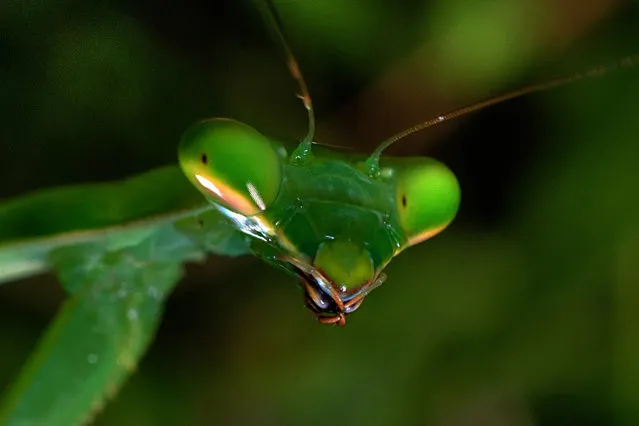
Close Encounter of the Insect Kind: “Check out the awesome face on this praying mantis. I can't get over the mouth, it's like something from a science fiction movie. Of all photographic styles macro is definitely my favorite. I am constantly amazed, in every photo that I take, by the intricate level of detail that exists on even the smallest of creatures. It's a stark reminder that a very complex and infinitely beautiful world exists just beyond our human-sized level of perception. Photo taken in Donnybrook, Queensland, Australia” – Andrew Young. (Photo by Andrew Young/National Geographic Photo Contest via The Atlantic)
Details
24 Sep 2012 09:18:00
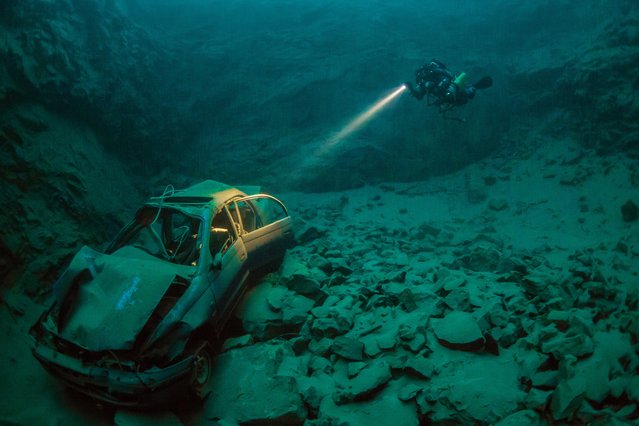
Wide-angle category winner. Part of the Illusion by Marcus Blatchford (UK). Location: National Dive & Activity Centre, Chepstow, Wales. “This is the deepest inland dive centre in the UK. The dive plan was to explore the deep end, but this time I dived ‘unplugged’ (without my strobes). With the exception of this change to my camera technique, there were no planned shots I wanted to achieve – just a fun dive with ad-hoc photos along the way. Shortly after this photo was captured, in 6C water and two hours of decompression ahead of us, we turned and started the long ascent back to the surface”. (Photo by Marcus Blatchford/Underwater Photographer of the Year 2016)

Wide-angle category winner. Part of the Illusion by Marcus Blatchford (UK). Location: National Dive & Activity Centre, Chepstow, Wales. “This is the deepest inland dive centre in the UK. The dive plan was to explore the deep end, but this time I dived ‘unplugged’ (without my strobes). With the exception of this change to my camera technique, there were no planned shots I wanted to achieve – just a fun dive with ad-hoc photos along the way. Shortly after this photo was captured, in 6C water and two hours of decompression ahead of us, we turned and started the long ascent back to the surface”. (Photo by Marcus Blatchford/Underwater Photographer of the Year 2016)
Details
18 Feb 2016 13:44:00
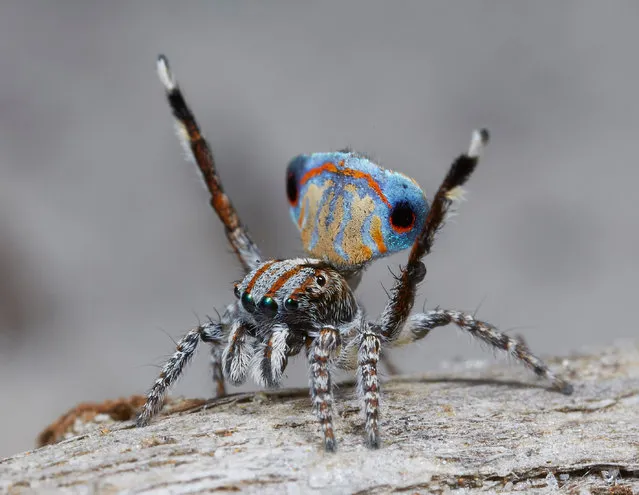
Several new species of peacock spider – just a few millimetres long and featuring extraordinary colours – have been discovered in Western Australia and South Australia. Jürgen Otto, a biologist from Sydney, has been researching the arachnids since 2005, and has gained a significant following online with his footage. He believes there are now 48 confirmed species of peacock spider within the Maratus genus, found across Australia but particularly in Western Australia – and many more awaiting confirmation. Here: Maratus Tasmanicus, one of seven new species of peacock spiders studied by the Sydney biologist Jürgen Otto. (Photo by Jürgen Otto)

Several new species of peacock spider – just a few millimetres long and featuring extraordinary colours – have been discovered in Western Australia and South Australia. Jürgen Otto, a biologist from Sydney, has been researching the arachnids since 2005, and has gained a significant following online with his footage. He believes there are now 48 confirmed species of peacock spider within the Maratus genus, found across Australia but particularly in Western Australia – and many more awaiting confirmation. Here: Maratus Tasmanicus, one of seven new species of peacock spiders studied by the Sydney biologist Jürgen Otto. (Photo by Jürgen Otto)
Details
30 May 2016 08:40:00
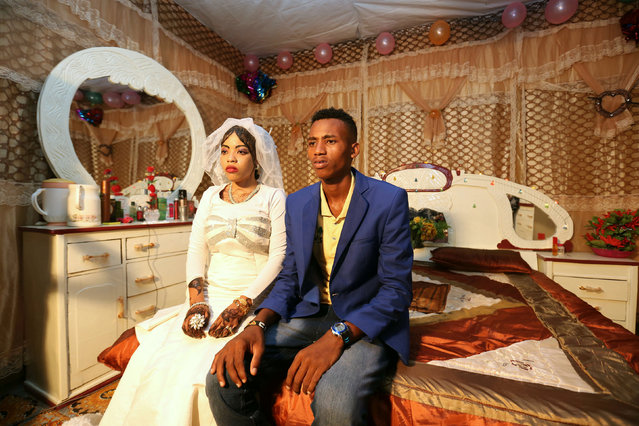
Somali couple Mohamed Noor (L) and Huda Omar pose for a photograph at their makeshift home during their wedding ceremony in Mogadishu's Rajo camp, Somalia August 17, 2016. Having met two years ago, the pair have just married at Rajo camp, where some 400 families live. Most, like Noor's parents, came here in the early 1990s to flee famine. They stayed on as years of conflict ravaged the Horn of Africa nation. As at any wedding, there is plenty of dancing and sweet treats for the young couple as they start married life in Noor's simple home, made of iron and plastic sheets. Noor works as a mason with his father. Others here are builders or sell sweets, nuts and stick toothbrushes to make money. Some beg around the seaside city, which like the rest of Somalia has been gripped by violence since the toppling of dictator Mohamed Siad Barre in 1991. (Photo by Feisal Omar/Reuters)

Somali couple Mohamed Noor (L) and Huda Omar pose for a photograph at their makeshift home during their wedding ceremony in Mogadishu's Rajo camp, Somalia August 17, 2016. Having met two years ago, the pair have just married at Rajo camp, where some 400 families live. Most, like Noor's parents, came here in the early 1990s to flee famine. (Photo by Feisal Omar/Reuters)
Details
14 Sep 2016 10:35:00