“The White Lotus” co-stars Parker Posey (left) and Leslie Bibb reunite at the Gotham TV Awards near Wall Street in NYC on June 2, 2025. (Photo by Zach Hilty/BFA.com/Rex Features/Shutterstock)
A male stag beetle walks on a branch in an oak forest near the Spree River in Kersdorf, Brandenburg, Germany, on June 8, 2025. (Photo by Patrick Pleul/picture alliance via Getty Images)
A purple haze of heather as the sun rises over the New Forest near Lyndhurst, Hampshire in UK on July 28, 2025. (Photo by Steve Hogan/Bournemouth News)
An abandoned protection masks in the deserted building near bypass channel for cooling at the Chernobyl nuclear power plant in the Exclusion Zone, Ukraine, April 5, 20177. The Chernobyl nuclear accident occurred on 26 April 1986 in the No.4 light water graphite moderated reactor at the Chernobyl Nuclear Power Plant near Pripyat. An estimated 47,000 people of the city of Pripyat were evacuated after the explosion in 1986. (Photo by Vitaliy Holovin/Corbis via Getty images)
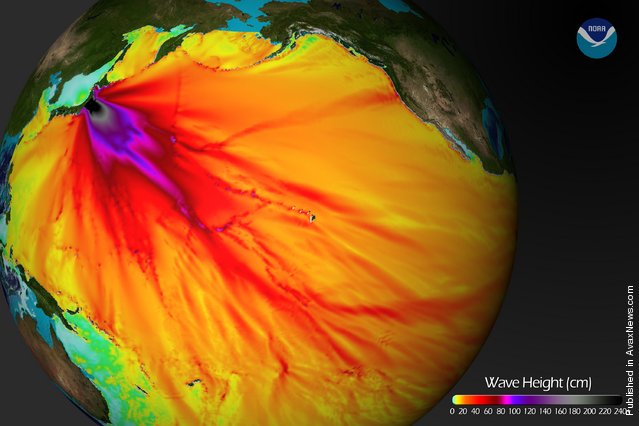
In this handout image provided by the National Oceanic and Atmospheric Administration (NOAA), model runs from the Center for Tsunami Research at the NOAA Pacific Marine Environmental Laboratory show the expected wave heights of the tsunami as it travels across the Pacific basin March 11, 2011. The largest wave heights are expected near the earthquake epicenter, off Japan. The wave will decrease in height as it travels across the deep Pacific but grow taller as it nears coastal areas. In general, as the energy of the wave decreases with distance, the near shore heights will also decrease (e.g., coastal Hawaii will not expect heights of that encountered in coastal Japan). (Photo by NOAA via Getty Images)
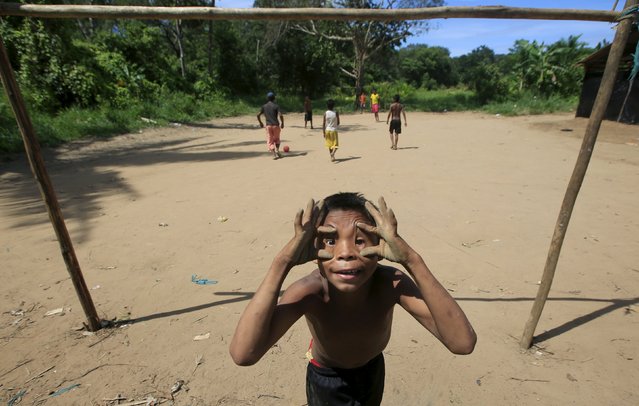
A Colombian Nukak Maku Indian boy gestures in a refugee camp at Agua Bonita near San Jose del Guaviare of Guaviare province September 3, 2015. Since emerging from the jungle in 2005, half naked and carrying blowpipes, the Nukak have lived in settlements near the frontier town of San Jose del Guaviare, a humid outpost in the Amazon 400 km (250 miles) southeast of the capital Bogota. (Photo by John Vizcaino/Reuters)
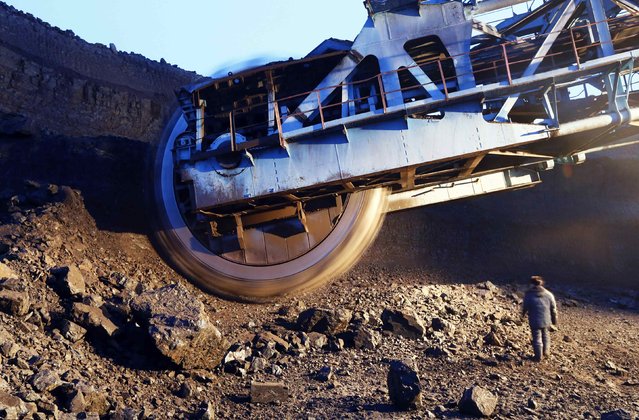
An employee walks near a rotary dredge which works on the coal face of the Borodinsky opencast colliery, near the Siberian town of Borodino, east of Krasnoyarsk, December 9, 2014. The Borodinsky colliery, 9 km (5.6 miles) long and more than 100 meters (328 feet) deep, annually produces more than 20 million tons of coal and is considered to be the biggest opencast coal mine in Russia, according to official representatives. (Photo by Ilya Naymushin/Reuters)
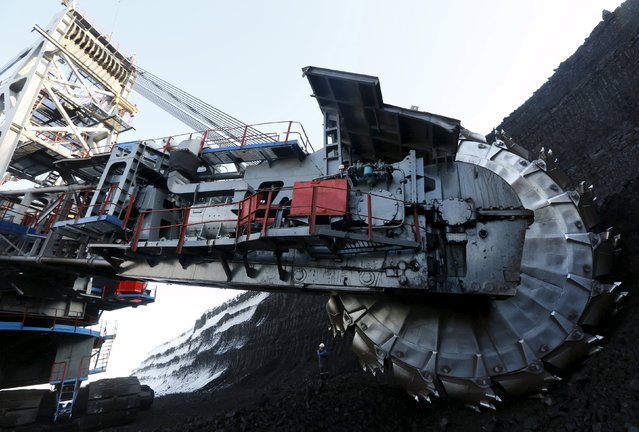
Master Sergey Suprun uses a portable radio set as he stands near a rotary dredge which works on the coal face of the Borodinsky opencast colliery, near the Siberian town of Borodino, east of Krasnoyarsk, Russia October 27, 2015. The Borodinsky colliery, 9 km (5.6 miles) long and more than 100 meters (328 feet) deep, annually produces more than 20 million tons of coal and is considered to be the biggest opencast coal mine in Russia, according to official representatives. (Photo by Ilya Naymushin/Reuters)