Loading...
Done
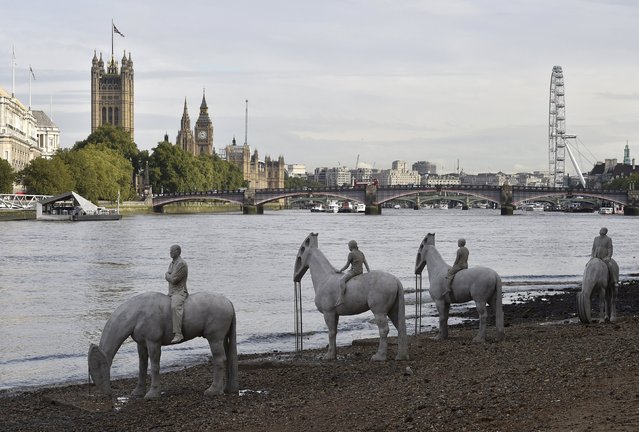
Sculptures entitled “The Rising Tide” by British sculptor Jason deCaires Taylor are seen beside the River Thames in front of the Houses of Parliament and the London Eye ferris wheel in London, September 3, 2015. The representations of four horses and riders are fully visible at low tide but become immersed underwater twice a day as the Thames rises to reach full tide. The installation will be on display throughout September as part of the annual Totally Thames festival. (Photo by Toby Melville/Reuters)

Sculptures entitled “The Rising Tide” by British sculptor Jason deCaires Taylor are seen beside the River Thames in front of the Houses of Parliament and the London Eye ferris wheel in London, September 3, 2015. The representations of four horses and riders are fully visible at low tide but become immersed underwater twice a day as the Thames rises to reach full tide. The installation will be on display throughout September as part of the annual Totally Thames festival. (Photo by Toby Melville/Reuters)
Details
04 Sep 2015 13:58:00
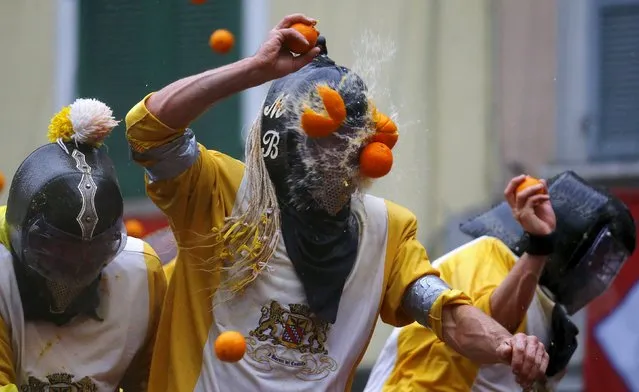
A participant is hit by an orange during an annual carnival battle in the northern Italian town of Ivrea February 7, 2016. Dressed up as Middle Age kings' guards, a group of men ride in a horse-drawn carriage and pelt “foot soldiers” with oranges as thousands of people gather to re-enact a Middle Age battle when the townsfolk of Ivrea overthrew an evil king. In a strange twist, instead of swords and cross bows, these days the weapons of choice are oranges. (Photo by Stefano Rellandini/Reuters)

A participant is hit by an orange during an annual carnival battle in the northern Italian town of Ivrea February 7, 2016. Dressed up as Middle Age kings' guards, a group of men ride in a horse-drawn carriage and pelt “foot soldiers” with oranges as thousands of people gather to re-enact a Middle Age battle when the townsfolk of Ivrea overthrew an evil king. In a strange twist, instead of swords and cross bows, these days the weapons of choice are oranges. (Photo by Stefano Rellandini/Reuters)
Details
08 Feb 2016 12:03:00
Festival goer practice yoga during the O.Z.O.R.A. festival on August 4, 2016 in Tolna, Hungary. Ozora is a village in Tolna County. In recent times it has become famous for the O.Z.O.R.A. psychedelic trance festival which has been held on an estate in Ozora near small village Dadpuszta every year since 2004. The first party was called Solipse and took place during the Solar eclipse of August 11, 1999. The Ozora festival (with Solar United Natives festival) is one of the two big psytrance festivals in Hungary, and is fastest growing psytrance festivals on the world, achieving incredible 60 000 visitors in 2015. (Photo by Mohai Balázs/MTI/MTVA)

Festival goer practice yoga during the O.Z.O.R.A. festival on August 4, 2016 in Tolna, Hungary. Ozora is a village in Tolna County. In recent times it has become famous for the O.Z.O.R.A. psychedelic trance festival which has been held on an estate in Ozora near small village Dadpuszta every year since 2004. The first party was called Solipse and took place during the Solar eclipse of August 11, 1999. (Photo by Mohai Balázs/MTI/MTVA)
Details
05 Aug 2016 13:40:00


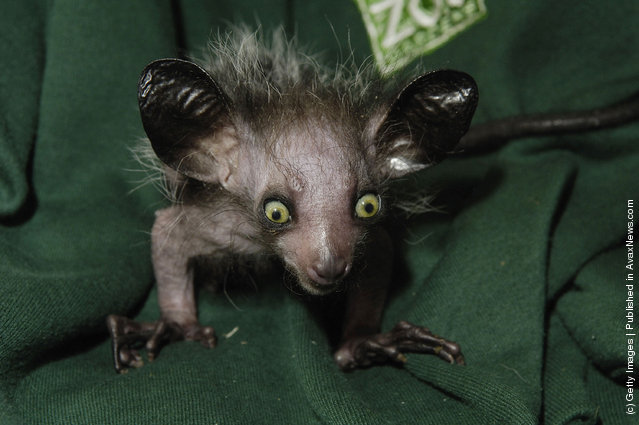
“The aye-aye (Daubentonia madagascariensis) is a lemur, a strepsirrhine primate native to Madagascar that combines rodent-like teeth and a special thin middle finger to fill the same ecological niche as a woodpecker. It is the world's largest nocturnal primate, and is characterized by its unusual method of finding food; it taps on trees to find grubs, then gnaws holes in the wood and inserts its narrow middle finger to pull the grubs out. The only other animal species known to find food in this way is the striped possum. From an ecological point of view the aye-aye fills the niche of a woodpecker as it is capable of penetrating wood to extract the invertebrates within”. – Wikipedia

Photo: In this handout image from Bristol Zoo is seen the first captive bred aye-aye in the UK named “Kintana” (meaning star in Malagasy) April 15, 2005 at Bristol Zoo Gardens, England. The zoo announced today only the second baby aye-aye to be hand-reared in the world (the first was in Jersey Zoo) and has now made his first public appearance since his birth on 11 February 2005. (Photo by Rob Cousins/Bristol Zoo via Getty Images)
Details
13 Apr 2011 13:33:00
A harp seal pup

“The harp seal or saddleback seal is a species of earless seal native to the northernmost Atlantic Ocean and adjacent parts of the Arctic Ocean. Newborn pups weigh around 11 kilograms (24 lb) and are 80–85 centimetres (31–33 in) long. After birth, the mother only feeds that pup. During the 12 day nursing period, the mother does not eat, losing up to 3 kilograms (7 lb) per day. Harp seal milk contains up to 48% fat, so pups gain over 2.2 kilograms (4.9 lb) per day. During this time, the juvenile's “greycoat” grows in beneath the white neonatal coat, and it weighs 80 pounds (36 kg)”. – Wikipedia

Photo: A harp seal pup lies on an ice floe in the Gulf of Saint Lawrence March 24, 2008 in Charlottetown, Canada. (Photo by Joe Raedle/Getty Images)
Details
19 Sep 2011 15:49:00
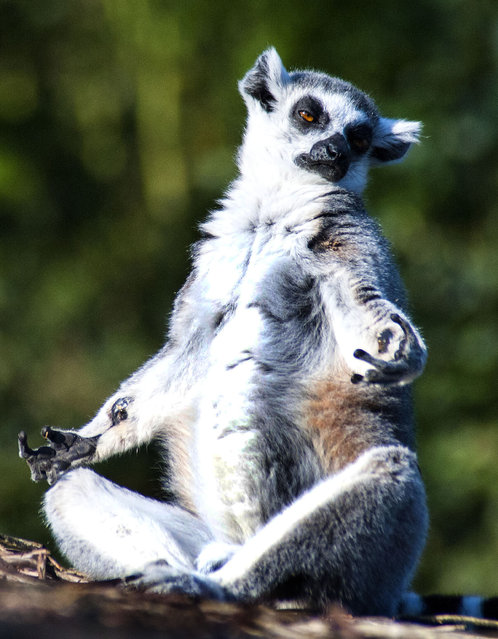
This lemur looks like he is channelling the spirit of Buddha – as he sits meditating. Sitting with his legs crossed, the lemur clasps his thumb and fore finger together with outstretched arms – just like the spiritual teacher. And amateur snapper Sebastien Degardin, 32, was on hand to capture the bizarre moment the animal searched for enlightenment on film. (Photo by Sebastien Degardin/Caters News)

This lemur looks like he is channelling the spirit of Buddha – as he sits meditating. Sitting with his legs crossed, the lemur clasps his thumb and fore finger together with outstretched arms – just like the spiritual teacher. And amateur snapper Sebastien Degardin, 32, was on hand to capture the bizarre moment the animal searched for enlightenment on film. Sebastien, who moved from his native Belgium to Finchley, North London, said: “I was gobsmacked when I saw this lemur meditating”. (Photo by Sebastien Degardin/Caters News)
Details
13 Apr 2014 10:18:00
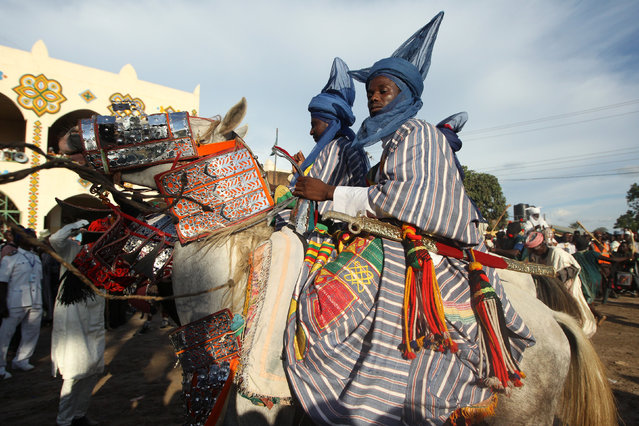
Horsemen take part in the Durbar festival parade in Zaria, Nigeria September 14, 2016. (Photo by Afolabi Sotunde/Reuters)

Horsemen take part in the Durbar festival parade in Zaria, Nigeria September 14, 2016. It is celebrated at the culmination of Muslim festivals Eid al-Fitr and Eid al-Adha. It begins with prayers, followed by a parade of the Emir and his entourage on horses, accompanied by music players, and ending at the Emir's palace. (Photo by Afolabi Sotunde/Reuters)
Details
22 Sep 2016 09:14:00


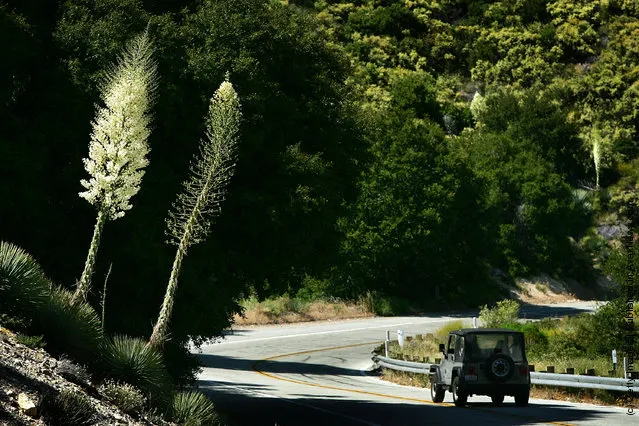
“Yucca is a genus of perennial shrubs and trees in the agave family, Agavaceae. Its 40-50 species are notable for their rosettes of evergreen, tough, sword-shaped leaves and large terminal panicles of white or whitish flowers. They are native to the hot and dry (arid) parts of North America, Central America, South America, and the Caribbean. Early reports of the species were confused with the cassava (Manihot esculenta). Consequently, Linnaeus mistakenly derived the generic name from the Carib word for the latter, yuca. It is also colloquially known in the midwest United States as “Ghosts in the graveyard”, as it is commonly found growing in rural graveyards and when in bloom the flowers appear as an apparition floating.” – Wikipedia

Photo: A yucca standing among flowers bursts forth a very large stalk of flowers as a heavy wildflower bloom on June 21, 2005 in the Angeles National Forest northwest of La Canada, California. (Photo by David McNew/Getty Images)
Details
29 Mar 2011 07:31:00