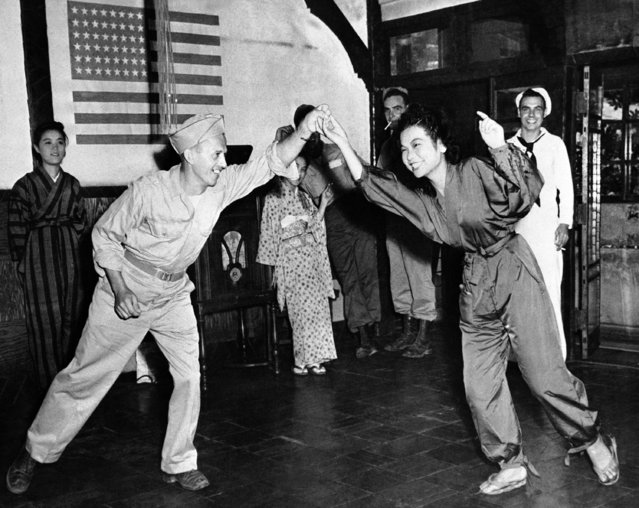
U.S. Corporal Stanley Suski, left, and Miss Tamako, a Geisha girl, whirl a bit of Jitterbug, in a bar, in Tokyo, Japan, on October 1, 1945. (Photo by AP Photo)
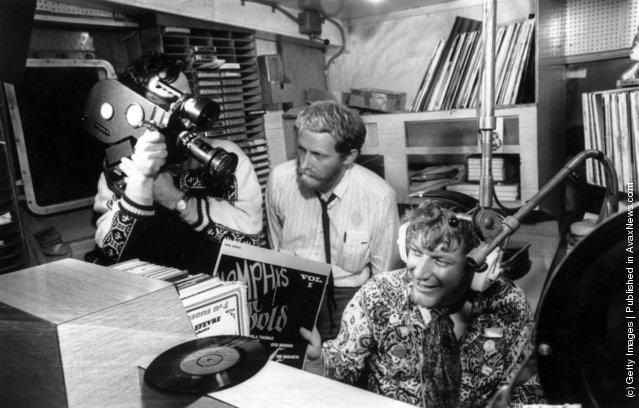
“«Pirate radio» in the UK first became widespread in the early 1960s when pop music stations such as Radio Caroline and Radio London started to broadcast on medium wave to the UK from offshore ships or disused sea forts. At the time these stations were not illegal because they were broadcasting from international waters. The stations were set up by entrepreneurs and music enthusiasts to meet the growing demand for pop and rock music, which was not catered for by the legal BBC Radio services”. – Wikipedia
Photo: The “World in Action” team making a program about the pirate radio ship Caroline, filmed by Paddy Searle, and produced by Mike Hodges. The DJ being filmed is Robbie Dale, and Hodges is standing behind him. (Photo by James Jackson/Evening Standard/Getty Images). 6th September 1967
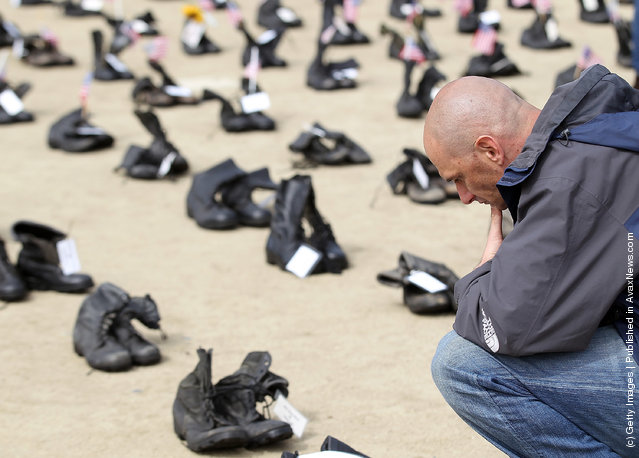
“Eyes Wide Open is an exhibit created by the American Friends Service Committee observing the American soldiers and marines that have died in the Iraq War. It contains a pair of combat boots to represent every American soldier and marine that has died in the war, as well as shoes representing Iraqi civilians who have lost their lives during the invasion and occupation”. – Wikipedia
Photo: A man pauses as he looks at rows of combat boots that are part of the "Eyes Wide Open" exhibit in front of San Francisco City Hall on March 19, 2012 in San Francisco, California. The Eyes Wide Open exhibition includes a pair of boots for every one of the 481 California servicemen and women who died in the Iraq war. (Photo by Justin Sullivan/Getty Images)
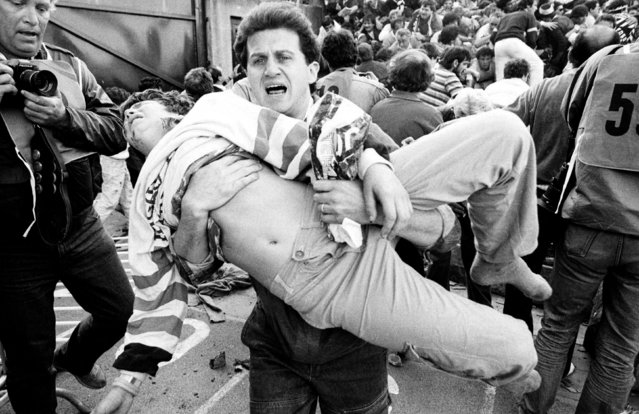
Reuters multi-award winning photographers are celebrated here in a three part retrospective on the 30th anniversary of the service's launch. They have captured dramatic images illustrating the human tragedy of natural disaster and war as well as the fallout of economic events across the continents, creating iconic images, recognised around the world. Here: an injured soccer fan is carried to safety by a friend after a wall collapsed during violence between fans before the European Cup final between Juventus and Liverpool at the Heysel stadium in Brussels, May 29, 1985. 39 people died, and a further 600 were injured. (Photo by Nick Didlick/Reuters)
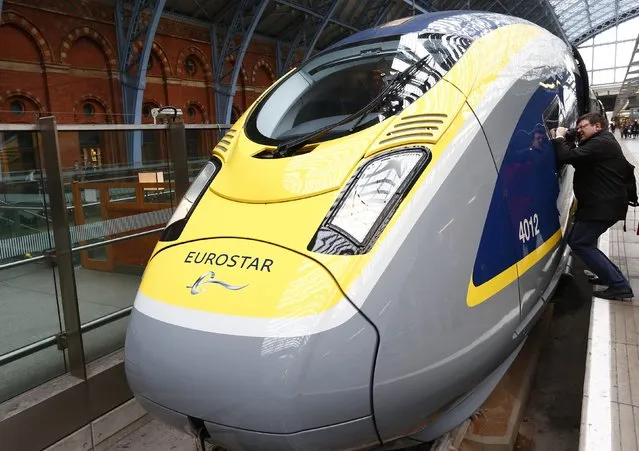
A man tries to photograph the interior of the driver's cab belonging to Eurostar's new Siemens e320 train at St Pancras station in central London, November 13, 2014. Eurostar, the company that runs passenger trains through the Channel tunnel between London and Paris, said it would buy seven additional e320 trains from Siemens for about 300 million pounds ($473 million). The company placed an order for 10 new trains in 2010, the first of which is due to enter commercial service next year, enabling the company to add new routes. (Photo by Andrew Winning/Reuters)
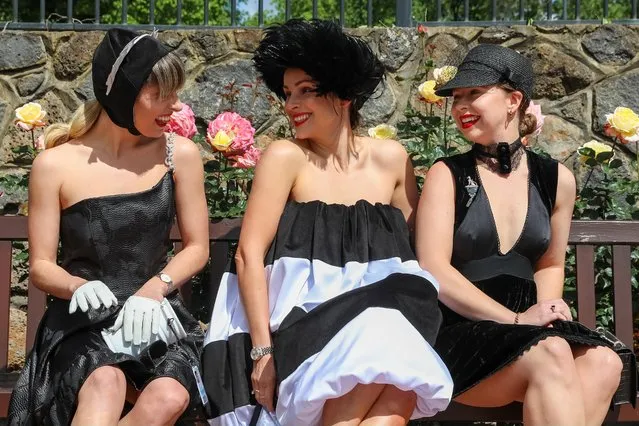
Spectators pose for a photo upon entry for Derby Day at Flemington Racecourse on October 30, 2021 in Melbourne, Australia. Victoria's COVID-19 restrictions have eased to allow spectators to return to Flemington racecourse for the first time since 2019. (Photo by Asanka Ratnayake/Getty Images)
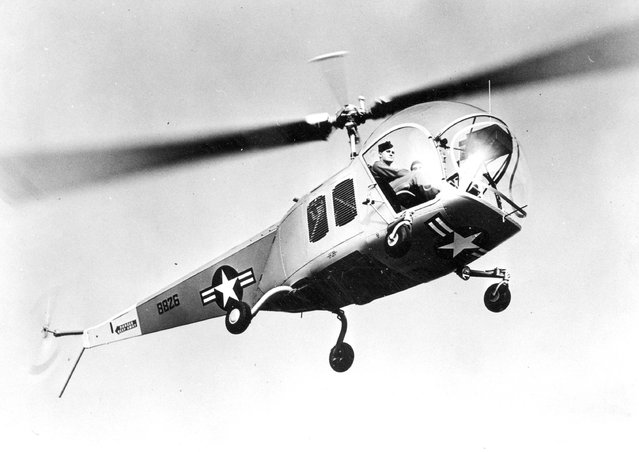
Number 10. BELL H-13 SIOUX was a two-bladed, single engine, light helicopter built by Bell Helicopter. Westland Aircraft manufactured the Sioux under license for the British military as the Sioux AH.1 and HT. In 1947, the United States Air Force ordered the improved Bell Model 47A. Most were designated YR-13 and three winterized versions were designated YR-13A. The United States Army first ordered Bell 47s in 1948 under the designation H-13. These would later receive the name Sioux. The Bell-built H-13 B is seen airborne in this April 29, 1951 photo. The helicopter is equipped with a 173 horsepower engine, cruises at 85 miles per hour, climbs 900 feet in a minute and has a service ceiling of 11,500 feet. (Photo by AP Photo)
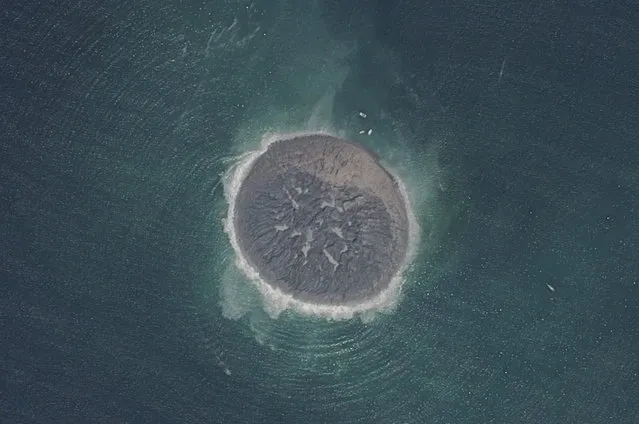
This handout picture taken by Pleiades satellite and released on September 27, 2013 shows a small island of mud and rock created by the huge earthquake that hit southwest Pakistan has fascinated locals but experts – who found methane gas rising from it – say it is unlikely to last long. The 7.7-magnitude quake struck on September 25 in Baluchistan's remote Awaran district, killing at least 271 people and affecting hundreds of thousands. The island is about 60 to 70 feet (18 to 21 metres) high, up to 300 feet wide and up to 120 feet long and sits about 650 feet from the coast. (Photo by AFP Photo/CNES/Distribution Astrium Services)