Loading...
Done
Orange Caramel (오렌지 캬라멜) - Lipstick (립스틱) Photoshoot

“Orange Caramel (오렌지 캬라멜), is the first sub group formed from the South Korean pop group After School. This sub-unit was formed with the third generation members: Nana, Raina and Lizzy. Orange Caramel’s concept is more lighthearted and sweet unlike many girl groups that have taken on darker, sexier concepts”. – Wikipedia


Details
07 Oct 2012 09:03:00
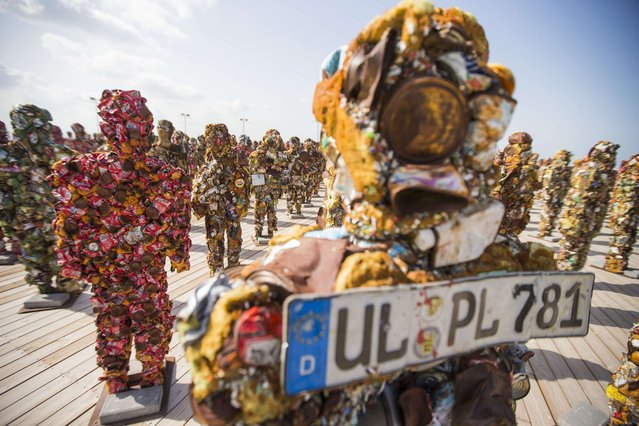
A general view shows sculptures made of waste material titled “Trash People” by German Artist HA Schult (unseen), on April 2, 2014 in Ariel Sharon Park, in the suburbs of Tel Aviv. Hundreds of human-size figures constructed from 20 tons of recycled material, including iron, glass, computer parts, cans and more, will dominate the sky line of Tel-Aviv city and be placed in the park. (Photo by Jack Guez/AFP Photo)

A general view shows sculptures made of waste material titled “Trash People” by German Artist HA Schult (unseen), on April 2, 2014 in Ariel Sharon Park, in the suburbs of Tel Aviv. Hundreds of human-size figures constructed from 20 tons of recycled material, including iron, glass, computer parts, cans and more, will dominate the sky line of Tel-Aviv city and be placed in the park. (Photo by Jack Guez/AFP Photo)
Details
03 Apr 2014 10:53:00
General view of the monument to memory of soldiers who liberated the city of Knin, in Knin, Croatia November 10, 2014. (Photo by Antonio Bronic/Reuters)

General view of the monument to memory of soldiers who liberated the city of Knin – in Knin, Croatia on November 10, 2014. Across the former Yugoslavia stand giant monuments to a state that no longer exists, once visited and celebrated during public holidays such as Republic Day on November 29, marking the creation of socialist Yugoslavia. Many are now neglected or ignored, aging symbols of a joint state forged during World War Two but torn apart by nationalism half a century later. Republic Day is no longer marked in any of the seven independent states that emerged from its ashes. (Photo by Antonio Bronic/Reuters)
Details
01 Dec 2014 14:00:00
An infrared portrait from NASA's Spitzer Space Telescope which shows generations of stars is seen in this undated NASA handout image released February 14, 2013. In this wispy star-forming region, called W5, the oldest stars can be seen as blue dots in the centers of the two hollow cavities (other blue dots are background and foreground stars not associated with the region). Red shows heated dust that pervades the region's cavities, while green highlights dense clouds. (Photo by NASA/Reuters/JPL-Caltech/Harvard-Smithsonian/Handout)

An infrared portrait from NASA's Spitzer Space Telescope which shows generations of stars is seen in this undated NASA handout image released February 14, 2013. In this wispy star-forming region, called W5, the oldest stars can be seen as blue dots in the centers of the two hollow cavities (other blue dots are background and foreground stars not associated with the region). Red shows heated dust that pervades the region's cavities, while green highlights dense clouds. (Photo by NASA/Reuters/JPL-Caltech/Harvard-Smithsonian/Handout)
Details
03 Mar 2013 08:44:00
Bao Bao, the Giant Panda cub is seen by the media for the first time January 6, 2014 inside his glass enclosure at the Smithsonian's National Zoo in Washington, DC, a few days before going on display to the general public. Bao Bao was born at the Smithsonian's National Zoo August 2, 2013. (Photo by Paul J. Richards/AFP Photo)

Bao Bao, the Giant Panda cub is seen by the media for the first time January 6, 2014 inside his glass enclosure at the Smithsonian's National Zoo in Washington, DC, a few days before going on display to the general public. Bao Bao was born at the Smithsonian's National Zoo August 2, 2013. (Photo by Paul J. Richards/AFP Photo)
Details
07 Jan 2014 08:58:00
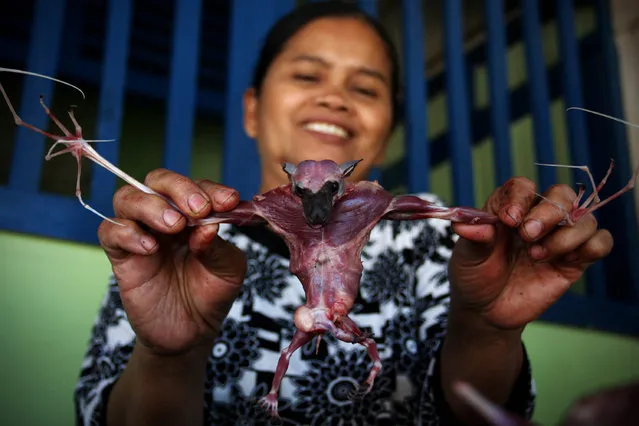
Bat seller Sukarwati shows a skinned bat on July 30, 2009 in Yogyakarta, Indonesia. Sukarwati and her family have hunted bats in the Imogiri region for generations, capturing more than 800 bats per month. The Sukarwati family believe that the meat from the bat heals asthma and respiratory problems and it is a great honour for them knowing that the meat that they provide will help ease people's health ailments

Bat seller Sukarwati shows a skinned bat on July 30, 2009 in Yogyakarta, Indonesia. Sukarwati and her family have hunted bats in the Imogiri region for generations, capturing more than 800 bats per month. The Sukarwati family believe that the meat from the bat heals asthma and respiratory problems and it is a great honour for them knowing that the meat that they provide will help ease people's health ailments. (Photo by Ulet Ifansasti)
Details
20 Sep 2012 08:57:00
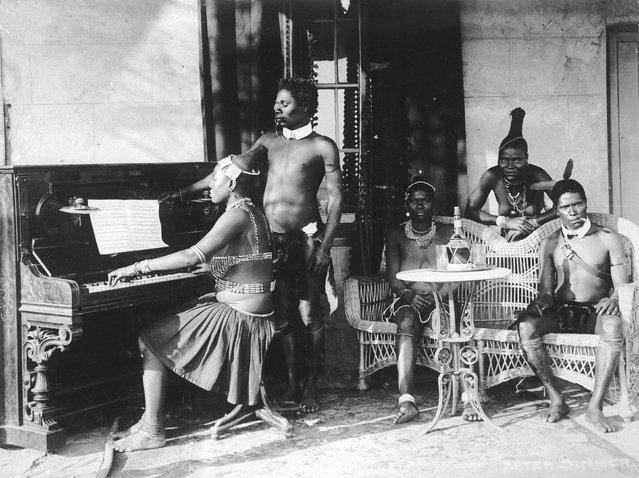
circa 1925:  A Zulu woman playing the piano while a group of others sit and listen.  (Photo by General Photographic Agency/Getty Images)

“The Zulu are the largest South African ethnic group, with an estimated 10–11 million people living mainly in the province of KwaZulu-Natal. Small numbers also live in Zimbabwe, Zambia, and Mozambique. Their language, Zulu, is a Bantu language; more specifically, part of the Nguni subgroup. The Zulu Kingdom played a major role in South African history during the 19th and 20th centuries. Under apartheid, Zulu people were classed as third-class citizens and suffered from state-sanctioned discrimination. They remain today the most numerous ethnic group in South Africa, and now have equal rights along with all other citizens”. – Wikipedia.

Photo: A Zulu woman playing the piano while a group of others sit and listen (to put it briefly, Englishmen scoff over Zulu). South Africa, circa 1925. (Photo by General Photographic Agency)


Details
03 Feb 2014 09:40:00
In this October 6, 1976, file photo, a right-wing student, center foreground, draws his arm back to strike a captured and wounded leftist student being taken by police to an ambulance in during a student massacre in Bangkok, Thailand. This year’s anti-government protests are seeking new elections, a more democratic constitution and an end to intimidation of political activists. Their speeches have repeatedly highlighted the 1976 tragedy, piquing the interest of the current generation in what their forebears faced. (Photo by Neal Ulevich/AP Photo/File)

In this October 6, 1976, file photo, a right-wing student, center foreground, draws his arm back to strike a captured and wounded leftist student being taken by police to an ambulance in during a student massacre in Bangkok, Thailand. This year’s anti-government protests are seeking new elections, a more democratic constitution and an end to intimidation of political activists. Their speeches have repeatedly highlighted the 1976 tragedy, piquing the interest of the current generation in what their forebears faced. (Photo by Neal Ulevich/AP Photo/File)
Details
30 Oct 2020 00:03:00