Loading...
Done
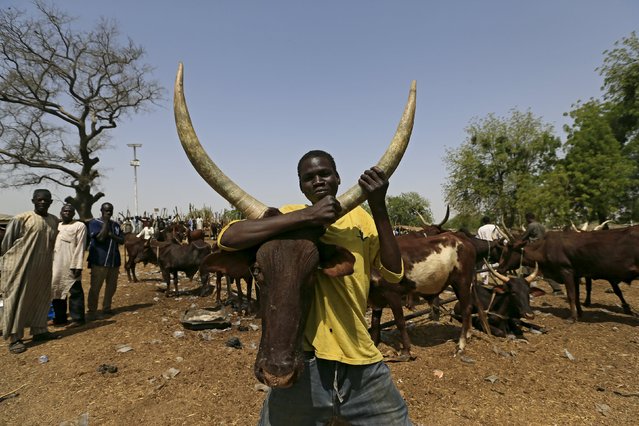
A man holds a cow at the cattle market in Maiduguri, Nigeria, March 9, 2016. (Photo by Afolabi Sotunde/Reuters)

A man holds a cow at the cattle market in Maiduguri, Nigeria, March 9, 2016. A Nigerian government push to strangle the Boko Haram insurgency has shut down the cattle trade that sustained the city of Maiduguri, leaving many residents with no livelihood, including many of the two million people displaced by the war. In recent months the army has taken back much of the territory lost to the jihadists during the five-year insurgency. (Photo by Afolabi Sotunde/Reuters)
Details
16 Mar 2016 14:06:00
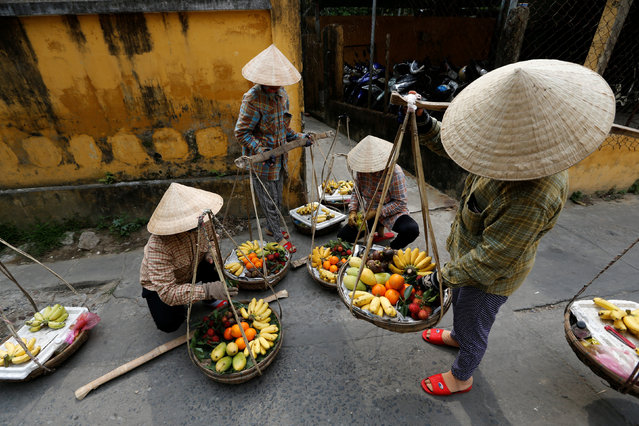
Women wearing traditional hats, known as a non la, sell fruits in Hoi An, Vietnam April 4, 2016. (Photo by Jorge Silva/Reuters)

Women wearing traditional hats, known as a non la, sell fruits in Hoi An, Vietnam April 4, 2016. The non la hats are made of readily available materials such as palm leaves, tree bark and bamboo and are visible everywhere in the city, a UNESCO World Heritage site. Hoi An's history as a busy trading port is evident throughout its architecture, a mix of eras and styles, with traditional wooden Vietnamese houses, Chinese temples and French colonial buildings. (Photo by Jorge Silva/Reuters)
Details
11 May 2016 11:32:00
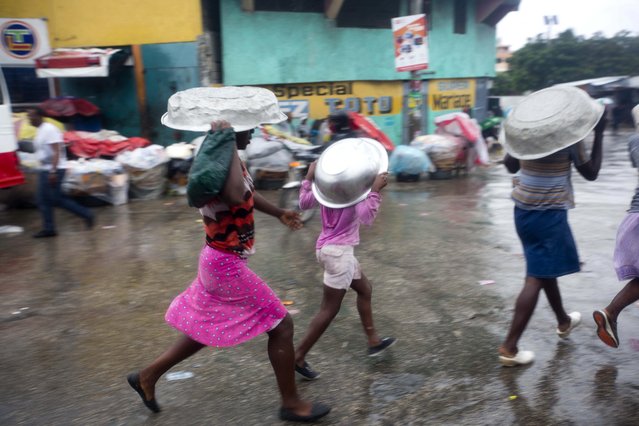
Women cover their heads with pans as they walk in a light rain brought by Hurricane Matthew in Port-au-Prince, Haiti, Tuesday, October 4, 2016. (Photo by Dieu Nalio Chery/AP Photo)

Women cover their heads with pans as they walk in a light rain brought by Hurricane Matthew in Port-au-Prince, Haiti, Tuesday, October 4, 2016. Matthew slammed into Haiti's southwestern tip with howling, 145 mph winds Tuesday, tearing off roofs in the poor and largely rural area, uprooting trees and leaving rivers bloated and choked with debris. (Photo by Dieu Nalio Chery/AP Photo)
Details
05 Oct 2016 09:14:00
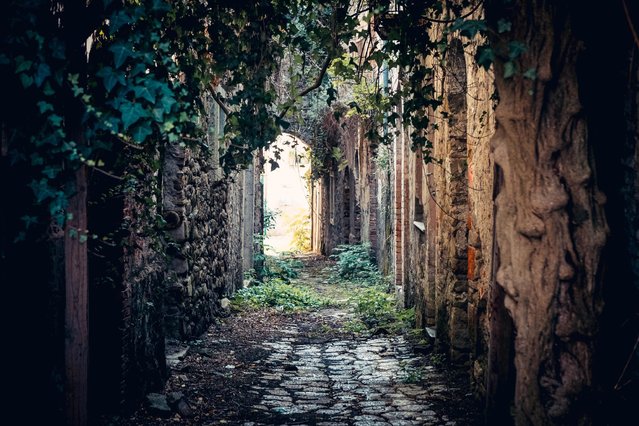
A deserted alley in the ghost town of Apice, in the province of Benevento, southern Italy, 22 November 2016. (Photo by Cesare Abbate/EPA)

A deserted alley in the ghost town of Apice, in the province of Benevento, southern Italy, 22 November 2016. After the Irpinia earthquake that took place in southern Italy on 23 November 1980, leaving at least 2,500 people dead, 8,000 injured and 250,000 homeless, the town in the heart of the Sannio area was evacuated and its residents moved into what has become the new Apice. Only recently the narrow streets and the tragically abandoned buildings have started, slowly, to repopulate. (Photo by Cesare Abbate/EPA)
Details
23 Nov 2016 11:30:00
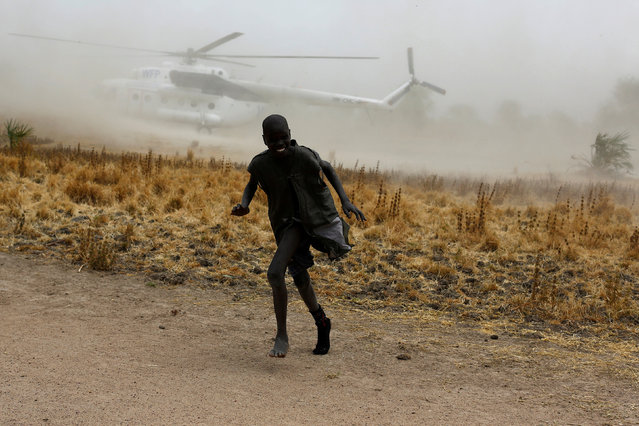
A boy moves away as a United Nations World Food Programme (WFP) helicopter lands in Rubkuai village, Unity State, northern South Sudan, February 18, 2017. (Photo by Siegfried Modola/Reuters)

A boy moves away as a United Nations World Food Programme (WFP) helicopter lands in Rubkuai village, Unity State, northern South Sudan, February 18, 2017. South Sudan on Monday declared famine in some parts of the country, with more than three years of war leaving nearly five million hungry in what aid groups called a “man-made” tragedy. (Photo by Siegfried Modola/Reuters)
Details
22 Feb 2017 00:03:00
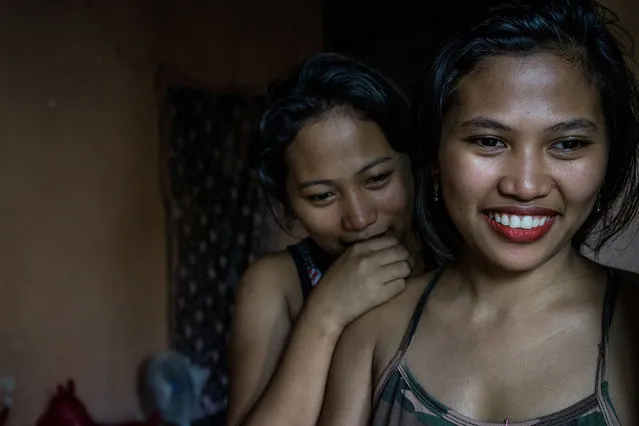
Gemma, right, and Joanne in their home in Angeles City. (Photo by Hannah Reyes Morales/The Washington Post)

Typhoon Yolanda – also known as Haiyan – struck the central part of the country November 8, 2013, leaving at least 6,300 people dead and over four million displaced. A month after Typhoon Haiyan, the United Nations Population Fund estimates that 5,000 women were subjected to sеxual violence. A study by the Health and Human Rights online publication shows the majority of young girls and women in Manila’s sеx industry come from poverty-stricken areas – such as Leyte, Samar, Cebu and southern Mindanao – and enter trafficking through force, deception, economic desperation and psychological manipulation. (Photo by Hannah Reyes Morales/The Washington Post)
Details
01 May 2017 09:59:00
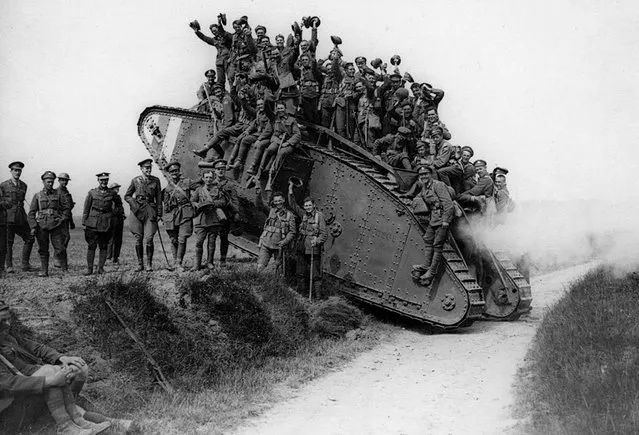
These black-and-white photos are taken from the new book “Armoured Warfare in the First World War 1916 – 1918” by Anthony Tucker-Jones and published by Pen & Sword Military. “Interestingly the British, French and Germans took completely different approaches with varying results”. The British military produced “Little Willie” in Autumn 1915 weighing 18 tonnes, which had a crew of two plus four gunners. “Inspired by a tracked artillery tractor “Little Willie” was referred to as a water tank – hence the name tank – to ensure secrecy”, said Anthony. “This led to the strange looking Mark I with its peculiar rhomboid shape, designed to cross trenches with guns in sponsons on either side. The Germans saw the tank as unchivalrous and were slow to grasp its utility. They favoured the Stormtrooper (specialist soldiers used to infiltrate enemy trenches) and artillery, not the tank”, said Anthony. “However, they didn’t hesitate to make use of captured British tanks. Although the tank helped secure victory and German soldiers dubbed it “Germany’s Downfall” the country was ultimately brought to its knees by the Allies blockade”. Here: British troops hitch a ride on a Mark IV after the massed tank fleet spearheading attack at Cambrai on November 20, 1917. (Photo by Anthony Tucker-Jones/Mediadrumworld.com)

These black-and-white photos are taken from the new book “Armoured Warfare in the First World War 1916 – 1918” by Anthony Tucker-Jones and published by Pen & Sword Military. Here: British troops hitch a ride on a Mark IV after the massed tank fleet spearheading attack at Cambrai on November 20, 1917. (Photo by Anthony Tucker-Jones/Mediadrumworld.com)
Details
23 Feb 2017 00:02:00
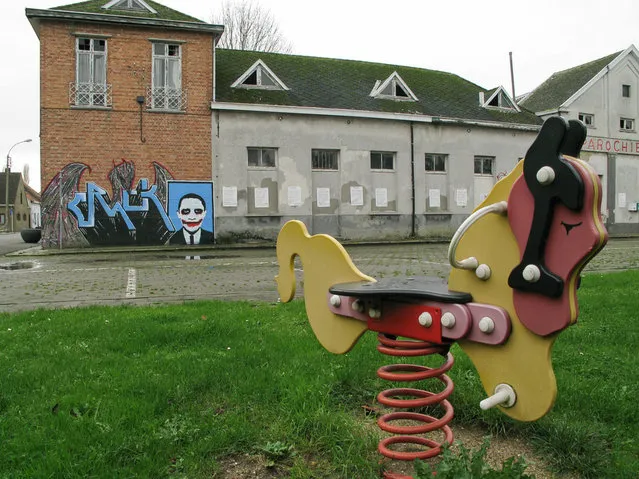
Abandon Village: Doel, Belgium

Doel is a 700 year old village on the river Scheldt in Belgium. Near to the local nuclear power plant, with its two giant cooling towers, it became the target for demolition not once but twice in order to make way for the ever expanding harbor. The successful protest groups of the seventies could not compete in the 90's and as residents began to leave, the government refused to rent out the properties again and instead let them fall into disrepair. On the 23rd of March 2007, the government decided that the village would be demolished by 2009 and in June 2008, residents received a letter informing them that they were to vacate their homes by the 1st of September 2009.
Details
20 Mar 2013 11:33:00