Loading...
Done
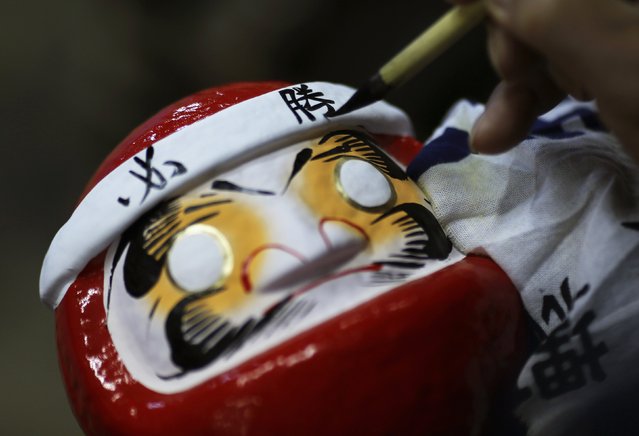
Japanese craftsman Sumikazu Nakata writes the Chinese character of “victory”, which is a part of the phrase “Certain victory”, as he adds the final touches on a Daruma doll, which is believed to bring good luck, at his studio “Daimonya” in Takasaki, northwest of Tokyo November 23, 2014. (Photo by Yuya Shino/Reuters)

Japanese craftsman Sumikazu Nakata writes the Chinese character of “victory”, which is a part of the phrase “Certain victory”, as he adds the final touches on a Daruma doll, which is believed to bring good luck, at his studio “Daimonya” in Takasaki, northwest of Tokyo November 23, 2014. Daruma dolls, representing the Indian priest Bodhidharma, the founder of Zen Buddhism in China, is used to bring luck. It is also a favorite item of election candidates where they traditionally paint only one eye on the doll when they start their campaign and paint the other eye if they win in the election. (Photo by Yuya Shino/Reuters)
Details
24 Nov 2014 13:39:00
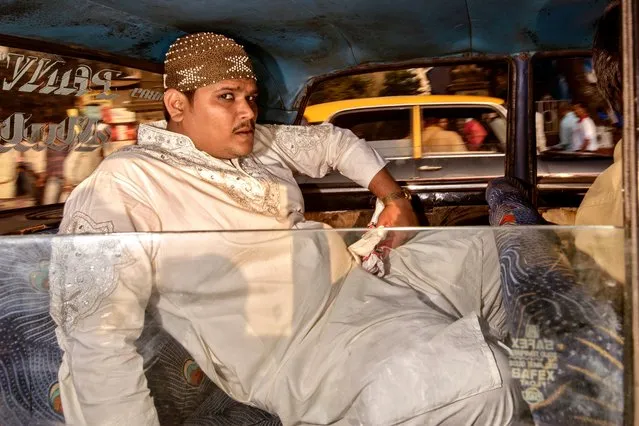
“I’m not scared of breaking the fourth wall”, Wallace has said of the photos where the subject is clearly aware of him taking the shot. “If they are looking at you in a photograph most photographers will think, oh, that’s not a good image. (But) people like to be involved and in the picture. You can see what they are thinking, see them talking”. (Photo by Dougie Wallace/The Guardian)

In Dougie Wallace’s photos of Mumbai taxis, the chatter, yelling, and constant horns of the city are almost audible. A selection of his images is on show at Gayfield Creative Spaces, Edinburgh, as part of the Retina photography festival until 30 July. For four years, the Glasgow-born Wallace focused his photos on one kind of taxi in particular: the Premier Padmini, a 1960s workhorse painted in black and yellow. Locally known as “Kaali-Peeli”, there were once more than 60,000 of them in the Indian city. But thanks to laws restricting pollution, the cars now are fast disappearing from Mumbai’s streets. (Photo by Dougie Wallace/The Guardian)
Details
13 Jul 2016 13:50:00
WeHo Pride's Grand Marshal Icon rapper Janelle Monáe rides in the city of West Hollywood's Pride Parade on June 05, 2022 in West Hollywood, California. (Photo by APEX/The Mega Agency)

WeHo Pride's Grand Marshal Icon rapper Janelle Monáe rides in the city of West Hollywood's Pride Parade on June 05, 2022 in West Hollywood, California. (Photo by APEX/The Mega Agency)
Details
14 Jun 2022 04:45:00
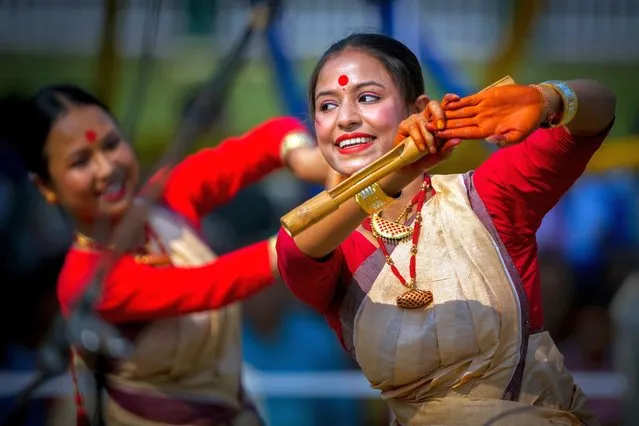
Assamese girls wearing traditional Mekhela Chadar perform the Bihu folk dance during the Rongali Bihu festival, organized by All Assam Students Union in Guwahati, capital of the north eastern state of Assam, India, Saturday, April 13, 2024. (Photo by Anupam Nath/AP Photo)

Assamese girls wearing traditional Mekhela Chadar perform the Bihu folk dance during the Rongali Bihu festival, organized by All Assam Students Union in Guwahati, capital of the north eastern state of Assam, India, Saturday, April 13, 2024. (Photo by Anupam Nath/AP Photo)
Details
25 Apr 2024 03:35:00
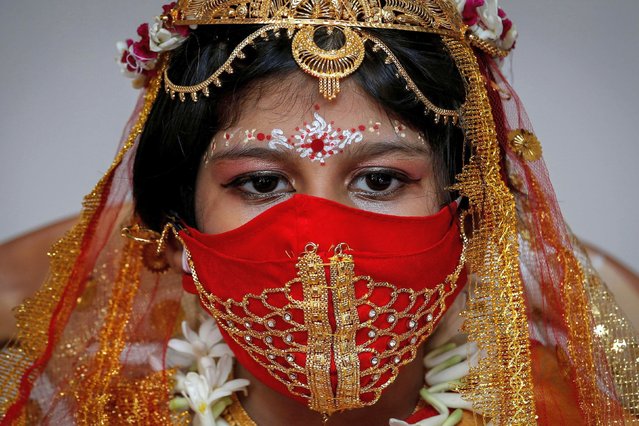
Sarayna Biswas, 6, wearing a face mask and dressed as Kumari wearing gold, takes part in a ritual during the Durga Puja festival celebrations at a pandal, or a temporary platform, amidst the outbreak of the coronavirus disease (COVID-19), in Kolkata, India, October 24, 2020. (Photo by Rupak De Chowdhuri/Reuters)

Sarayna Biswas, 6, wearing a face mask and dressed as Kumari wearing gold, takes part in a ritual during the Durga Puja festival celebrations at a pandal, or a temporary platform, amidst the outbreak of the coronavirus disease (COVID-19), in Kolkata, India, October 24, 2020. (Photo by Rupak De Chowdhuri/Reuters)
Details
04 Nov 2020 00:05:00
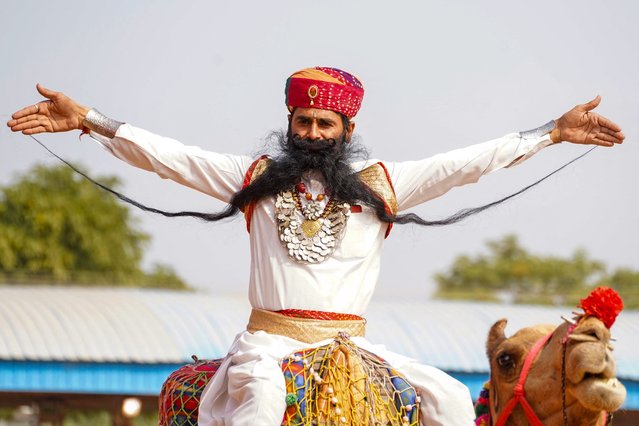
A Rajasthani man displays his moustache during the closing ceremony of annual Camel Fair in Pushkar, in India's desert state of Rajasthan, on November 8, 2022. (Photo by Himanshu Sharma/AFP Photo)

A Rajasthani man displays his moustache during the closing ceremony of annual Camel Fair in Pushkar, in India's desert state of Rajasthan, on November 8, 2022. (Photo by Himanshu Sharma/AFP Photo)
Details
16 Nov 2022 05:37:00
Spectacular images offering insight into the lives of the Huaorani people in the Ecuadorian Amazon have been revealed showing how they use traditional methods to hunt monkeys for food. The stunning pictures were taken by conservation photographer Pete Oxford from Torquay, Devon in the Ecuadorian Amazon. “The Huaorani Indians are a forest people highly in tune with their environment. Many are now totally acculturated since the 1950s by missionaries”, said Pete. “Today they face radical change to their culture to the proximity of oil exploration within their territory and the Yasuni National Park and Biosphere Reserve, they are vastly changed. Some still live very traditionally and for this shoot, through my Huaorani friend, a direct relative of those photographed he wanted to depict them as close to their original culture as possible. They still largely hunt with blow pipes and spears eating a lot of monkeys and peccaries”. The Huaorani are also known as the Waorani, Waodani or the Waos and are native Amerindians. Their lands are located between the Curaray and Napo rivers and speak the Huaorani language. Pete says that during his visit he was welcomed into the group and hopes that ancient cultures can be saved. Here: The tribe were seen celebrating after a hunter returned to camp with a wild pig. (Photo by Pete Oxford/Mediadrumworld.com)

Spectacular images offering insight into the lives of the Huaorani people in the Ecuadorian Amazon have been revealed showing how they use traditional methods to hunt monkeys for food. The stunning pictures were taken by conservation photographer Pete Oxford from Torquay, Devon in the Ecuadorian Amazon. Here: The tribe were seen celebrating after a hunter returned to camp with a wild pig. (Photo by Pete Oxford/Mediadrumworld.com)
Details
20 Jan 2017 07:58:00
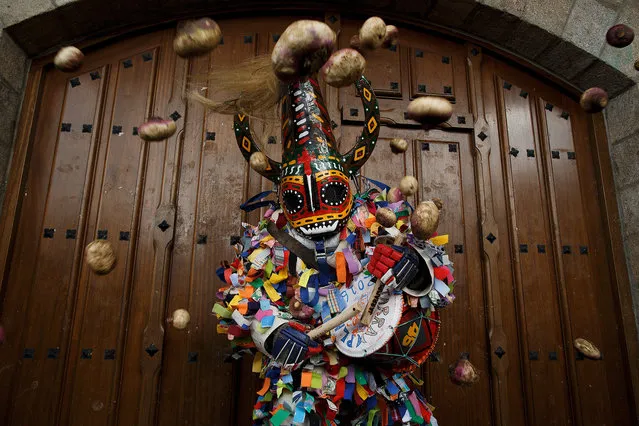
People throw turnips at the Jarramplas as he comes out from the church beating his drum during the Jarramplas Festival on January 20, 2016 in Piornal, Caceres province, Spain. The centuries old Jarramplas festival takes place annually every January 19-20 on Saint Sebastian Day and this year they expect to use more than 20 thousand kilogrames of turnips. Even though the exact origins of the festival are not known, various theories exist including the mythological punishment of Caco by Hercules. (Photo by Pablo Blazquez Dominguez/Getty Images)

People throw turnips at the Jarramplas as he comes out from the church beating his drum during the Jarramplas Festival on January 20, 2016 in Piornal, Caceres province, Spain. The centuries old Jarramplas festival takes place annually every January 19-20 on Saint Sebastian Day and this year they expect to use more than 20 thousand kilogrames of turnips. Even though the exact origins of the festival are not known, various theories exist including the mythological punishment of Caco by Hercules, a relation to ceremonies celebrated by the American Indians that were seen by the first conquerors, to a cattle thief ridiculed and expelled by his village neighbours. It is generally believed to symbolize the expulsion of everything bad. (Photo by Pablo Blazquez Dominguez/Getty Images)
Details
21 Jan 2016 13:21:00