Loading...
Done
A couple hugs while standing near a Christmas tree made out of plastic bins and plastic hampers outside the Museum of History in Monterrey, Mexico, December 4, 2015. (Photo by Daniel Becerril/Reuters)

A couple hugs while standing near a Christmas tree made out of plastic bins and plastic hampers outside the Museum of History in Monterrey, Mexico, December 4, 2015. The humble Christmas tree has a rich history, from evergreen trees used to symbolise eternal life in Ancient Egypt to tree worship among pagan Europeans. The modern version has its origins in Germany, where the song “O Tannenbaum” is still a festive favourite. Today the traditional tree with lights and decorations appears in cities including Washington, Moscow and Beirut. Alternative constructions range from recycled rubbish in Mexico City to old window frames in Rakvere, Estonia. Whatever the shape or size, the message is the same: Merry Christmas. (Photo by Neil Hall/Reuters)
Details
23 Dec 2015 08:01:00


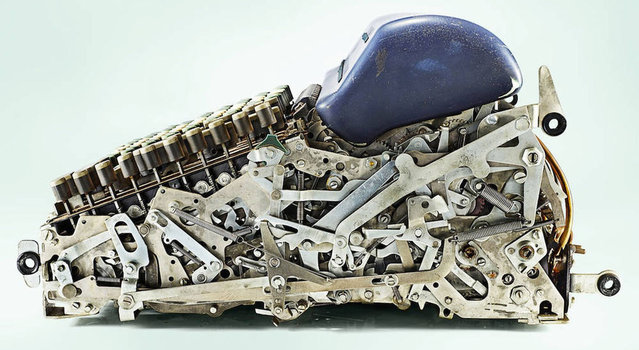
In his newest series of photos called Low Tech, Kevin Twomey artfully captures the complexity of old-style typewriters and similar machines. Despite being completely outdated, you cannot help being amazed at how complicated those “simple” devises really are. Hundreds of little parts were meticulously put together to form a machine that would perform such “basic” functions by today’s standards. Similarly, very few modern people actually think about how complicated the current technology really is. We take for granted streaming videos, GPS, and countless devises that we use every day, while in reality, these things would seem like magic to even the most prominent scientists from only half a century ago. (Photo by Kevin Twomey)
Details
21 Nov 2014 12:42:00
A woman is helped with adorning her hair with jewelry, part of the traditional clothing known as “Pollera”, before the annual Thousand Polleras parade in Las Tablas, in the province of Los Santos January 10, 2015. According to local residents, the Pollera dates back to the 18th century and was worn by the Spanish lower classes. (Photo by Carlos Jasso/Reuters)

A woman is helped with adorning her hair with jewelry, part of the traditional clothing known as “Pollera”, before the annual Thousand Polleras parade in Las Tablas, in the province of Los Santos January 10, 2015. According to local residents, the Pollera dates back to the 18th century and was worn by the Spanish lower classes. Today, it has become the Panamanian national costume. The dress is made entirely by hand and the jewellery worn is pure gold and worth thousands of dollars. (Photo by Carlos Jasso/Reuters)
Details
12 Jan 2015 15:46:00
Turkish artist Nezaket Ekici performs a live art performance entitled 'Emotion in Motion' on the first day of Art Basel 2015, Hong Kong, China, 13 March 2015. Art Basel 2015 features 233 galleries from 37 countries and territories. (Photo by Alex Hofford/EPA)

Turkish artist Nezaket Ekici performs a live art performance entitled 'Emotion in Motion' on the first day of Art Basel 2015, Hong Kong, China, 13 March 2015. The Hong Kong show of Art Basel features 233 galleries from 37 countries and territories, presenting works ranging from the Modern period of the early 20th century to the most contemporary artists of today, according to the official press release. (Photo by Alex Hofford/EPA)
Details
18 Mar 2015 11:22:00
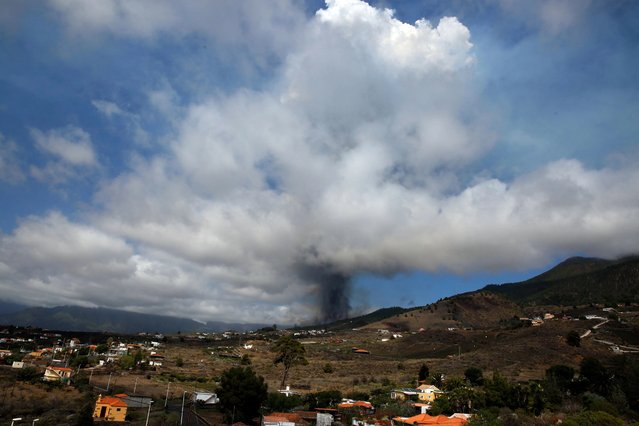
Mount Cumbre Vieja erupts spewing a column of smoke and ash as seen from Los Llanos de Aridane on the Canary island of La Palma on September 19, 2021. (Photo by Desiree Martin/AFP Photo)

Mount Cumbre Vieja erupts spewing a column of smoke and ash as seen from Los Llanos de Aridane on the Canary island of La Palma on September 19, 2021. The Cumbre Vieja volcano erupted on Spain's Canary Islands today spewing out lava, ash and a huge column of smoke after days of increased seismic activity, sparking evacuations of people living nearby, authorities said. Cumbre Vieja straddles a ridge in the south of La Palma island and has erupted twice in the 20th century, first in 1949 then again in 1971. (Photo by Desiree Martin/AFP Photo)
Details
20 Sep 2021 08:27:00
Is it a leaf? Is it tree bark? No, it’s the Satanic leaf-tailed gecko. Cleverly disguised as a rotting leaf, Madagascar’s camouflage king has red eyes, pointy horns and a taste for night hunting: it’s nature’s most devilish deceiver. (Photo by Thomas Marent/ARDEA)

Is it a leaf? Is it tree bark? No, it’s the Satanic leaf-tailed gecko. Cleverly disguised as a rotting leaf, Madagascar’s camouflage king has red eyes, pointy horns and a taste for night hunting: it’s nature’s most devilish deceiver. The twisted body and veiny skin echo the detail of a dry leaf, which ensures the gecko blends in with its forest home. The mottled tail appears to have sections missing, as though it has withered over time. This mini-monster epitomises survival of the fittest, having adapted gradually to become today’s extraordinary leaf impersonator. (Photo by Thomas Marent/ARDEA)
Details
20 Nov 2015 08:03:00
State Plates Project By Jonathan Lawrence

You have to agree, that most of the designs of the license plates in the United States are pretty boring and bland. In most cases, a three-year-old could have done a better job. This is the reason why Jonathan Lawrence has decided to create a project of redesigning the license plates of all 50 states. His designs feature fresh vibrant colors, as well as clean and readable design. These are the license plates you’d want to use if you have anything that is better than a rundown, old pickup truck (no offence to owners of rundown, old pickup trucks). Some of his designs are humorous, some are strict and official; however, all of them look better than the license plates that are in circulation today. (Photo by Jonathan Lawrence)
Details
24 Nov 2014 13:45:00
Roma Community In Romania

“Inspired by the French authorities' solution to move Romas from point A to point B, Romanian authorities planned and started forced evictions of Roma informal settlements in cities like Cluj-Napoca and Baia Mare. Some of these settlements date back to the early 1990’s. These communities were tolerated by the authorities who verbally encouraged Romas to build in the area, meanwhile, reassuring them nothing bad would ever happen to them. However, the the reality today is that during political campaigns, authorities are planning forced evictions without reasons other than ethnic cleansing of the cities. My home documents the every day life of Roma communities in Romania, 2011”. – Mugur Varzariu. (Photo by Mugur Varzariu, 2011 FotoVisura Grant Finalist)
Details
20 Apr 2012 13:22:00