Loading...
Done
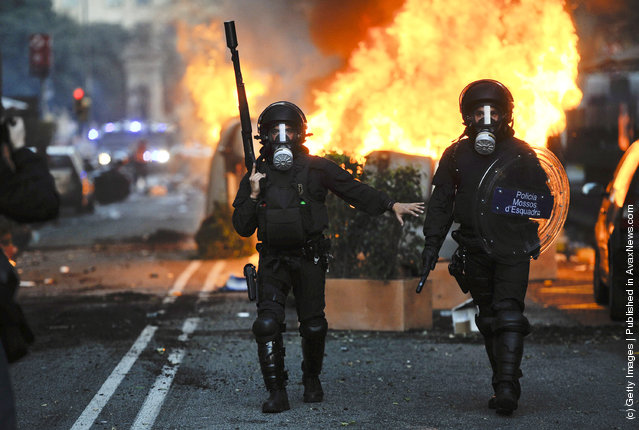
Riot police walk past burning garbage containers during heavy clashes with demonstrators during a 24-hour strike on March 29, 2012 in Barcelona, Spain

Riot police walk past burning garbage containers during heavy clashes with demonstrators during a 24-hour strike on March 29, 2012 in Barcelona, Spain. Spanish workers staged a general strike to protest the government's latest labour reforms, which are designed to help Spain lower its deficit within EU limits. (Photo by David Ramos/Getty Images)
Details
30 Mar 2012 10:40:00
Chernobyl

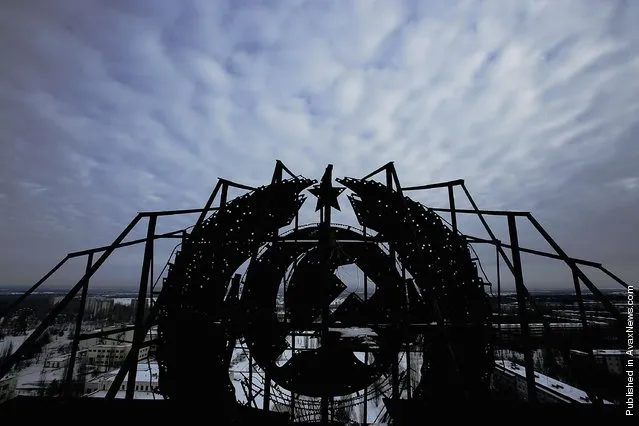
Scaffolding holding a remnant of the Soviet Union, the hammer and sickle, is seen on a rooftop of an abandoned building in the town of Pripyat on January 25, 2006 near Chernobyl, Ukraine. The town of Pripyat, deserted since the 1986 catastrophe, once housed 30,000 people, the majority of being workers from the Chernobyl Nuclear Power Plant. Days after the catastrophe the inhabitants were relocated to other locations in the Soviet Union. The town of Pripyat has remained uninhabited since. Prypyat and the surrounding area will not be safe for human habitation for several centuries. Scientists estimate that the most dangerous radioactive elements will take up to 900 years to decay sufficiently to render the area safe.
Details
14 Mar 2011 10:20:00
A female traffic police officer in the snow in February 2013, in Pyongyang, North Korea. (Photo by Andrew Macleod/Barcroft Media)

North Korea has closed its borders in fear of the spread of the Ebola virus. But at a time when the secretive state was still welcoming tourists, former aid worker Andrew Macleod made the journey to the repressive nation. Andrew's holiday snaps and camera footage provide a unique insight into the reclusive country, where he came across deserted motorways, metro stations plastered with propaganda and attractive border guards. Here: a female traffic police officer in the snow in February 2013, in Pyongyang, North Korea. (Photo by Andrew Macleod/Barcroft Media)
Details
06 Nov 2014 09:11:00
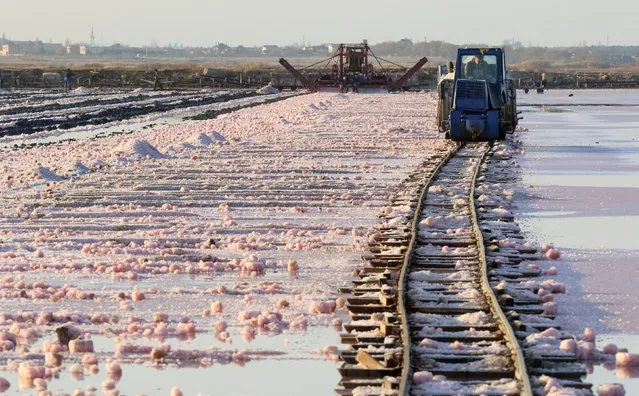
A train drives along a field at a salt production site at the Sasyk-Sivash lake near the city of Yevpatoria, Crimea, November 14, 2017. (Photo by Pavel Rebrov/Reuters)

A train drives along a field at a salt production site at the Sasyk-Sivash lake near the city of Yevpatoria, Crimea, November 14, 2017. A saltwater lagoon known as Lake Sasyk-Sivash on Ukraine's Crimea peninsula is the source of a rare resource: pink salt. The mineral is tinted by tiny algae that produce the pigment beta-carotene. Each autumn, seasonal workers collect thousands of tons of pink salt for processing and export. (Photo by Pavel Rebrov/Reuters)
Details
16 Nov 2017 08:18:00
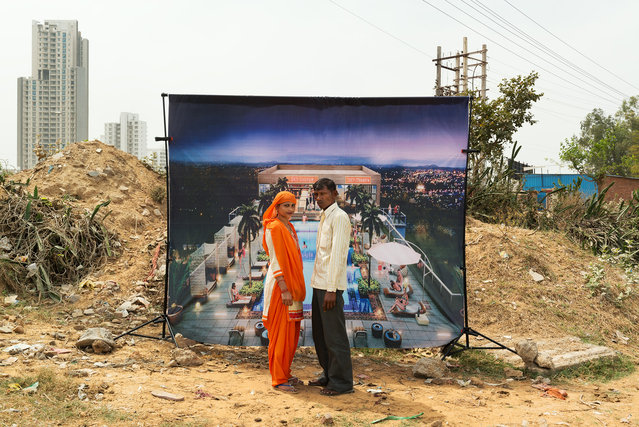
Luxury Living Bhiwadi: “Sky Club on 18th Floor”. Passersby, workers and villagers pose in front of the idealised representations of modern homes. (Photo by Arthur Crestani/The Guardian)

Inspired by traditional Indian travelling photography studios, Arthur Crestani photographed the inhabitants of Gurgaon, a city built almost entirely by private companies. Arthur Crestani’s “Bad City Dreams” contrasts the glossy ideal sold by developers with urban reality. Here: Luxury Living Bhiwadi: “Sky Club on 18th Floor”. (Photo by Arthur Crestani/The Guardian)
Details
16 Mar 2018 00:01:00
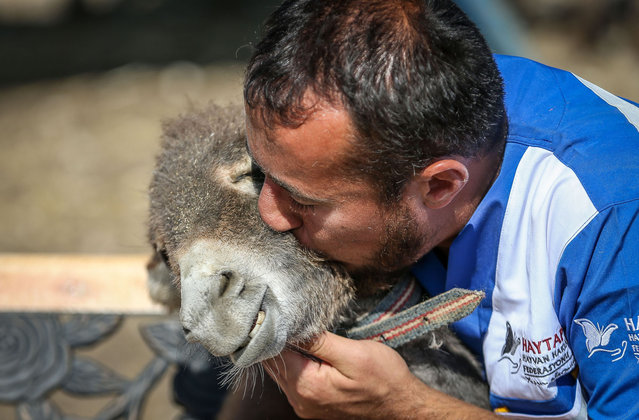
A worker caresses a donkey at the Retired Animals Farm in Turkey's Bursa on October 01, 2020. Animal Rights Federation in Turkey (HAYTAP) established a “Retired Animals Farm” in Bursa for animals that were tortured, thrown out by their owners, injured and in need of assistance for similar reasons. Built in the neighborhood of Baskoy in Nilufer district after long term efforts, the farm provides a home to animals of many species, such as horse, donkey, cow, sheep, chicken from all around Turkey. The farm project receives support from various institutions and organizations. (Photo by Sergen Sezgin/Anadolu Agency via Getty Images)

A worker caresses a donkey at the Retired Animals Farm in Turkey's Bursa on October 01, 2020. Animal Rights Federation in Turkey (HAYTAP) established a “Retired Animals Farm” in Bursa for animals that were tortured, thrown out by their owners, injured and in need of assistance for similar reasons. Built in the neighborhood of Baskoy in Nilufer district after long term efforts, the farm provides a home to animals of many species, such as horse, donkey, cow, sheep, chicken from all around Turkey. The farm project receives support from various institutions and organizations. (Photo by Sergen Sezgin/Anadolu Agency via Getty Images)
Details
22 Oct 2020 00:01:00
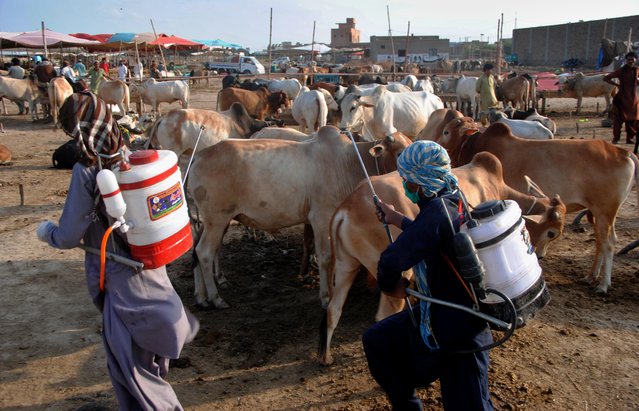
Health workers wearing face masks spray disinfectant liquid on sacrificial animals amid concerns over the spread of the SARS-CoV-2 coronavirus that causes the pandemic COVID-19 disease ahead of the Muslim festival of Eid al-Adha at an animal market in Hyderabad, southern Pakistan, 21 July 2020. Eid al-Adha, also known as the Festival of the Sacrifice, is the second and holiest of the two main Islamic holidays celebrated each year (the other one being Eid al-Fitr). Every year, on the 10th day of the Islamic lunar month of Dhu al-Hijjah, Muslims around the world ritually slaughter a sacrificial animal and split the meat into three parts: one is reserved for the family, another for friends and relatives, and the third is given to the poor and needy. The Saudi Supreme Court has declared that the first day of Eid al-Adha this year falls on 31 July. (Photo by Nadeem Khawar/EPA/EFE)

Health workers wearing face masks spray disinfectant liquid on sacrificial animals amid concerns over the spread of the SARS-CoV-2 coronavirus that causes the pandemic COVID-19 disease ahead of the Muslim festival of Eid al-Adha at an animal market in Hyderabad, southern Pakistan, 21 July 2020. (Photo by Nadeem Khawar/EPA/EFE)
Details
23 Jul 2020 00:07:00
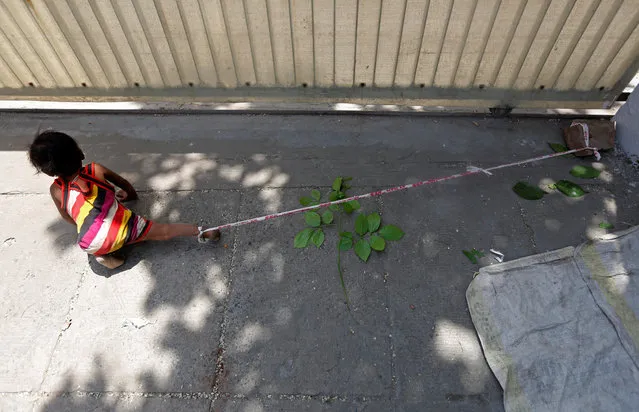
Barrier tape is tied around 15-month-old Shivani's ankle to prevent her from running away, while her mother Sarta Kalara works at a construction site nearby, in Ahmedabad, India, April 19, 2016. Kalara says she has no option but to tether her daughter Shivani to a stone despite her crying, while she and her husband work for 250 rupees ($3.8) each a shift digging holes for electricity cables in the city of Ahmedabad. There are about 40 million construction workers in India, at least one in five of them women, and the majority poor migrants who shift from site to site, building infrastructure for India's booming cities. Across the country it is not uncommon to see young children rolling in the sand and mud as their parents carry bricks or dig for new roads or luxury houses. (Photo by Amit Dave/Reuters)

Barrier tape is tied around 15-month-old Shivani's ankle to prevent her from running away, while her mother Sarta Kalara works at a construction site nearby, in Ahmedabad, India, April 19, 2016. Kalara says she has no option but to tether her daughter Shivani to a stone despite her crying, while she and her husband work for 250 rupees ($3.8) each a shift digging holes for electricity cables in the city of Ahmedabad. There are about 40 million construction workers in India, at least one in five of them women, and the majority poor migrants who shift from site to site, building infrastructure for India's booming cities. Across the country it is not uncommon to see young children rolling in the sand and mud as their parents carry bricks or dig for new roads or luxury houses. (Photo by Amit Dave/Reuters)
Details
14 Dec 2016 07:39:00