Loading...
Done
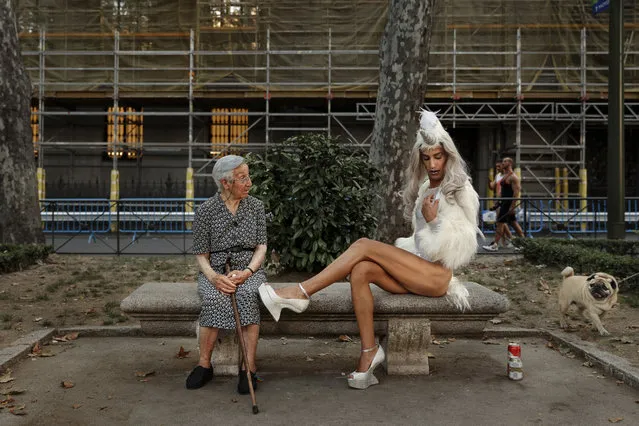
A woman looks across as a gay parade participant poses for pictures during Gay Pride parade in Madrid, Spain, Saturday, July 2, 2016. Hundreds of thousands of people defied high temperatures and relative security concerns and turned out in Madrid to march in Saturday's LGTB Pride parade, one of the biggest in Europe, along the streets of the Spanish capital, just three weeks after members of the gay, lesbian, bisexual and transgender community were tragically victimized in a shooting massacre at a United States nightclub. (Photo by Daniel Ochoa de Olza/AP Photo)

A woman looks across as a gay parade participant poses for pictures during Gay Pride parade in Madrid, Spain, Saturday, July 2, 2016. Hundreds of thousands of people defied high temperatures and relative security concerns and turned out in Madrid to march in Saturday's LGTB Pride parade, one of the biggest in Europe, along the streets of the Spanish capital, just three weeks after members of the gay, lesbian, bisexual and transgender community were tragically victimized in a shooting massacre at a United States nightclub. (Photo by Daniel Ochoa de Olza/AP Photo)
Details
03 Jul 2016 11:20:00
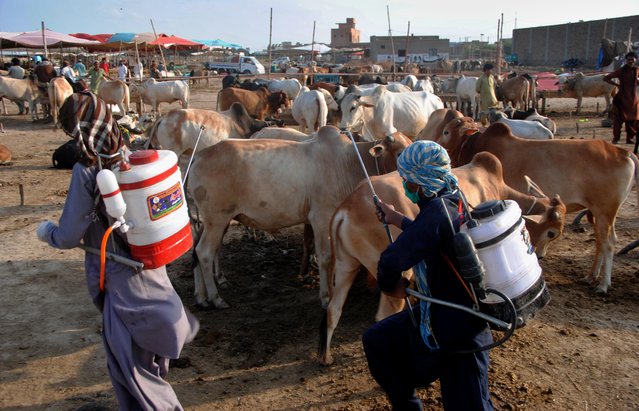
Health workers wearing face masks spray disinfectant liquid on sacrificial animals amid concerns over the spread of the SARS-CoV-2 coronavirus that causes the pandemic COVID-19 disease ahead of the Muslim festival of Eid al-Adha at an animal market in Hyderabad, southern Pakistan, 21 July 2020. Eid al-Adha, also known as the Festival of the Sacrifice, is the second and holiest of the two main Islamic holidays celebrated each year (the other one being Eid al-Fitr). Every year, on the 10th day of the Islamic lunar month of Dhu al-Hijjah, Muslims around the world ritually slaughter a sacrificial animal and split the meat into three parts: one is reserved for the family, another for friends and relatives, and the third is given to the poor and needy. The Saudi Supreme Court has declared that the first day of Eid al-Adha this year falls on 31 July. (Photo by Nadeem Khawar/EPA/EFE)

Health workers wearing face masks spray disinfectant liquid on sacrificial animals amid concerns over the spread of the SARS-CoV-2 coronavirus that causes the pandemic COVID-19 disease ahead of the Muslim festival of Eid al-Adha at an animal market in Hyderabad, southern Pakistan, 21 July 2020. (Photo by Nadeem Khawar/EPA/EFE)
Details
23 Jul 2020 00:07:00
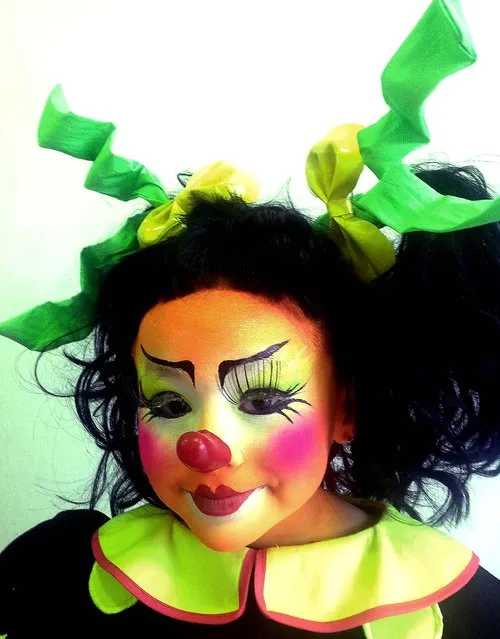
Kika-evolution, 5, an Auguste clown, poses for a photo during Mexico’s 17th annual clown convention, La Feria de la Risa, in Mexico City, October 23, 2012. Approximately 500 clowns gathered at two local theaters in the capital city to exchange ideas, compete for laughs and show off their comedy performances. (Photo by Anita BacaAP Photo)

Kika-evolution, 5, an Auguste clown, poses for a photo during Mexico’s 17th annual clown convention, La Feria de la Risa, in Mexico City, October 23, 2012. Approximately 500 clowns gathered at two local theaters in the capital city to exchange ideas, compete for laughs and show off their comedy performances. (Photo by Anita Baca/AP Photo)
Details
27 Oct 2012 07:51:00
This handout photograph released by Taipei City Zoo on July  11, 2013 shows a newly-born panda cub of giant panda Yuan Yuan in an incubator at Taipei Zoo in Taipei. The public will  have to wait three months to catch a glimpse of the first panda  born in Taiwan, officials said after she was  successfully delivered by parents who were gifted from China. (Photo by AFP Photo/Taipei City Zoo)

This handout photograph released by Taipei City Zoo on July 11, 2013 shows a newly-born panda cub of giant panda Yuan Yuan in an incubator at Taipei Zoo in Taipei. The public will have to wait three months to catch a glimpse of the first panda born in Taiwan, officials said after she was successfully delivered by parents who were gifted from China. (Photo by AFP Photo/Taipei City Zoo)
Details
13 Jul 2013 12:29:00
An employee of Paris city Hall removes padlocks clipped by lovers on the fence of the Pont des Arts over the River Seine in Paris, December 9, 2014. For years, visiting couples have hung brass padlocks on the iron grills lining the city's bridges to symbolise their undying love – they write their names on the locks, then toss the key into the Seine below. (Photo by Philippe Wojazer/Reuters)

An employee of Paris city Hall removes padlocks clipped by lovers on the fence of the Pont des Arts over the River Seine in Paris, December 9, 2014. For years, visiting couples have hung brass padlocks on the iron grills lining the city's bridges to symbolise their undying love – they write their names on the locks, then toss the key into the Seine below. About 700,000 love locks are added every few months and Paris officials say they are damaging the bridges and threatening safety because of the added weight. (Photo by Philippe Wojazer/Reuters)
Details
10 Dec 2014 12:24:00
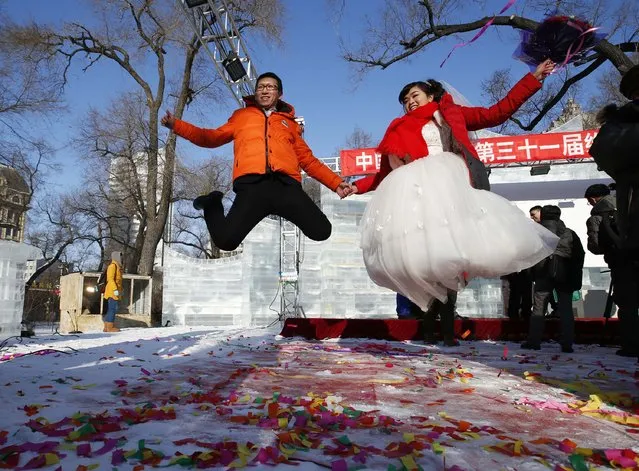
A newly wed couple jumps to pose for their wedding photographs after their group wedding ceremony which was held as part of the Harbin International Ice and Snow Festival in the northern city of Harbin, Heilongjiang province January 6, 2015. The wedding ceremony was organised by the city government and 11 couples from China, Russia and Egypt participated in the ceremony. (Photo by Kim Kyung-Hoon/Reuters)

A newly wed couple jumps to pose for their wedding photographs after their group wedding ceremony which was held as part of the Harbin International Ice and Snow Festival in the northern city of Harbin, Heilongjiang province January 6, 2015. The wedding ceremony was organised by the city government and 11 couples from China, Russia and Egypt participated in the ceremony. (Photo by Kim Kyung-Hoon/Reuters)
Details
07 Jan 2015 13:57:00
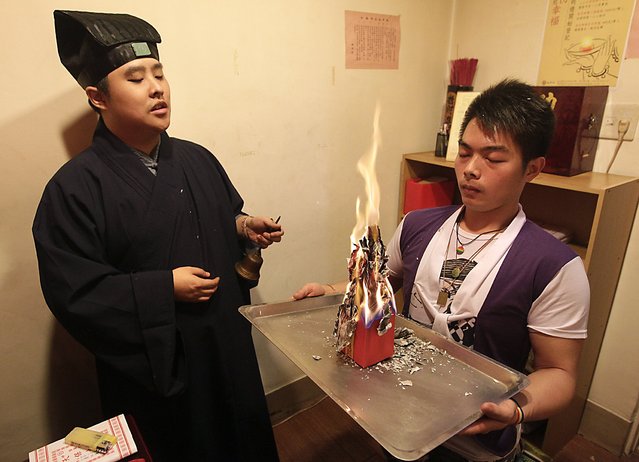
Lu Wei-ming (L), priest of the Wei-ming temple, and a worshipper burn a Taoist paper amulet during a prayer ritual at the temple in New Taipei city January 8, 2015. The shrine, down a narrow alleyway in a bustling district of the city, is dedicated to a deity who has watched over homosexuals for four centuries. (Photo by Pichi Chuang/Reuters)

Lu Wei-ming (L), priest of the Wei-ming temple, and a worshipper burn a Taoist paper amulet during a prayer ritual at the temple in New Taipei city January 8, 2015. The shrine, down a narrow alleyway in a bustling district of the city, is dedicated to a deity who has watched over homosexuals for four centuries. Priest Lu founded the temple in 2006, at a time gays were excluded from most religious ceremonies. (Photo by Pichi Chuang/Reuters)
Details
21 Jan 2015 13:06:00
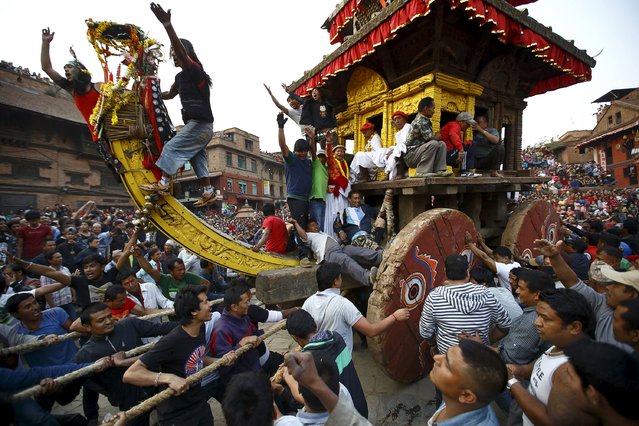
The chariot of God Bhairab is pulled through the city centre of Bhaktapur near Kathmandu during the Bisket festival April 10, 2015. The festival, which runs for more than a week and coincides with the Nepalese New Year, involves devotees offering prayers and the pulling of two chariots, one carrying the idol of God Bhairab and the other with the idol of Goddess Bhadrakali, around the ancient city of Bhaktapur. (Photo by Navesh Chitrakar/Reuters)

The chariot of God Bhairab is pulled through the city centre of Bhaktapur near Kathmandu during the Bisket festival April 10, 2015. The festival, which runs for more than a week and coincides with the Nepalese New Year, involves devotees offering prayers and the pulling of two chariots, one carrying the idol of God Bhairab and the other with the idol of Goddess Bhadrakali, around the ancient city of Bhaktapur. Devotees participate in the festival with the belief that they will be blessed with good health, fortune and harvest for the coming year. (Photo by Navesh Chitrakar/Reuters)
Details
12 Apr 2015 07:52:00