Loading...
Done


Dan Balan – Numa Numa 2 feat. Marley Waters (Official Video)
Details
06 Feb 2019 00:01:00
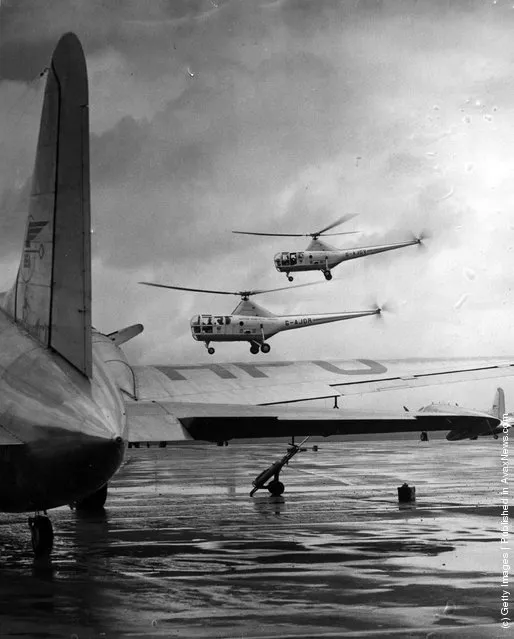
Sikorsky H-5 helicopters

“Igor Sikorsky (May 25, 1889 – October 26, 1972), born Igor Ivanovich Sikorsky was a Russian American pioneer of aviation in both helicopters and fixed-wing aircraft. He designed and flew the world's first multi-engine fixed-wing aircraft, the Russky Vityaz in 1913, and the first airliner, Ilya Muromets, in 1914. After immigrating to the United States in 1919, Sikorsky founded the Sikorsky Aircraft Corporation in 1923, and developed the first of Pan American Airways' ocean-conquering flying boats in the 1930s. In 1939 Sikorsky designed and flew the Vought-Sikorsky VS-300, the first viable American helicopter, which pioneered the rotor configuration used by most helicopters today. Sikorsky would modify the design into the Sikorsky R-4, which became the world's first mass-produced helicopter in 1942”. – Wikipedia

Photo: Westland Sikorsky H-5's, used by British European Airways Helicopters, which fly between London and Birmingham. The Sikorsky H-5, (aka R-5, S-51, HO3S-1, or Horse) (R-5 until 1948; company designation VS-327) is a helicopter built by Sikorsky Aircraft Corporation, formerly used by the United States Air Force, and its predecessor, the United States Army Air Forces, as well as the United States Navy and United States Coast Guard (with the designations HO2S and HO3S). (Photo by Harrison /Topical Press Agency/Getty Images). 22nd May 1951
Details
06 Sep 2011 10:18:00
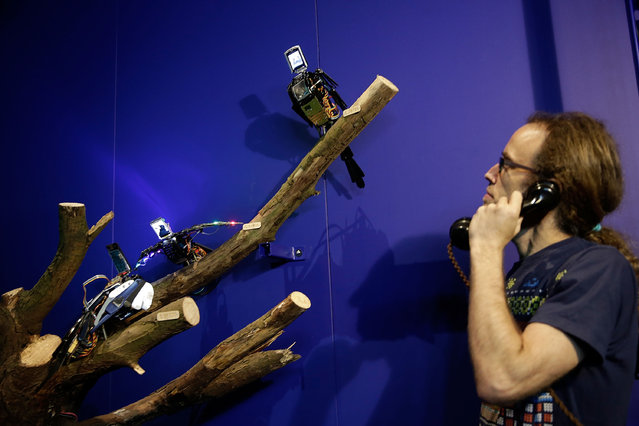
Unwanted phones recreated as interactive birds, part of "Escape III" by Anthony Goh and Neil Mendoza seen on display at the Barbican's Digital Revolution exhibition on July 2, 2014 in London, England. The exhibition brings together artists, designers, film makers, musicians and architects who push the boundaries of creativity that digitial technology can offer, and runs from July 3 until September 14, 2014.  (Photo by Matthew Lloyd/Getty Images for Barbican Art Gallery)

Unwanted phones recreated as interactive birds, part of “Escape III” by Anthony Goh and Neil Mendoza seen on display at the Barbican's Digital Revolution exhibition on July 2, 2014 in London, England. The exhibition brings together artists, designers, film makers, musicians and architects who push the boundaries of creativity that digitial technology can offer, and runs from July 3 until September 14, 2014. (Photo by Matthew Lloyd/Getty Images for Barbican Art Gallery)
Details
04 Jul 2014 10:18:00
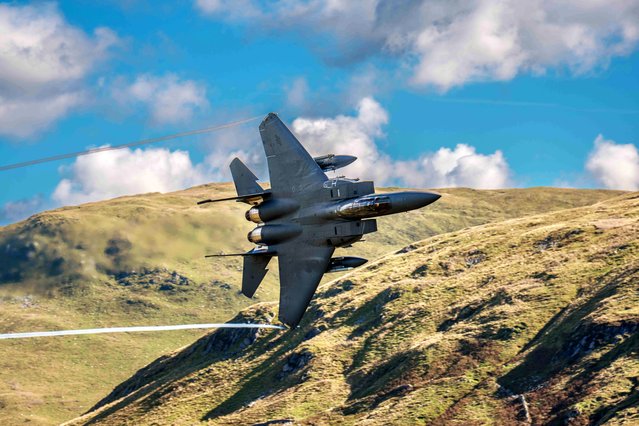
A military aircraft flies low through the Mach Loop in west-central Wales on September 25, 2025 during Cobra Warrior 25-2, one of Nato’s largest multinational air exercises. The operation, running across the UK until October 3, brings together air forces from the UK, US, Canada, Italy and Germany for three weeks of high-intensity training in challenging low-level environments. (Photo by Tony Marsh)

A military aircraft flies low through the Mach Loop in west-central Wales on September 25, 2025 during Cobra Warrior 25-2, one of Nato’s largest multinational air exercises. The operation, running across the UK until October 3, brings together air forces from the UK, US, Canada, Italy and Germany for three weeks of high-intensity training in challenging low-level environments. (Photo by Tony Marsh)
Details
15 Nov 2025 03:07:00
U.S. Marine Lt. Ben Reid from 1/2 Charlie Company of Task Force Tarawa waits to be medivaced after being hit with shrapnel and a machine gun round, in the southern Iraqi city of Nasiriyah, on March 23, 2003. The Marines suffered a number of deaths and casualties during gun battles throughout the city. (Photo by Joe Raedle/The Atlantic)

U.S. Marine Lt. Ben Reid from 1/2 Charlie Company of Task Force Tarawa waits to be medivaced after being hit with shrapnel and a machine gun round, in the southern Iraqi city of Nasiriyah, on March 23, 2003. The Marines suffered a number of deaths and casualties during gun battles throughout the city. (Photo by Joe Raedle via The Atlantic)
Details
20 Mar 2013 08:50:00
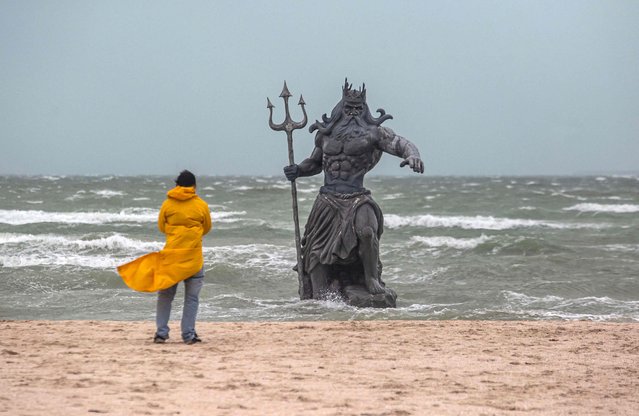
A man looks at a statue of the Greek god Poseidon on a beach during the passage of tropical storm Beryl in Progreso, on the Yucatan Peninsula, Mexico, on July 5, 2024. Beryl weakened to a tropical storm Friday after hitting Mexico as a Category 2 hurricane, with fierce winds causing material damage but no injuries along the tourist-rich Yucatan Peninsula. (Photo by Hugo Borges/AFP Photo)

A man looks at a statue of the Greek god Poseidon on a beach during the passage of tropical storm Beryl in Progreso, on the Yucatan Peninsula, Mexico, on July 5, 2024. Beryl weakened to a tropical storm Friday after hitting Mexico as a Category 2 hurricane, with fierce winds causing material damage but no injuries along the tourist-rich Yucatan Peninsula. (Photo by Hugo Borges/AFP Photo)
Details
14 Nov 2025 03:34:00
A picture taken on June 3, 2022 shows a unique albinos Galapagos giant tortoise baby, born on May 1, at the Tropicarium of Servion, western Switzerland. Albinos Galapagos tortoises have never been observed in captivity or in the nature. The Galapagos giant tortoises are strictly protected and are among the most endangered species among CITES-listed animals. (Photo by Fabrice Coffrini/AFP Photo)

A picture taken on June 3, 2022 shows a unique albinos Galapagos giant tortoise baby, born on May 1, at the Tropicarium of Servion, western Switzerland. Albinos Galapagos tortoises have never been observed in captivity or in the nature. The Galapagos giant tortoises are strictly protected and are among the most endangered species among CITES-listed animals. (Photo by Fabrice Coffrini/AFP Photo)
Details
19 Jun 2022 04:00:00
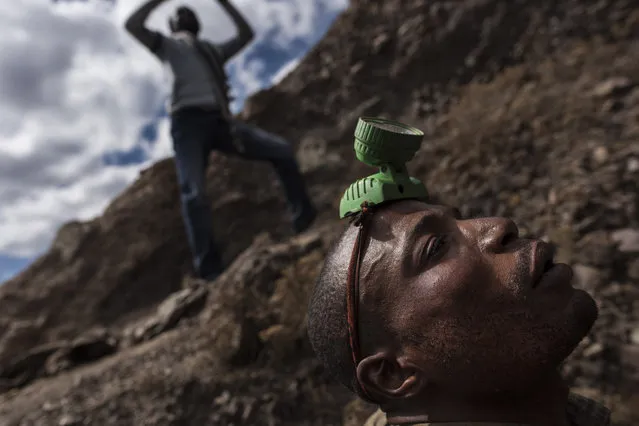
A “creuseur”, or digger, a plastic lantern on his head, readies to enter a copper and cobalt mine in Kawama, Democratic Republic of Congo on June 8, 2016. Cobalt is used in the batteries for electric cars and mobile phones. Working conditions are dangerous, often with no safety equipment or structural support for the tunnels. The diggers say they are paid on average US$2-3/day. (Photo by Michael Robinson Chavez/The Washington Post)

A “creuseur”, or digger, a plastic lantern on his head, readies to enter a copper and cobalt mine in Kawama, Democratic Republic of Congo on June 8, 2016. Cobalt is used in the batteries for electric cars and mobile phones. Working conditions are dangerous, often with no safety equipment or structural support for the tunnels. The diggers say they are paid on average US$2-3/day. (Photo by Michael Robinson Chavez/The Washington Post)
Details
30 Dec 2016 10:29:00