Loading...
Done
A man uses a floating pitcher to catch a fish after removing it from a net at Keenjhar Lake, near Thatta, February 22, 2015. This technique of fishing using floating pitchers is a unique and traditional one for this community, found only on Keenjhar Lake, one of the largest freshwater lakes in Pakistan, which is famous for its variety of breeding and wintering waterbirds. (Photo by Akhtar Soomro/Reuters)

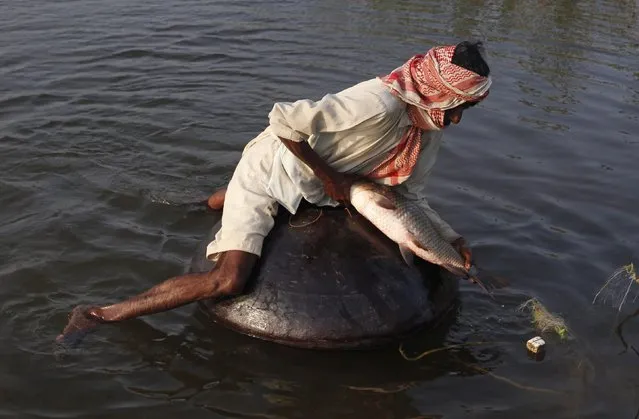
A man uses a floating pitcher to catch a fish after removing it from a net at Keenjhar Lake, near Thatta, February 22, 2015. This technique of fishing using floating pitchers is a unique and traditional one for this community, found only on Keenjhar Lake, one of the largest freshwater lakes in Pakistan, which is famous for its variety of breeding and wintering waterbirds. (Photo by Akhtar Soomro/Reuters)
Details
23 Feb 2015 13:27:00
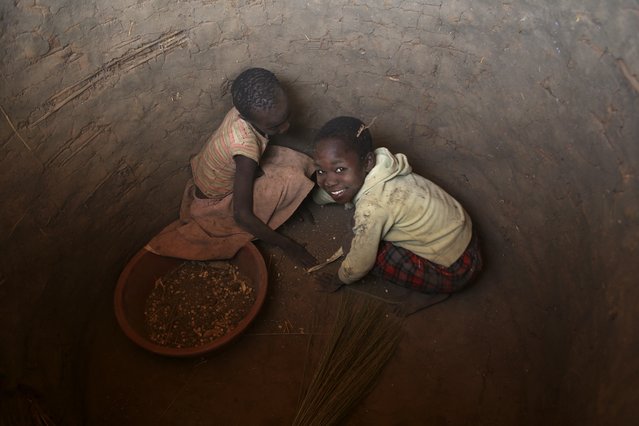
Children clean the interior of a granary in preparation for grain storage in Odek village, north of Uganda capital Kampala February 14, 2015. Odek is the birthplace of Joseph Kony, founder and leader of the rebel group Lord's Resistance Army. (Photo by James Akena/Reuters)

Children clean the interior of a granary in preparation for grain storage in Odek village, north of Uganda capital Kampala February 14, 2015. Odek is the birthplace of Joseph Kony, founder and leader of the rebel group Lord's Resistance Army. The LRA rose up against the government in northern Uganda under the leadership of Kony in the late 1980s and has been accused of abducting children to serve as fighters and s*x slaves. (Photo by James Akena/Reuters)
Details
24 Feb 2015 14:36:00
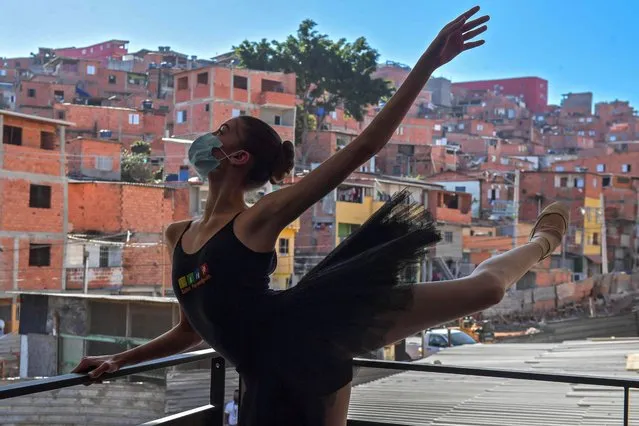
Mariana Sousa, student of the Ballet Paraisopolis, warms up during a rehearse in Paraisopolis favela, outskirts of Sao Paulo, Brazil on August 27, 2020, amid the new coronavirus COVID-19 pandemic. The 200 ballet students of Paraisopolis, the second largest favela in Sao Paulo, restarted rehearsals after five months with a coreography about a police operation that put their community in mourning last year. (Photo by Nelson Almeida/AFP Photo)

Mariana Sousa, student of the Ballet Paraisopolis, warms up during a rehearse in Paraisopolis favela, outskirts of Sao Paulo, Brazil on August 27, 2020, amid the new coronavirus COVID-19 pandemic. The 200 ballet students of Paraisopolis, the second largest favela in Sao Paulo, restarted rehearsals after five months with a coreography about a police operation that put their community in mourning last year. (Photo by Nelson Almeida/AFP Photo)
Details
11 Sep 2020 00:03:00
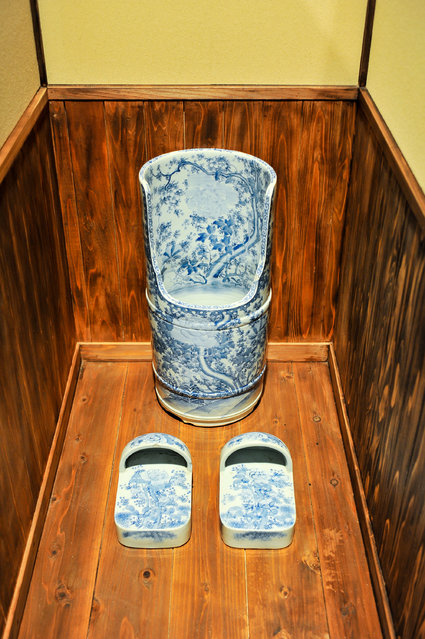
An old toilet is displayed during the “Toilet!? Human Waste and Earth's Future” exhibition at The National Museum of Emerging Science and Innovation – Miraikan on July 1, 2014 in Tokyo, Japan. The exhibition focuses on how the toilet has changed our daily lives and discovers what the most environment-friendly and ideal toilet is. (Photo by Keith Tsuji/Getty Images)

An old toilet is displayed during the “Toilet!? Human Waste and Earth's Future” exhibition at The National Museum of Emerging Science and Innovation – Miraikan on July 1, 2014 in Tokyo, Japan. The exhibition focuses on how the toilet has changed our daily lives and discovers what the most environment-friendly and ideal toilet is. (Photo by Keith Tsuji/Getty Images)
Details
03 Jul 2014 11:34:00
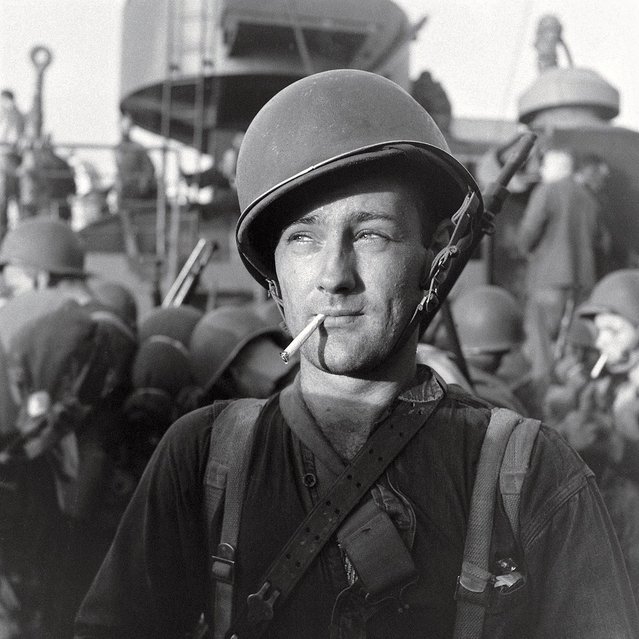
An American Marine readies to land on Guadalcanal during the five-month struggle for the island between late 1942 and early 1943. Three thousand miles south of Tokyo, Guadalcanal was a major shipping point for military supplies. The Allied victory there in February, 1943, marked a major turning point in the war after a string of Japanese victories in the Pacific. (Photo by Joe Scherschel/Time & Life Pictures)

An American Marine readies to land on Guadalcanal during the five-month struggle for the island between late 1942 and early 1943. Three thousand miles south of Tokyo, Guadalcanal was a major shipping point for military supplies. The Allied victory there in February, 1943, marked a major turning point in the war after a string of Japanese victories in the Pacific. (Photo by Joe Scherschel/Time & Life Pictures)
Details
10 Mar 2013 12:50:00
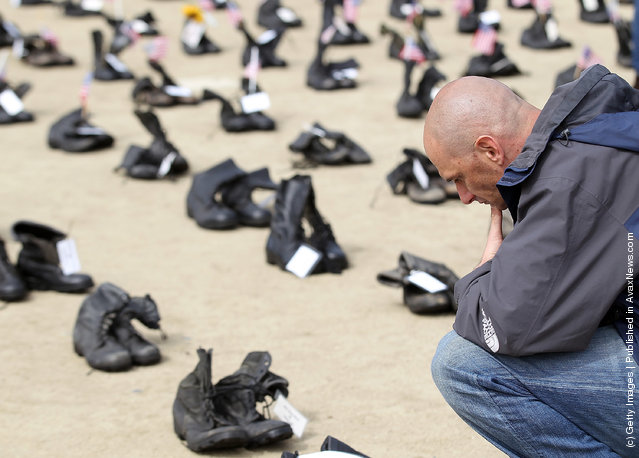
A man pauses as he looks at rows of combat boots that are part of the Eyes Wide Open exhibit in front of San Francisco City Hall

“Eyes Wide Open is an exhibit created by the American Friends Service Committee observing the American soldiers and marines that have died in the Iraq War. It contains a pair of combat boots to represent every American soldier and marine that has died in the war, as well as shoes representing Iraqi civilians who have lost their lives during the invasion and occupation”. – Wikipedia

Photo: A man pauses as he looks at rows of combat boots that are part of the "Eyes Wide Open" exhibit in front of San Francisco City Hall on March 19, 2012 in San Francisco, California. The Eyes Wide Open exhibition includes a pair of boots for every one of the 481 California servicemen and women who died in the Iraq war. (Photo by Justin Sullivan/Getty Images)
Details
20 Mar 2012 11:17:00
In this photo taken Wednesday, April 30, 2014, a dragonfly sits on the nose of a Gharial, rare crocodile-like creatures, in the River Chambal near Bhopepura village in the northern Indian state of Uttar Pradesh. The narrow 250-mile stretch of the Chambal is a place of crocodiles and jackals, of river dolphins and the occasional wolf. Hundreds of species of birds, storks, geese, babblers, larks, falcons and so many more, nest along the river. (Photo by Altaf Qadri/AP Photo)

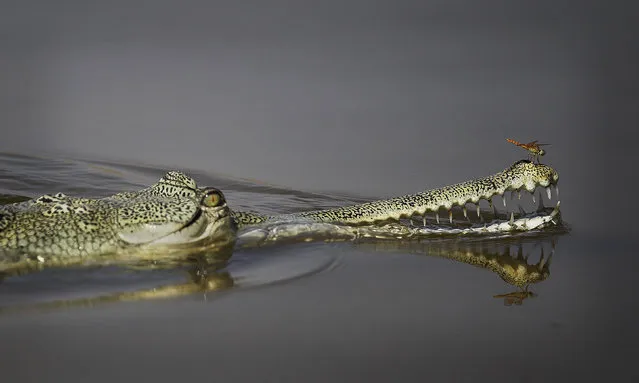
In this photo taken Wednesday, April 30, 2014, a dragonfly sits on the nose of a Gharial, rare crocodile-like creatures, in the River Chambal near Bhopepura village in the northern Indian state of Uttar Pradesh. The narrow 250-mile stretch of the Chambal is a place of crocodiles and jackals, of river dolphins and the occasional wolf. Hundreds of species of birds, storks, geese, babblers, larks, falcons and so many more, nest along the river. Endangered birds lay small speckled eggs in tiny pits they dig in the sandbars. Gharials, rare crocodile-like creatures that look like they swaggered out of the Mesozoic Era, are commonplace here and nowhere else. (Photo by Altaf Qadri/AP Photo)
Details
23 Feb 2015 12:55:00
Master of throat singing (or Khoomei) Aikhan Orzhak (L) and model Choigana Kertek, dressed in traditional costume, perform during sunset at the Aldyn Bulak area on the bank of the Yenisei River outside the village of Ust-Elegest in Tuva region, Southern Siberia, Russia, October 7, 2015. The region is inhabited by Tuvans, historically cattle-herding nomads, who nowadays practise two main confessions - Buddhism and Shamanism. (Photo by Ilya Naymushin/Reuters)

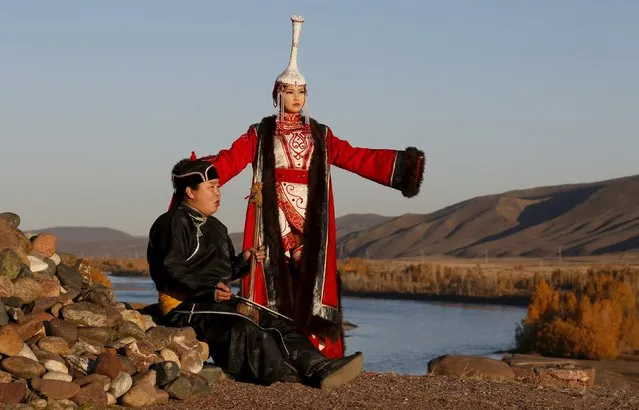
Master of throat singing (or Khoomei) Aikhan Orzhak (L) and model Choigana Kertek, dressed in traditional costume, perform during sunset at the Aldyn Bulak area on the bank of the Yenisei River outside the village of Ust-Elegest in Tuva region, Southern Siberia, Russia, October 7, 2015. The region is inhabited by Tuvans, historically cattle-herding nomads, who nowadays practise two main confessions – Buddhism and Shamanism. (Photo by Ilya Naymushin/Reuters)
Details
17 Oct 2015 08:03:00