Loading...
Done
Pro-Russian activists attack policemen guarding the burned trade union building in the southern Ukrainian city of Odessa on May 3, 2014. More than 30 people were killed in a “criminal” blaze in Ukraine's southern city of Odessa, as violence spread across the country during the bloodiest day since Kiev's Western-backed government took power. (Photo by Anatolii Stepanov/AFP Photo)

Pro-Russian activists attack policemen guarding the burned trade union building in the southern Ukrainian city of Odessa on May 3, 2014. More than 30 people were killed in a “criminal” blaze in Ukraine's southern city of Odessa, as violence spread across the country during the bloodiest day since Kiev's Western-backed government took power. Ukraine's interior ministry said at least 31 people had died in the fire Friday, with local media reporting that pro-Russian militants were believed to have been in the burning building at the time. (Photo by Anatolii Stepanov/AFP Photo)
Details
04 May 2014 09:33:00
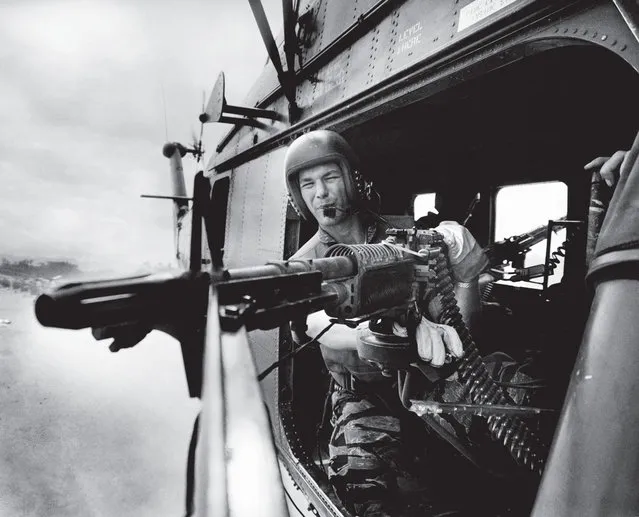
Man your battle stations: The crew chief of helicopter Yankee Papa 13, lance corporal James C. Farley, mans an M-60 machine gun during a mission near Da Nang, Vietnam on March 31, 1965. (Photo by Larry Burrows/Time & Life Pictures)

In the spring of 1965, within weeks of 3,500 American Marines arriving in Vietnam, a 39-year-old Briton named Larry Burrows began work on a feature for LIFE magazine, chronicling the day-to-day experience of U.S. troops on the ground – and in the air – in the midst of the rapidly widening war. The photographs in this gallery focus on a calamitous March 31, 1965, helicopter mission; Burrows’ “report from Da Nang”, featuring his pictures and his personal account of the harrowing operation, was published two weeks later as a now-famous cover story in the April 16, 1965, issue of LIFE.

Photo: Man your battle stations: The crew chief of helicopter Yankee Papa 13, lance corporal James C. Farley, mans an M-60 machine gun during a mission near Da Nang, Vietnam on March 31, 1965. (Photo by Larry Burrows/Time & Life Pictures)
Details
07 Apr 2013 07:08:00
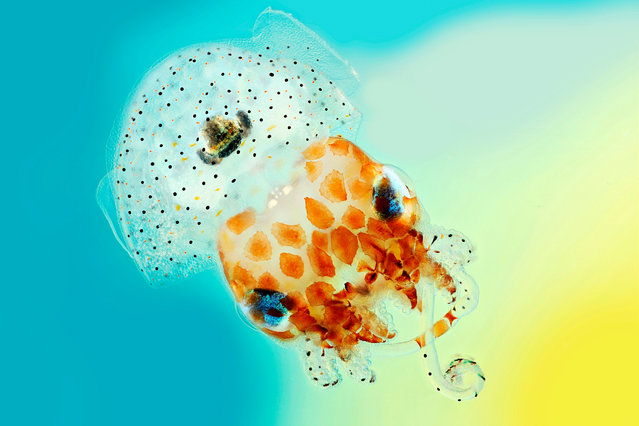
With its huge eyes, comical name and diminutive size, Mark R. Smith’s image of a baby Hawaiian bobtail squid can’t help but raise a smile. A curiously endearing creature, the cephalopod is just 1.5cm across, its mantle cavity bearing more than a passing resemblance to a rather natty shower cap. But it is also a beautiful example of symbiosis – nature’s version of “I’ll scratch your back if you scratch mine” – for on the underside of the squid is a light organ which houses bioluminescent bacteria. The squid offers the bacteria protection and food, while the bacteria emit a glow – a handy trait that the squid uses to offset its silhouette, helping it to evade predators in the depths below. Mark R. Smith’s entry combines several images of a Hawaiian bobtail squid with different focus lengths to create a final picture with greater depth of field than normal. (Photo by Mark R. Smith/Wellcome Images/Macroscopic Solutions)

With its huge eyes, comical name and diminutive size, Mark R. Smith’s image of a baby Hawaiian bobtail squid can’t help but raise a smile. A curiously endearing creature, the cephalopod is just 1.5cm across, its mantle cavity bearing more than a passing resemblance to a rather natty shower cap. But it is also a beautiful example of symbiosis – nature’s version of “I’ll scratch your back if you scratch mine” – for on the underside of the squid is a light organ which houses bioluminescent bacteria. The squid offers the bacteria protection and food, while the bacteria emit a glow – a handy trait that the squid uses to offset its silhouette, helping it to evade predators in the depths below. Mark R. Smith’s entry combines several images of a Hawaiian bobtail squid with different focus lengths to create a final picture with greater depth of field than normal. (Photo by Mark R. Smith/Wellcome Images/Macroscopic Solutions)
Details
08 Mar 2017 00:05:00
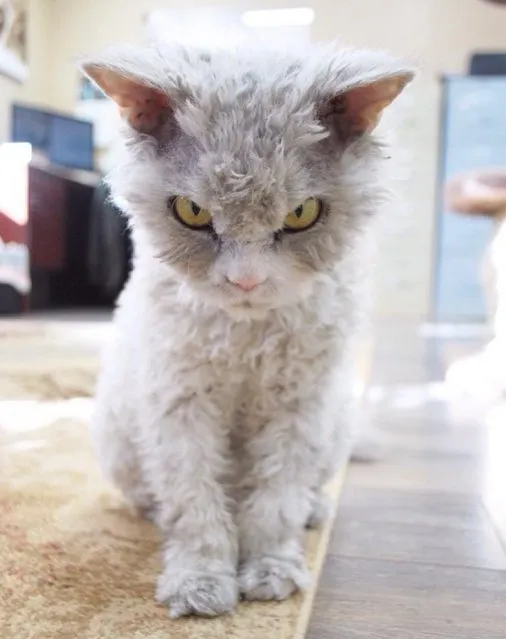
A Beautiful Scowling Curly-Haired Cat

Albert is not the happiest looking kitty in the world. Even Tard the Grumpy Cat looks more cheerful. Well… maybe not cheerful. But at least Tard doesn’t have a look of menace and a desire to kill in his eyes. What could have caused a kitty to wear such a stern look all the time? It might be the fact that he’s all curly. Almost no one likes to stand out too much, and maybe Albert is no exception. Despite his menacing appearance, Albert’s owner claims that he’s a very polite cat and plays nicely with children. Though it is hard to believe at first glance, we shouldn’t judge a book by its cover, even when we’re looking at a cat.


Details
24 Mar 2015 10:02:00
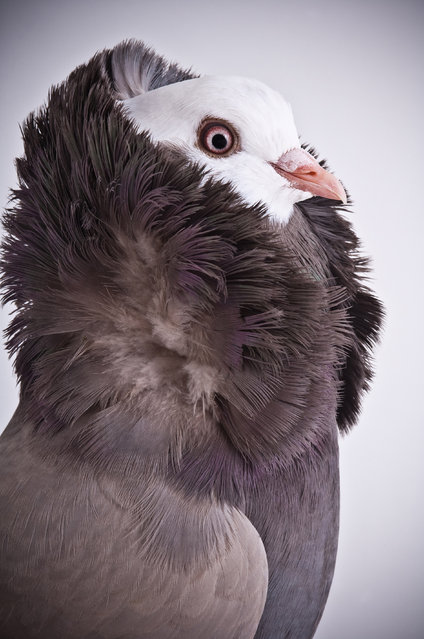
Old Dutch Capucine. Darwin’s Pigeons series. (Photo by Photo by Richard Bailey/Caters News)

“These dolly birds are showing off the latest haute COO-ture in a stunning set of images that portray everyday pigeons as fashion models. The series, titled “Darwin’s Pigeons”, was snapped by British photographer Richard Bailey, who was looking to capture the birds’ photogenic side as a tribute to the Father of Evolution himself, who it is believed was fascinated by the birds”. – Caters News. Photo: Old Dutch Capucine. Darwin’s Pigeons series. (Photo by Photo by Richard Bailey/Caters News)
Details
01 Apr 2014 12:14:00
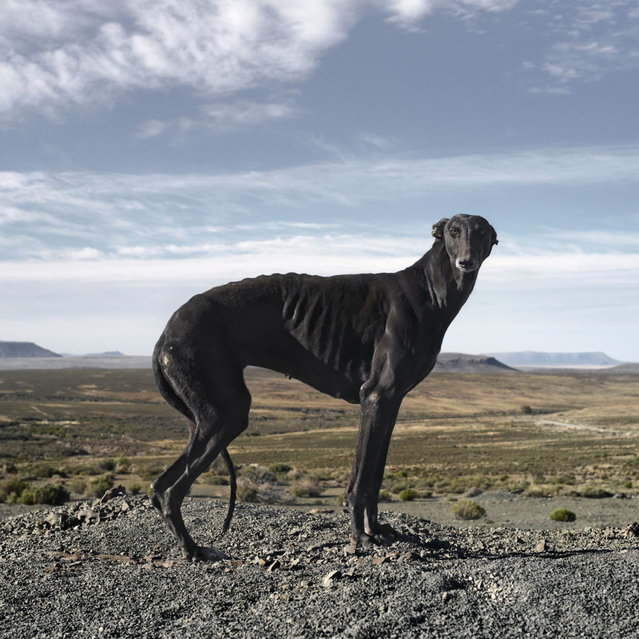
Africanis 18. Murraysburg, Western Cape, May 10, 2010. (Photo by Daniel Naudé)

“The Africanis is a landrace of South African dogs. It is believed to be of ancient origin, directly descended from hounds and pariah dogs of ancient Africa, introduced into the Nile Valley from the Levant. The Swahili name for the breed is umbwa wa ki-shenzi meaning common or mongrel or “traditional dog”. Africanis is also an umbrella name for all the aboriginal dogs in southern Africa”. – Wikipedia. Photo: Africanis 18. Murraysburg, Western Cape, May 10, 2010. (Photo by Daniel Naudé)
Details
19 May 2013 11:51:00
Rev. Yeon Ah Lee Moon of the Sanctuary Church holds a gold AR-15 during a ceremony to rededicate marriages at the World Peace and Unification Sanctuary in Newfoundland, Pennsylvania, USA, 28 February 2018. (Photo by Jim Lo Scalzo/EPA/EFE)

Rev. Yeon Ah Lee Moon of the Sanctuary Church holds a gold AR-15 during a ceremony to rededicate marriages at the World Peace and Unification Sanctuary in Newfoundland, Pennsylvania, USA, 28 February 2018. The church, a breakaway from the Unification Church, believes guns are a symbol of the “rod of iron” referenced in the Book of Revelations. (Photo by Jim Lo Scalzo/EPA/EFE)
Details
01 Mar 2018 07:35:00


Sushi chef Mitsuru Tamura uses a radiation detector on seafood before it is prepared in Manhattan's Sushi Yasuda restaurant April 8, 2011 in New York City. The restaurant has begun using the detector as a precautionary measure due to consumer concerns over possible radiation contamination in seafood from the nuclear emergency in Japan. Health officials believe contamination is unlikely to threaten the food supply chain and none has been found in this restaurant. (Photo by Mario Tama/Getty Images)
Details
09 Apr 2011 08:52:00