Loading...
Done
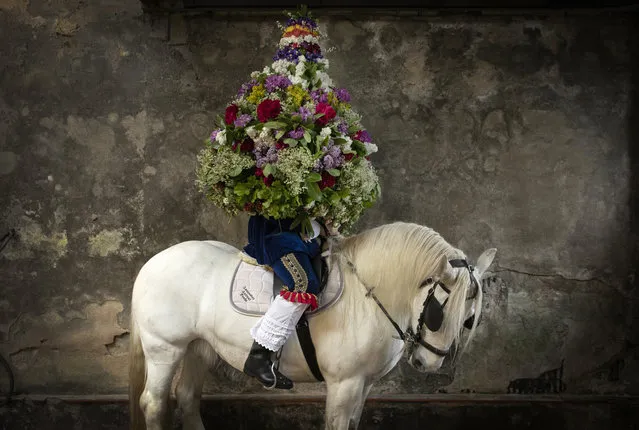
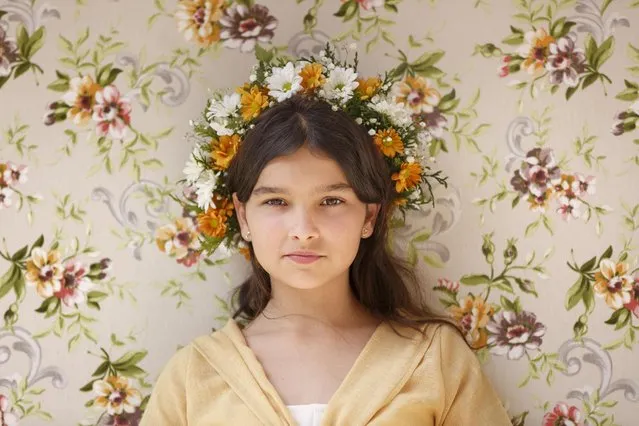
“The King”, Johnathon Haddock poses for a portrait with the Garland before the procession during “Castleton Garland Day” on May 29, 2019 in Castleton, England. The first records of Garland day date back to the 1700's and though it's true origins are not fully understood it is believed to be an ancient fertility rite with Celtic connections. The celebration also incorporates more recent elements of 'Oak Apple Day' which falls on May 29th, and celebrates the restoration of the monarchy in 1660. The garland is a framework of cut flowers which is prepared on the day by villagers before being placed on the head of the “King”, and paraded around the town on horseback with his “Consort”, also on horseback, dressed in Stuart costume. (Photo by Dan Kitwood/Getty Images)

“The King”, Johnathon Haddock poses for a portrait with the Garland before the procession during “Castleton Garland Day” on May 29, 2019 in Castleton, England. The first records of Garland day date back to the 1700's and though it's true origins are not fully understood it is believed to be an ancient fertility rite with Celtic connections. (Photo by Dan Kitwood/Getty Images)
Details
01 Jun 2019 00:07:00
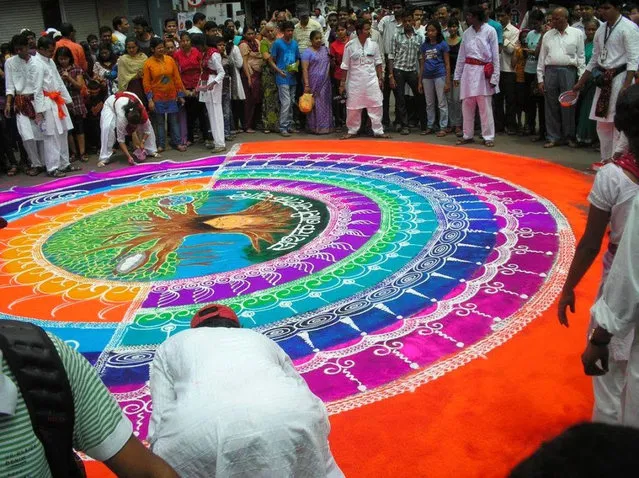
Rangoli Folk Art From India

Rangoli, also known as kolam or Muggu, is a folk art from India in which patterns are created on the floor in living rooms or courtyards using materials such as colored rice, dry flour, colored sand or flower petals. It is usually made during Diwali, Onam, Pongal and other Indian festivals. They are meant to be sacred welcoming areas for the Hindu deities. The ancient symbols have been passed down through the ages, from each generation to the next, keeping both the art form and the tradition alive. Similar practices are followed in different Indian states: in Tamil Nadu, there is Kolam in Tamil Nadu; Mandana in Rajasthan; Chaookpurna in Chhattisgarh; Alpana in West Bengal; Aripana in Bihar; Chowk pujan in Uttar Pradesh; Muggu in Andhra Pradesh and others.
Details
16 Jun 2014 10:37:00
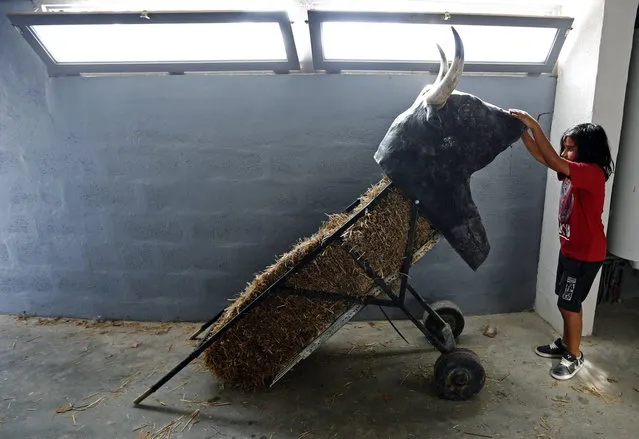
Nino, a ten-year-old toreador apprentice of the French Tauromachy Centre, nicknamed El Nino, touches a practice bull at the bullring of Garons, near Nimes, September 25, 2013. (Photo by Jean-Paul Pelissier/Reuters)

Nino, a ten-year-old toreador apprentice of the French Tauromachy Centre, nicknamed El Nino, touches a practice bull at the bullring of Garons, near Nimes, September 25, 2013. Since 1983, the French Tauromachy Centre in Nimes has trained some 1,000 youths in the art of bullfighting. Twenty of them have gone on to become professional matadors, facing fighting bulls in the arena. Twice a week, students take courses with a matador to learn the movements and gestures of the bullfighter in the ring, but without an animal present. Students train with calves in the surrounding fields during spring, and regularly participate in beginner's bullfights (becerradas) without killing calves. Solal has been taking courses for three years and Nino, for just a year now. Both are normally enrolled in French public schools, but have one thought in mind – bullfighting. They share a passion linked to the city of Nimes, famous for its ferias and bullring. (Photo by Jean-Paul Pelissier/Reuters)

Details
06 Nov 2013 10:12:00
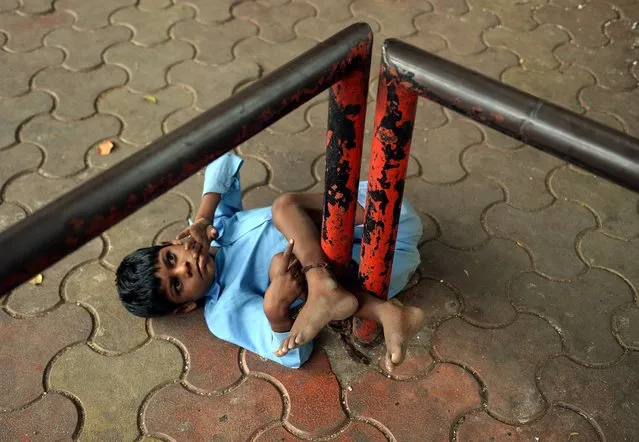
In this photograph taken on May 20, 2014 nine year old Indian boy Lakhan Kale is tied with a cloth rope around his ankle, to a bus-stop pole in Mumbai. (Photo by Punit Paranjpe/AFP Photo)

In this photograph taken on May 20, 2014 nine year old Indian boy Lakhan Kale is tied with a cloth rope around his ankle, to a bus-stop pole in Mumbai. The nine-year-old boy dressed in blue lay listlessly on the pavement in the scorching Mumbai summer afternoon, his ankle tethered with rope to a bus stop, unheeded by pedestrians strolling past. Lakhan Kale cannot hear or speak and suffers from cerebral palsy and epilepsy, so his grandmother and carer tied him up to keep him safe while she went to work, selling toys and flower garlands on the city's roadsides. (Photo by Punit Paranjpe/AFP Photo)
Details
04 Jul 2014 09:54:00
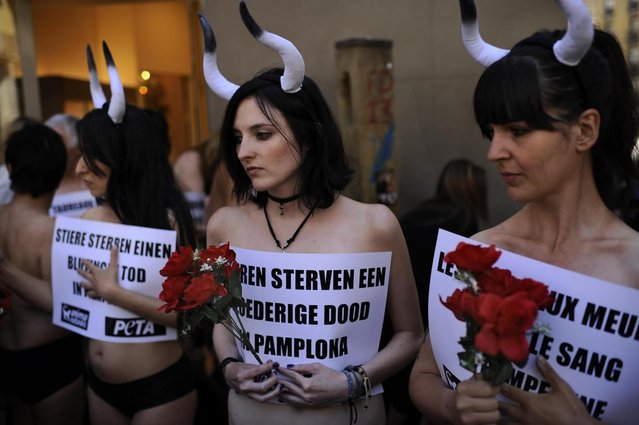
Anti-bullfighting demonstrators protest  against the bulls runs, on the Ayuntamiento Square in Pamplona northern Spain on Friday July 5, 2013. On July 6, the San Fermin festival will begin with the ''txupinazo'' , the opening ceremony with people participating in bull runs, music and dance, through the old street of the city. (AP Photo/Alvaro Barrientos)

Anti-bullfighting demonstrators protest against the bulls runs, while standing in cardboard coffins and holding red flowers, on the Ayuntamiento Square in Pamplona northern Spain on Friday July 5, 2013. On July 6, the San Fermin festival will begin with the “txupinazo” , the opening ceremony with people participating in bull runs, music and dance, through the old street of the city. (Photo by Alvaro Barrientos/AP Photo)
Details
07 Jul 2013 09:52:00
A “Maya” girl sits in an altar during the traditional celebration of “Las Mayas” on the streets in Madrid, Spain Sunday, May 10, 2015. The festivity of the Maya comes from pagan rites and dates from the medieval age, appearing in ancient documents. It takes place every year in the beginning of May and celebrates the beginning of the spring. (Photo by Daniel Ochoa de Olza/AP Photo)

A “Maya” girl sits in an altar during the traditional celebration of “Las Mayas” on the streets in Madrid, Spain Sunday, May 10, 2015. The festivity of the Maya comes from pagan rites and dates from the medieval age, appearing in ancient documents. It takes place every year in the beginning of May and celebrates the beginning of the spring. Girls between 7 and 11 years old are chosen as “Maya” and should sit still, serious and quiet for a couple of hours in altars on the street decorated with flowers and plants and afterwards they walk to the church with their family where they attend a ceremony. (Photo by Daniel Ochoa de Olza/AP Photo)
Details
14 May 2015 11:12:00
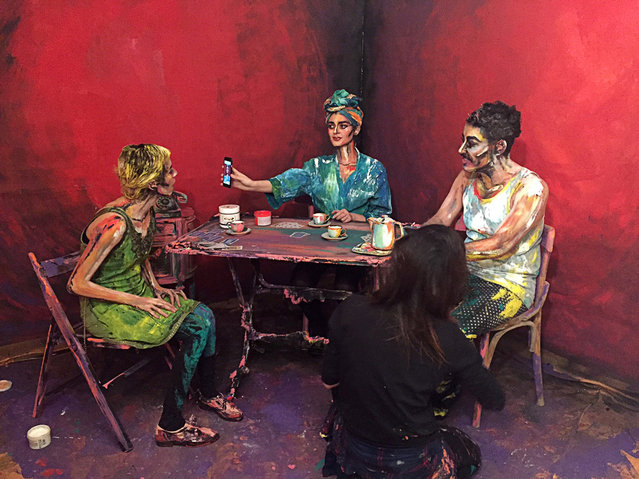
Cairo-based artist Chanel Arif's paints for her art project called After Dinner that uses humans and their surroundings as her canvas, in her gallery in the capital of Cairo, Egypt March 2, 2017. (Photo by Sherif Fahmy/Reuters)

Cairo-based artist Chanel Arif's paints for her art project called After Dinner that uses humans and their surroundings as her canvas, in her gallery in the capital of Cairo, Egypt March 2, 2017. (Photo by Sherif Fahmy/Reuters)
Details
07 Mar 2017 11:01:00
“Seven Magic Points”. The rusty red swirls of the circular, iron sculpture Seven Magic Points in Brattebergan, Norway mirror the rippling aurora above. (Photo by Rune Engebø/Royal Observatory Greenwich’s Astronomy Photographer of the Year 2016/National Maritime Museum)

Gorgeous galaxies and stunning stars make up this selection of pictures from the shortlisted entries for this year’s Insight Astronomy Photographer of the Year award. The winners will be announced on 15 September, and an exhibition of the winning images will be will be displayed in a free exhibition at the Royal Observatory Greenwich’s Astronomy Centre from 17 September. Here: “Seven Magic Points”. The rusty red swirls of the circular, iron sculpture Seven Magic Points in Brattebergan, Norway mirror the rippling aurora above. (Photo by Rune Engebø/Royal Observatory Greenwich’s Astronomy Photographer of the Year 2016/National Maritime Museum)
Details
28 Jul 2016 13:51:00